
If you were born after 2000, 1994 is mostly Friends reruns. Wall Street remembers it as the year the bond market broke.
On September 16, the Fed raised rates for the first time since 2023, reviving comparisons with a tightening cycle that caught investors off guard three decades ago. The 10-year Treasury yield is at its highest in about two decades, Bitcoin keeps stalling below $87K, and crypto marks one year since the October 10 crash.
Across decades, the same question remains: what falls during a rate-hike cycle, and what rises after it?
The Year the Bond Market Broke
On February 4, 1994, the Fed raised rates for the first time in five years. Investors had spent those years assuming money would stay cheap, and the Fed didn't stop at one hike.
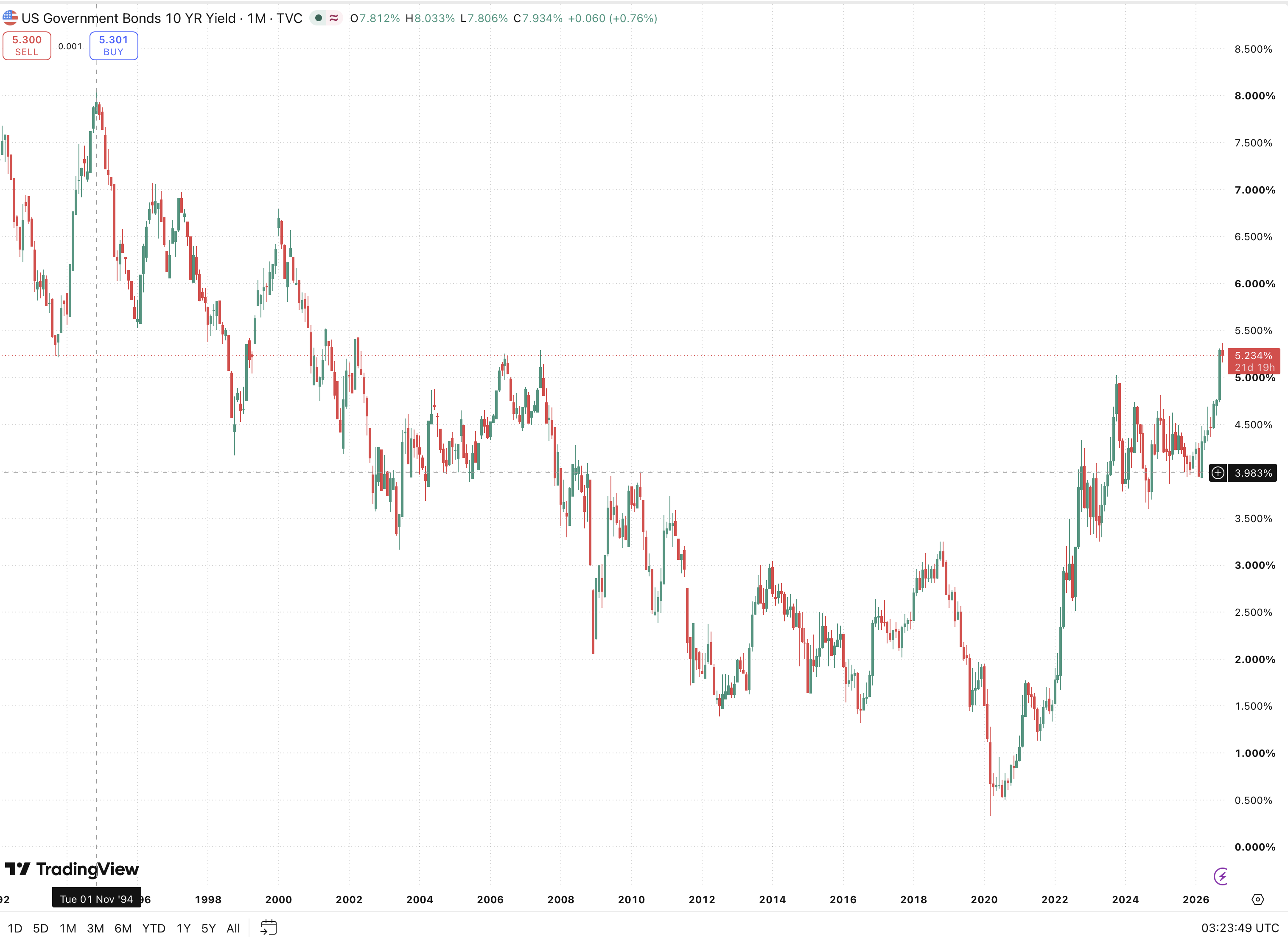
Seven hikes over the following year doubled its benchmark rate from 3% to 6%. The 10-year Treasury yield climbed from below 6% to above 8%, and an estimated $1.5 trillion was wiped off global bond markets.
Some investors paid a much higher price than others. Orange County, California, had borrowed heavily to amplify returns from investments that were vulnerable to rising rates. When borrowing costs climbed and bond prices fell, the strategy unraveled. The county lost $1.5 billion and filed what was then the largest municipal bankruptcy in US history.
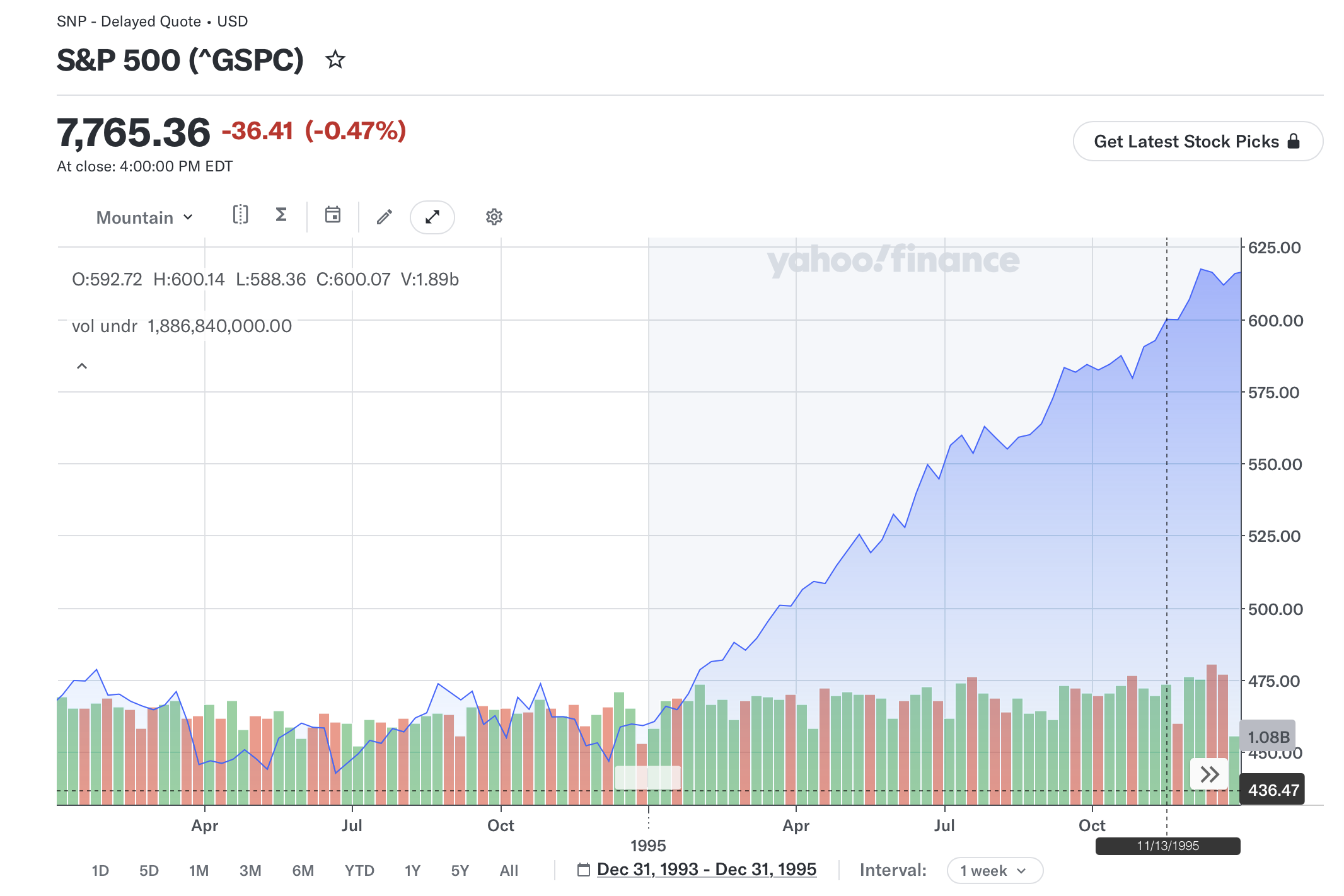
Stocks, meanwhile, did something less dramatic: almost nothing. The S&P 500 finished 1994 roughly flat. Then came 1995, when it gained more than 34%. Corporate earnings had kept growing despite higher rates, and investors rewarded them. That August, Netscape went public and more than doubled on its first trading day. The dot-com era had begun.
Which Year Is This?
The September 16 hike, to 3.75%-4.00%, ended a long stretch of holding and cutting, just as February 1994 did. The bond market is reacting in a familiar way: the 10-year yield has climbed to its highest level in about two decades, and bond prices are falling with it. And, as in 1994, stocks are mostly holding up.
But one hike doesn't tell us how the cycle ends. Wall Street has three historical playbooks to consider:
Hike fast, stocks stall: it's 1994. Inflation proves stubborn and hikes come faster than expected. Bonds suffer, financing gets more expensive, and crowded positions become vulnerable. Stocks may hold up, but returns are harder to come by.
One and done, risk takes off: it's 1997. The Fed hiked once, then stopped. Strong growth did the rest, and the S&P 500 climbed roughly 42% over the following year. The optimistic case for 2026 is that AI investment provides the growth engine the internet boom supplied in the late 1990s.
Bounce, then break: it's 2022. Inflation refuses to cooperate, the Fed keeps tightening, and conditions turn against risk-taking. Bitcoin initially finds buyers, but a prolonged tightening cycle combines with crypto-specific failures to deepen the downturn.
History offers a clue, though not a prediction. LPL Financial found that across the six tightening cycles since 1994, stocks were usually down in the first four months after the initial hike, then recovered, with an average gain of 6.7% a year later.
The first hike didn't decide the outcome. What mattered was what came next: how far the Fed went, whether the economy held up, and whether investors had priced in the risks.
Bitcoin's Extra Variable: Positioning
If you trade crypto, 1994 can feel like ancient history: no Bitcoin, no ETFs, no market that never closes. But take away the details and it's a story every crypto trader knows. A market gets comfortable, positions pile up on one assumption, and one shock reprices everything at once.
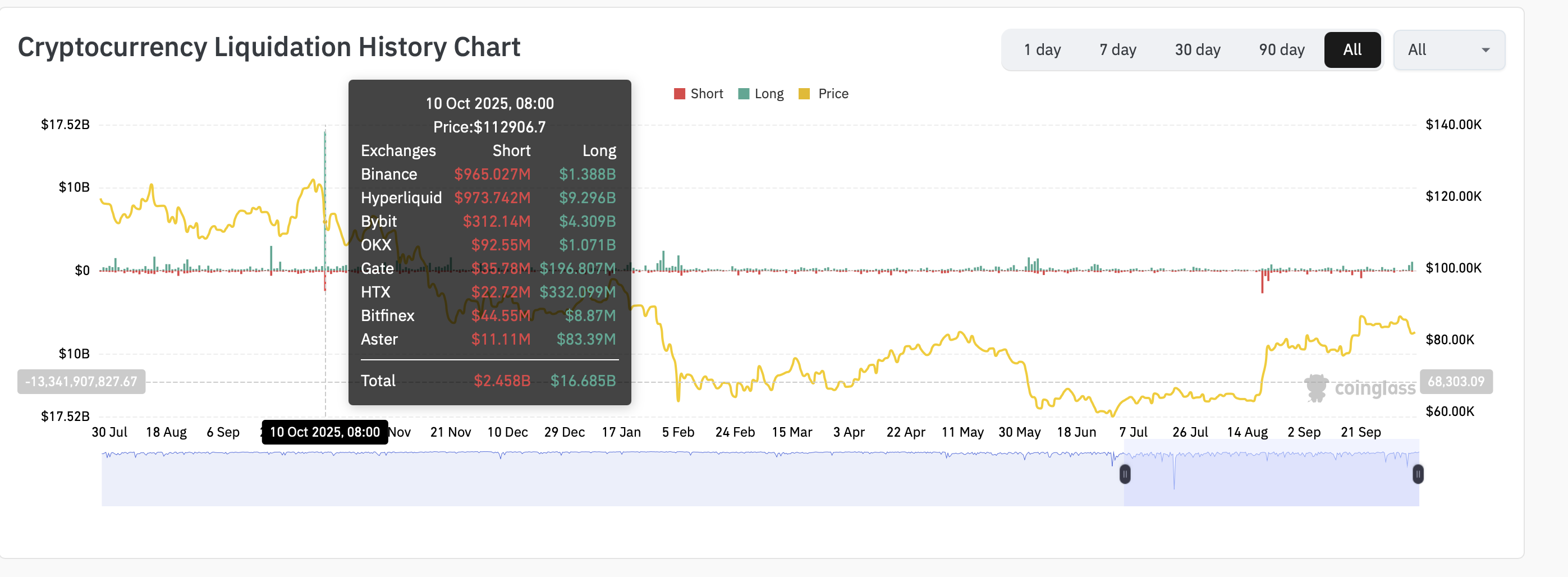
Crypto lived its own version a year ago. On October 10, 2025, a tariff headline hit a market leaning heavily long, and more than $19 billion in leveraged positions were liquidated in a single day, the largest wipeout on record. Same pattern as Orange County: leverage itself wasn't the problem. So much of it pointing the same way was.
What doesn't carry over is the earnings cushion. Stocks got through 1994 because profits outgrew higher rates.
Bitcoin runs on flows instead, and that doesn't rule out a bull market. Bitcoin just had its best Q3 since 2017, and spot ETFs took in $2.4 billion in the week to September 25, their best week since October 2025.
The macro picture is shifting too. The 1994 case needed strong jobs data to force the Fed's hand. Instead, September showed only 29,000 jobs added, and markets now see an October hike as unlikely, though Fed minutes show officials still expect another one eventually. A Fed that stops after one or two hikes looks more like 1997 than 1994.
For now, Bitcoin is boxed in: $87K has held as a ceiling, and the $80K area is being tested as a floor. Which way it breaks matters less than what drives the move. One backed by spot buying and ETF demand suggests investors will hold Bitcoin through tighter conditions. One driven by leverage stacked in one direction risks another crowded trade that unwinds just as fast.
In 1994, the most expensive assumption wasn't that rates would rise. It was that they wouldn't.
The 1994 story had a second half. After the Fed stopped hiking, stocks rallied. By August 1995, Netscape's blockbuster IPO had become a symbol of a new era of risk-taking.
Thirty-two years later, Bitcoin is waiting out another hiking cycle. The question isn't whether it can outrun the Fed. It's whether, when the cycle turns, crypto gets its Netscape moment.
Quick Hits
Gold has Bitcoin's problem. Gold has been stuck around $4,150 an ounce this week, held back by a firm dollar and Treasury yields near their highest in about two decades. Like Bitcoin, gold pays nothing while you hold it, so when bonds pay 5%, owning it costs more. The next test is September CPI on October 14: a hot reading would push yields higher and pressure both, while a soft one would give them room.
Oil is setting the tone. Brent is back above $100 as tanker attacks in Hormuz intensify. That keeps inflation sticky and rate hikes on the table, pushing up yields and the dollar, a tough backdrop for Bitcoin. Until the Gulf de-escalates, oil is the macro number to watch.
New and Noteworthy
IBVM brings smart contracts to Bitcoin. IBVM is a Bitcoin-native Layer 2 that aims to add fast, low-cost smart contracts while settling to Bitcoin.
AGENCY gives every coin its own AI. AGENCY is a launchpad where each Pump coin gets an autonomous AI agent and a treasury funded by the coin's creator fees, and the agent, not the launcher, decides how to use it.
Translation
“Play the ball, not the referee.”
- Kevin Warsh, Fed Chair, FOMC press conference, July 29, 2026
Warsh wants markets to trade the data, not the Fed's hints. It's become his signature line, and he has since told senators to "play the ball, don't play the Fed." There's a 1994 twist: that February's hike was the first time the Fed's policy committee announced a decision right after making it. Now its chair is asking markets to stop listening so closely.
Before You Go
This week's issue went back to 1994 because a rate cycle doesn't stay in one market: it moves through bonds, stocks, gold and crypto all at once. If you want to see how those pieces connect, Opportunity Compass covers it in five seasons on the markets beyond crypto.
And if this week's lesson is about assumptions, start with your own. The Wall Street DNA test sorts you into one of six trader types, with a share of $1,000,000 in rewards up for grabs until October 16.
Not financial advice. We describe, you decide.