Overview
Ahead of Unitree Robotics' STAR Market subscription on August 10, one of the questions investors most need answered is what actually justifies a 42 billion yuan issuance valuation. A key part of the answer sits not in the prospectus but on a stage in Taipei on June 1. During his Computex keynote, NVIDIA CEO Jensen Huang announced the Isaac GR00T reference humanoid robot, built jointly with Unitree and Singapore-based dexterous hand maker Sharpa, pairing Unitree's H2 Plus body with NVIDIA's Jetson Thor compute and Isaac GR00T foundation models as the brain. Leading research institutions including the Stanford Robotics Center, ETH Zurich, Ai2 and UC San Diego will use the design. In effect, Unitree's robot body has been selected as one of the standard hardware platforms for global embodied AI research. For an IPO about to be priced, that relationship offers more than brand validation. It represents a technology moat independent of the Chinese market, and its importance multiplies now that the United States has imposed import curbs on foreign-made robots.
Key Takeaways
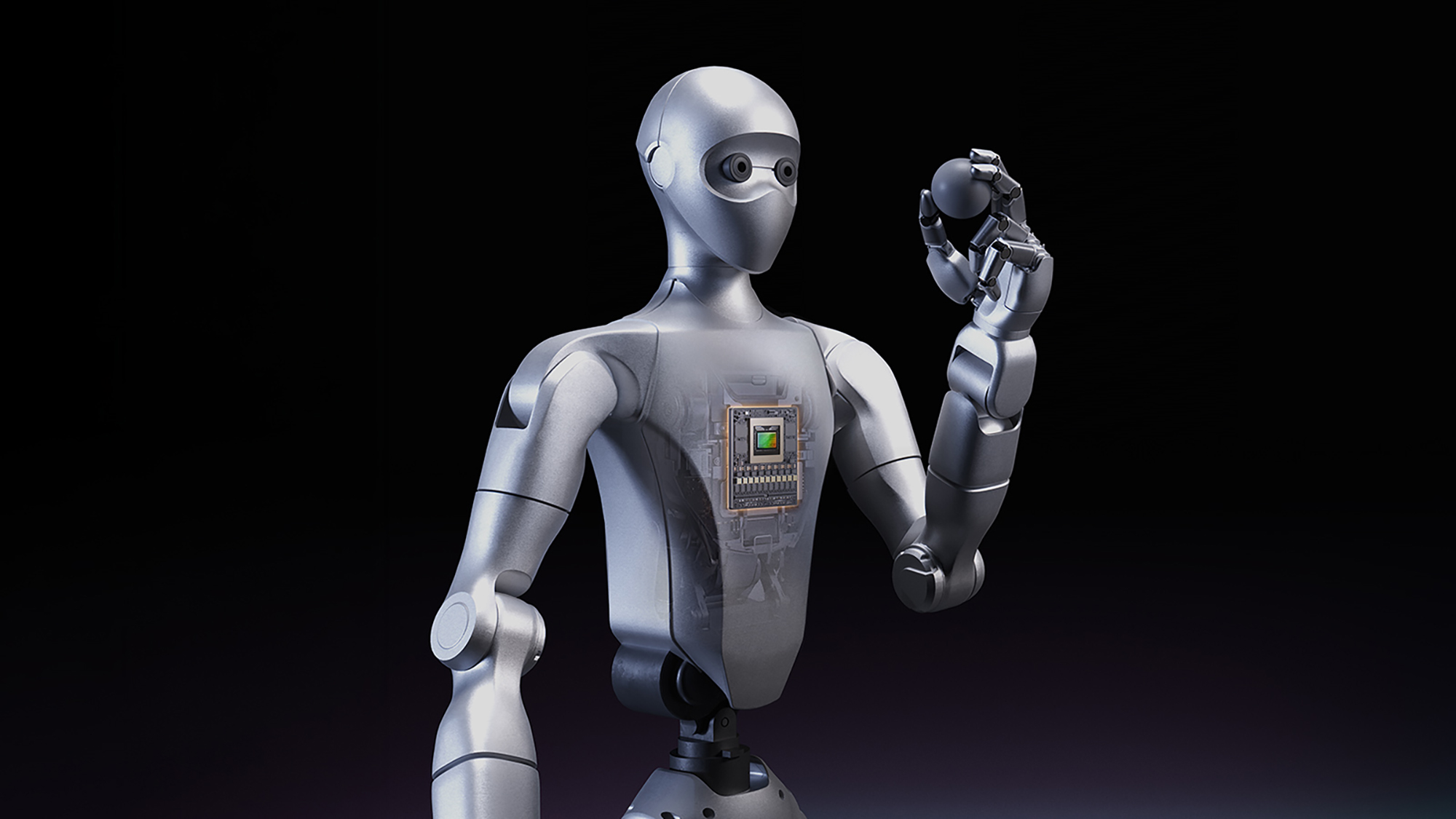
NVIDIA announced the Isaac GR00T reference humanoid robot on June 1, 2026 during Computex, combining a Unitree H2 Plus body, Sharpa five-fingered tactile hands, NVIDIA Jetson Thor onboard compute and the open Isaac GR00T software stack, with Unitree founder Wang Xingxing quoted in the official release.
The robot stands roughly 1.8 meters tall and weighs about 68 kilograms, with 31 degrees of freedom in the body plus 22 in each Sharpa hand for a combined total near 75, and arms capable of lifting around 33 pounds.
The brain is the Jetson AGX Thor T5000 module built on Blackwell architecture, rated at 2,070 FP4 teraflops with 128GB of unified memory and a 14-core Arm processor, with a 15Ah onboard battery supporting roughly three hours of continuous operation.
The Isaac GR00T platform also supports Unitree's G1 humanoid, and the open GR00T N1.7 vision-language-action model published on GitHub and Hugging Face includes a dedicated UNITREE_G1_SONIC embodiment tag for whole-body control.
Unitree's IPO timetable is set, with price inquiries on August 5, the offer price on August 6, subscriptions on August 10 and results on August 14, targeting roughly 4.2 billion yuan, while local industry expectations point to a listing around August 19 pending exchange confirmation.
MEXC lists USDT-settled UNITREE stock futures and raised the contract's maximum leverage from 10x to 25x on August 4, offering an alternative tracking instrument that trades 24/7, works in both directions and carries no subscription allocation limits.
Why NVIDIA Chose Unitree
The weight of this partnership starts with NVIDIA's selection logic. Per
NVIDIA's official newsroom release, the company announced an open humanoid robot reference design built on the Isaac GR00T platform, combining a Unitree H2 Plus humanoid, Sharpa five-fingered hands for dexterous manipulation, NVIDIA Jetson Thor onboard compute for advanced reasoning and control, and Isaac GR00T open software and models. Leading research institutions including Ai2, ETH Zurich, the Stanford Robotics Center and UC San Diego's Advanced Robotics and Controls Laboratory will use the reference design to advance frontier humanoid research.
In robotics, reference designs function as blueprints that other industry participants adopt and customise. Per the
South China Morning Post's report, Huang said in his Computex keynote that for agentic systems, robotic systems and physical AI, data is the hardest problem. That line explains NVIDIA's intent, since it needs widely adopted standard hardware to solve the collection and reuse of embodied AI training data, and Unitree's H2 became the vehicle for that standard.
Who Supplies What
The division of labour is clear in public statements. Per
China.org.cn's interview coverage, Unitree provides the H2 humanoid hardware while NVIDIA supplies the AI computing platform, robot foundation models and simulation system support, with Sharpa providing the five-fingered hands. Unitree marketing manager Yolanda Xie noted that the partnership is built on the H2 humanoid hardware where Unitree holds advantages.
That split reveals Unitree's actual coordinate in the global embodied AI value chain. It is a leading supplier at the robot body layer rather than a full-stack platform owner. This positioning is both an advantage, given the cost and scale capabilities in body manufacturing that are hard to replicate, and a constraint, since value capture in software and models accrues primarily to NVIDIA.
What the Specifications Actually Say
The technical parameters themselves define this system's positioning. Per
Quartz's reporting, the humanoid achieves a combined 75 degrees of freedom, 31 from the body and 22 from each of the two Sharpa hands. Powering it is the Jetson AGX Thor T5000 module integrating a Blackwell GPU rated at 2,070 FP4 teraflops, a 14-core Arm processor and 128GB of unified memory, with a 15Ah onboard battery pack supporting approximately three hours of continuous use.
Per
BGR's description, the H2 Plus body stands close to six feet with arms that can lift as much as 33 pounds, combined with whole-body control abilities including reaching and lifting. The GR00T software stack includes tools for teleoperation and demonstration data capture, open foundation models for reasoning and multitask behavior, simulation and training environments via Isaac Sim and Isaac Lab, and middleware for deploying trained policies onto the physical robot.
The Open Source Element Changes the Competitive Map
An easily overlooked detail with far-reaching consequences is the open licensing. Per
The Robotics Media's analysis, the software side ships with the Isaac GR00T N1.7 open VLA reasoning model and Isaac Sim training pipelines, both available on Hugging Face and GitHub. Until now, the race to build foundation models for humanoids has been a closed-loop game among well-funded startups, with Physical Intelligence, Skild AI, 1X and Figure all training on proprietary hardware.
Per
NVIDIA's Isaac GR00T repository, GR00T N1.7 supports whole-body humanoid control via the UNITREE_G1_SONIC embodiment tag, where the VLA predicts compact latent action tokens that a learned whole-body controller decodes into full-body joint commands including legs, arms and hands. Unitree's hardware is now written into the embodiment taxonomy of NVIDIA's open model, and the value of that depth of integration far exceeds an ordinary commercial partnership.
What It Means for the IPO Valuation
Unitree's issuance timetable has entered its final phase. Per
Caixin Global, the company formally launched its STAR Market IPO on July 30, targeting 4.2 billion yuan at an implied valuation near 42 billion yuan. Per
Gasgoo, preliminary price inquiries take place on August 5, with online and offline subscriptions opening simultaneously on August 10 and payment due August 12. The
South China Morning Post adds that the offer price is set on August 6 with final results published August 14, while the actual listing date awaits official exchange confirmation.
The NVIDIA relationship supports the valuation on three levels. First, technical validation, since being chosen as reference design hardware by the leading compute company is the strongest possible third-party endorsement of body engineering capability. Second, distribution, since adoption by Stanford, ETH Zurich and peers places Unitree hardware into the standard configuration of global academic research, a long-term brand and ecosystem asset. Third, hedging, since with the US having added foreign-made humanoid and quadruped robots to import restrictions, deep technical integration with NVIDIA preserves a channel into the Western innovation system.
Objectively, the reference design targets research institutions rather than mass commercial deployment, so its direct revenue contribution will be limited for the foreseeable future. The H2 Plus is due from Unitree in late 2026 per the company website, with pricing undisclosed. The value of this partnership currently sits at the strategic level rather than in the financial statements.
What It Means for Investors
For global investors, this IPO's greatest significance is that humanoid robotics finally gains a public pricing benchmark. Unitree arrives with real financials, with the prospectus showing 2025 revenue of 1.708 billion yuan up 335% and a 60.27% gross margin alongside more than 5,500 humanoids shipped. Growth is decelerating, however, with first-half 2026 revenue guided up roughly 35.6% to 45.4% and adjusted net profit expected to fall about 6% to 22%. That combination of technical leadership with margin pressure is precisely what needs careful pricing.
The practical obstacle is access. STAR Market subscription requires a mainland account, 500,000 yuan in assets and 24 months of trading experience, with allocation rates typically minuscule, while overseas investors cannot participate directly. That is why derivative instruments tracking the name have drawn attention.
The Practical Differences of Tracking It Through Derivatives
MEXC lists USDT-settled UNITREE stock futures, and several differences from conventional subscription carry real meaning for traders.
On timing, the contract trades before the official listing, so there is no waiting for the debut and no dependence on subscription dates or allocation lotteries, with position size determined by the trader rather than by a ballot. Trading runs 24/7, meaning news breaking while the A-share market is closed, over weekends or during holidays, whether an NVIDIA announcement, a US policy shift or an overseas order disclosure, can be traded immediately rather than at the next open.
On direction, the contract works both ways. Facing a newly listed name whose growth has slowed from 332% to around 40% and that has just lost its largest overseas market, the ability to express a bearish view matters as much as a bullish one, which outright share ownership cannot provide.
On leverage, per
MEXC's official announcement, maximum leverage on UNITREEUSDT was raised from 10x to 25x at 07:30 UTC on August 4, 2026, materially improving capital efficiency. It must be stated alongside this that leverage amplifies losses in exactly the same proportion as gains, and the announcement itself warns that leveraged trading involves significant risk and may not be suitable for all investors, that the adjustment may not be available in certain countries or regions, and that applicable leverage should be confirmed on the trading page. Newly listed names are volatile by nature, and when combined with high leverage, strict position sizing and stop discipline matter more than directional conviction.
What to Watch Next and Where the Risks Sit
Three Threads Worth Tracking
First, the commercialization pace of the H2 Plus. The company website indicates availability in late 2026, and its pricing, order volume and deliveries will be the direct measure of whether the NVIDIA relationship converts from strategic asset into revenue.
Second, the expansion of the Isaac GR00T ecosystem. The platform also supports the G1 humanoid, with a reference workflow expected on GitHub and Hugging Face, and the number and output of research institutions adopting it will determine the stickiness of Unitree hardware.
Third, the real impact of the US import curbs, where the overseas revenue share in the first post-listing report will give the first quantifiable answer.
Risks to Recognize Clearly
Technically, Unitree supplies the body while value capture in software and models accrues primarily to NVIDIA, which caps long-term margin potential. Per The Robotics Media's analysis, H2 Plus pricing is expected to undercut Western humanoid hardware by a wide margin, and the bargaining power of hardware suppliers within a value chain is a structural issue.
Commercially, the reference design targets a limited research market with modest near-term revenue. Competitively, average humanoid selling prices have already fallen from 590,000 to 166,400 yuan, and the erosion of that 60% gross margin warrants continuous monitoring. Geopolitically, US import curbs and intensifying US-China robotics rivalry could affect the durability of cross-border technical partnerships. From a market standpoint, CXMT's 466% first-day surge on July 27 has inflated subscription expectations, and sentiment pricing detached from fundamentals can retrace just as violently.
Exclusive View from James Mitchell
What genuinely matters about this partnership is not another corporate co-branding but that it establishes Unitree's coordinate within the global embodied AI value chain. NVIDIA selected Unitree's body when constructing a standard platform for physical AI, a path closely resembling how it locked in the AI compute ecosystem through CUDA. Grasping that means recognizing that Unitree's valuation logic cannot rest on current revenue alone but on whether it becomes a hard-to-replace node in the chain. The dedicated embodiment tag for Unitree hardware inside GR00T N1.7 is technical evidence of how deep that integration runs.
Two misreadings look likely. The first is treating the NVIDIA relationship as an earnings catalyst. The reference design serves a research institution market of limited scale, the H2 Plus is not available until late 2026 with pricing undisclosed, and it will barely register in near-term financials. Conflating strategic value with financial contribution is the most common error in pricing new listings. The second is underestimating the long-run constraint of value chain position. In this configuration NVIDIA provides the brain and Unitree the body, and historically the compute and model layers capture materially more value than hardware. Unless Unitree moves up into software and applications, margin pressure is structural rather than cyclical.
What investors should focus on next is the cross validation of three data sets. The premium of the final offer price set on August 6 relative to the 42 billion yuan base, representing institutions' real judgment during book-building. The overseas revenue share in the first post-listing report, the direct test of the import curbs' bite. And the trajectory of average humanoid selling prices, where continued decline from 590,000 to 166,400 yuan would confirm the volume-over-price strategy is deepening and margin pressure will persist.
For cross-asset investors, Unitree's listing completes the AI narrative's pricing chain from chips through cloud to embodied endpoints. Any revaluation along that chain transmits through risk appetite to adjacent links, including AI and robotics themed tokens in crypto. From a risk management standpoint, when a sector transitions from private to public pricing, volatility typically rises before settling, and whatever instrument is used to participate, especially a leveraged one, position sizing should take priority over conviction in direction.
FAQ
What exactly is the Unitree and NVIDIA partnership?
During Computex on June 1, 2026, NVIDIA announced the Isaac GR00T reference humanoid robot, combining a Unitree H2 Plus body, Sharpa five-fingered tactile hands from Singapore, and NVIDIA Jetson Thor onboard compute with the open Isaac GR00T software and models. Unitree supplies the robot hardware while NVIDIA provides the AI computing platform, robot foundation models and simulation support. Research institutions including Ai2, ETH Zurich, the Stanford Robotics Center and UC San Diego will use the reference design.
What is Isaac GR00T?
Isaac GR00T is NVIDIA's development platform and foundation model family for humanoid robots, spanning data capture and generation through model training, evaluation and deployment. At its core, GR00T N1.7 is an open vision-language-action model that takes multimodal input including language and images to perform manipulation tasks, published on GitHub and Hugging Face. It supports whole-body humanoid control via the UNITREE_G1_SONIC embodiment tag, decoding predicted latent action tokens into full-body joint commands covering legs, arms and hands.
How much does this partnership help Unitree's valuation?
Primarily at the strategic level rather than in current financials. Selection as reference design hardware is third-party validation of body engineering capability, adoption by leading labs builds long-term ecosystem assets, and integration with NVIDIA preserves a link to the Western innovation system amid US import curbs. But the reference design serves a limited research market, the H2 Plus is due only in late 2026 with pricing undisclosed, and near-term revenue contribution is minimal, so strategic value should not be equated with earnings delivery.
When will Unitree Robotics go public?
The subscription timetable is officially confirmed, with price inquiries on August 5, the offer price set August 6, online and offline subscriptions on August 10, payment due August 12 and results published August 14. The formal listing date has not been officially announced, though per industry expectations cited by local outlets including 21st Century Business Herald, trading may begin around August 19, with the precise date pending announcements from the Shanghai Stock Exchange and the company. The offering targets about 4.2 billion yuan at a base valuation near 42 billion yuan.
What options exist for investors who cannot subscribe to the A-share IPO?
STAR Market subscription requires a mainland account, 500,000 yuan in assets and 24 months of trading experience, with typically minimal allocation rates, and overseas investors cannot participate directly. One alternative is tracking price expectations through derivatives, and MEXC lists USDT-settled UNITREE stock futures that trade 24/7, work in both directions, and let users set their own position size without subscription allocation limits. It bears emphasis that derivatives are entirely different products from holding shares, are highly volatile, and require full understanding of contract mechanics and risks beforehand.
What is the leverage on MEXC's UNITREE contract?
Per MEXC's official announcement, maximum leverage on UNITREEUSDT was raised from 10x to 25x at 07:30 UTC on August 4, 2026. The same announcement warns that leveraged trading involves significant risk and may not be suitable for all investors, that traders should carefully consider their investment objectives, experience level and risk tolerance before participating, and should seek independent financial advice if needed. The adjustment may also be unavailable in certain countries or regions, with applicable leverage shown on the trading page. High leverage magnifies losses proportionally, making position and stop discipline essential during the volatility typical of new listings.
What are the main risks around this listing?
At least four. Valuation risk, since CXMT's 466% first-day surge has inflated subscription expectations and sentiment pricing detached from fundamentals retraces just as sharply. Fundamental risk, with revenue growth slowing from 332% to around 40% and adjusted net profit guided lower year over year. Geopolitical risk, with the US having added foreign-made humanoid and quadruped robots to import restrictions. And value chain risk, since Unitree supplies the body while value capture concentrates in compute and models, making long-term margin pressure structural rather than cyclical.
Disclaimer
This content is provided for informational purposes only and does not constitute investment advice, financial advice, legal advice, tax advice or a recommendation to buy or sell any asset. Prices of equities, new listings, derivatives and crypto assets can move sharply, with newly listed names and leveraged derivative instruments particularly volatile, and leverage amplifies both gains and losses proportionally, potentially producing losses beyond expectations and making such products unsuitable for all investors. Past performance, technical indicators and on-chain data cannot guarantee future results, and the listing timeline expectations, valuation discussion and scenarios presented here rest on public information, so actual outcomes may differ materially, with official announcements from the Shanghai Stock Exchange, the China Securities Regulatory Commission, Unitree Robotics, NVIDIA and the relevant platforms taking precedence. Readers should conduct their own research and reach independent conclusions based on their financial circumstances, investment objectives and risk tolerance, consulting licensed professionals where appropriate. The MEXC Crypto Pulse Team accepts no liability for any direct or indirect losses arising from the use of or reliance on this content.
About the Author
James Mitchell specializes in technical analysis, market trends, and trading strategies for both Bitcoin and altcoins. Based in London, he has over 10 years of experience in financial markets. Before joining MEXC Learn, James worked as a senior analyst at a leading European investment firm, where he developed expertise in risk management and quantitative trading. His transition to cryptocurrency markets began in 2017, and he has since become recognized for his data-driven approach. He holds a Master's degree in Financial Economics from the London School of Economics. His analytical approach combines traditional technical analysis with on-chain metrics to provide readers with actionable insights.
Areas of Expertise:
Research References