

The biggest scam in the prediction market: your commission is not 0.07%
When you come across posts predicting the market, do you often see this kind of post showing orders?
Polymarket only charged a 0.07% handling fee for this order, just like using it for nothing. I also believed it at first. It wasn't until I compared my own on-chain transaction hash and screenshots to compare my cost and the share I received, and honestly converted each transaction price into what ordinary people understand as "I paid 100 U and actually deducted how much handling fee", that I realized - the current handling fee charging curve of major prediction markets is very deep, and ordinary people really don't understand how much they have charged...
In today's article, I directly exposed the fees of Polymarket, Kalshi, Gate prediction market, and Mexc prediction market. The whole process is my own account real order, screenshot, chain hash can be checked , refuse to imagine. Let's start with the conclusion: if you often place orders at niche events or mid-range prices, the actual transaction fees for Polymarket and Kalshi are far less than the official documentation suggests. There are already platforms on the market that offer fixed-rate plans, such as the prediction market launched by Mexc, which is actually much cheaper. Keep reading for specific data and you will understand.
1.Why do you always feel that the handling fee is more expensive than the official statement?
Polymarket's documentation would say "rate as low as 0.07%" and Kalshi would say "small fee per transaction". They didn't lie, but that's a rate calculated by shares , not the ratio between the U deducted from your account and your order cost. The money you spend on the share of "a certain result occurs" is called cost . The calculation formula for the fees collected by the platform is: fee = fee_rate × shares × P × (1 - P) Among them:
- fee_rate: Platform base rate parameters (Polymarket crypto is usually 0.07, which is a 7% front factor)
- P: The current probability price of this result (for example, 0.5 dollars is a 50% probability).
- Shares: the number of shares you bought
And what we really care about is the handling fee calculated by the transaction amount (that is, you paid 100 U, how much is the fee), it should be: Actual fee rate = fee/cost Because cost = shares × P, a very refreshing formula can be obtained by simply substituting: Actual handling rate = fee_rate (1-P) * What does this mean?
The closer your probability of buying is to 1 dollar, the lower the fee rate; the closer it is to 0 dollars, the higher the fee rate. It's not a fixed "ten thousandth", but a dynamic cost coefficient that can reach a full 100% of the base rate. The fee_rate of Polymarket crypto is 0.07, then:
- Buy a share priced at 0.99 dollars (popular event will be settled soon), the actual rate ≈ 0.07 × 0.01 = 0.07% , which is really low, so you will see "almost free" promotional screenshots everywhere.
- But if you buy a cold event that just broke out, the price is 0.01 dollars, and the actual rate is ≈ 0.07 × 0.99 = 6.93% ! This 6.93% is a pure handling fee, and your profit and loss line is directly cut off.
Kalshi is the same, fee_rate is also 0.07, so the rate curve and Polymarket crypto completely coincide. This is why most players, once they start trading seriously, will vaguely feel that "transaction fees are a bit painful" - because you can't enter the market at 0.99 dollars every day.
2. I placed a real gold and silver order and ran through the rates
In order to make this curve visible to the naked eye, I used 100 units as the trading unit (for easy cost calculation), and drew up a table of actual rates at various price points for everyone to make a visual comparison. Assuming each transaction is worth 100 copies x P, the cost is 100P. The percentage in the table is: actual deducted expenses ÷ costs × 100%
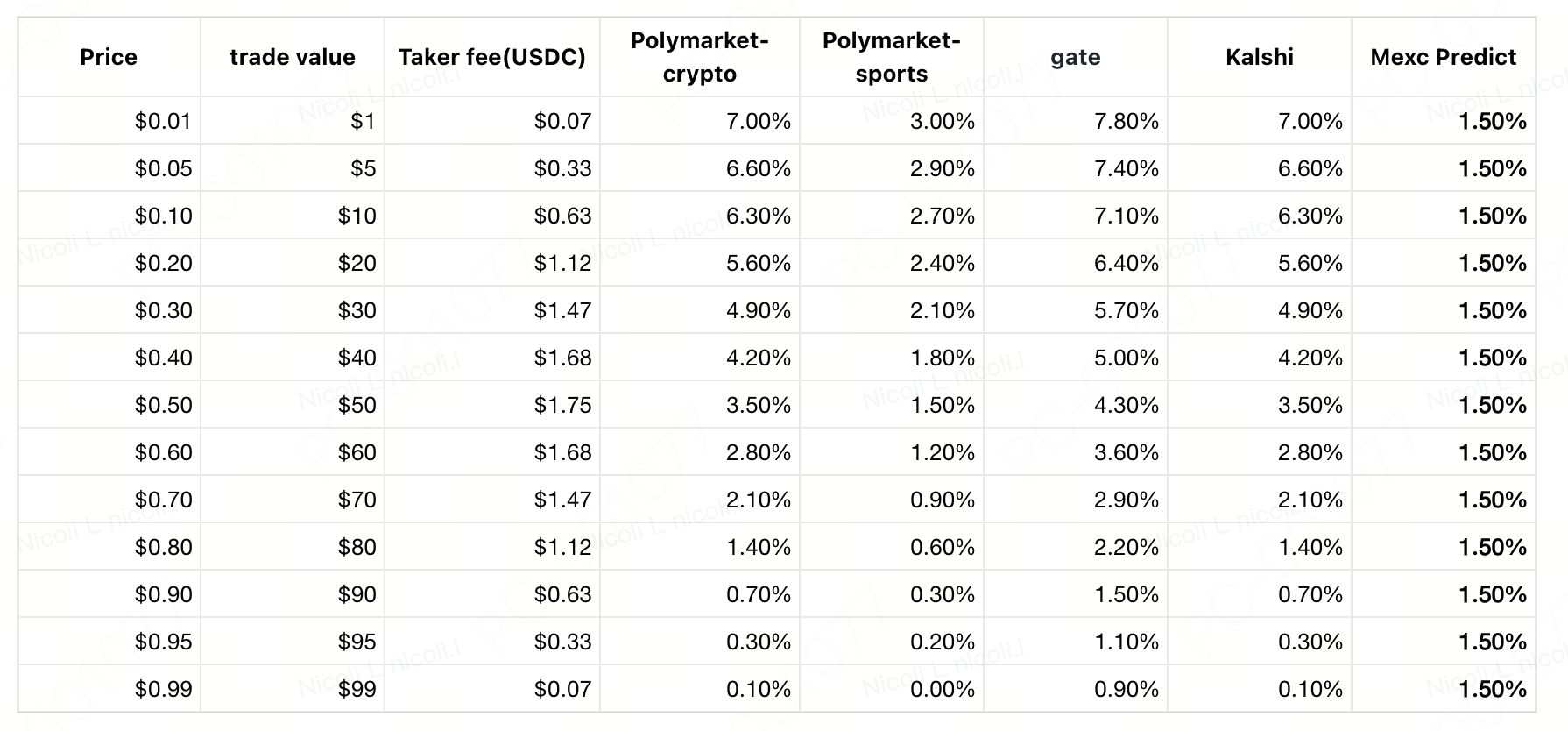
Two key observations:
- The highest rate appears in the lowest probability range
- Buying at 0.01 dollars, Polymarket crypto and Kalshi received 7.0% directly.
- That is to say, if you spend 100 U to buy an extremely unpopular product, 7 U will go directly into the platform's pocket. This is much more severe than most CEX spot transaction fees.
- 50% probability (0.5 dollars) rate cut in half, but still not cheap
- The most neutral price point, Polymarket crypto is 3.5%, and Kalshi is the same.
- At the same price, gate.io is higher (4.3%), and the Mexc Predict is still 1.50% .
Polymarket's sports section has a slightly lower fee rate, but it also starts at 3.0%. At 0.5 dollars, it is 1.5%, which barely touches the threshold of Mexc, but it is still not lower than it. In addition, in order to verify the authenticity, I placed orders in multiple markets separately, and I kept the order screenshot, and the hash address of the polymarket's order was also kept (I will put the transaction hash and screenshot collection at the end of the article. Friends who want to check it by hand can go directly to check it)
3.How "smart" are Polymarket and Kalshi? It lies in using shares to embellish fees
As many prediction market veterans know, Polymarket and Kalshi's fee-based design is derived from a classic automated market-making curve . From the perspective of product design, it can make liquidity more concentrated in the middle price range, while punishing noise trading at extreme prices. This is mathematically sound. However, the problem is that when facing the general public, they deliberately only mention "extremely low-priced rates", and do not talk about high-priced rates.
You open the documentation page of Polymarket, they will emphasize that "rates are determined by curves", and then list a table of share fees, which looks very transparent. See the figure below, you think the highest rate is 1.75%, but in fact it is calculated by shares, and the actual rate calculated by cost can reach up to 7% !
When 99% of users place an order, their minds will not automatically complete the conversion from "share cost" to "real cost". It's like the ticket price is all naked, and you pay to tell you that the fuel infrastructure occupies half of the ticket . Mathematically correct, but the feeling is very poor.
Kalshi is the same. Its Fee Schedule is even written like a regulatory document, densely packed, but it is almost invisible about "what is your Actual Cost Rate".
In contrast, Mexc Predict's approach is very rough and frank: it is a fixed rate of 1.50%, whether you buy 0.01 dollars or 0.99 dollars, the rate remains unchanged.
For retail investors, this is simply the light of the fee industry.
4. the gate.io rate is more expensive, and 0.8% is added to the Polymarket rate
Originally, I thought gate.io as a leading CEX, the predicted market commission would be relatively low, and I was even a little surprised after the data came out.
- At 0.01 dollars,gate.io closed at 7.8% , 0.8 points more than PM crypto.
- At 0.5 dollars, the rate is 4.3%, still 0.8 points higher than PM/Kalshi.
- Even if the price is pulled down to 0.99 dollars, it still charges 0.9%.
This shows that gate.io did not give traders any preferential treatment in the fee design of the prediction market track. If you are a regular small investor, you have already been stripped of a layer of skin when you enter the market. 5.Is the fixed rate plan promising? Taking Mexc Predict as an example After comparing the curves of these few companies, there is a question that cannot be avoided: If we don't use probability curves and directly use fixed fees, will it be more friendly to traders? Currently, Mexc Predict is one of the earliest solutions available on the market. Regardless of the price you enter, the taker fee is 1.50% (maker fee is 0) and remains constant.
- Low probability event (0.01 dollars) : PM/Kalshi closed 7.0%, Mexc closed 1.50%, a difference of nearly 5 points;
- Medium probability event (0.5 dollars) : PM/Kalshi is 3.5%, Mexc is still 1.50%, or more than half cheaper;
- High probability event (0.9 dollars +) : PM/Kalshi rate is below 1%, Mexc is still fixed at 1.5%.
So if your trading style prefers frequent entry and exit in high price ranges near settlement, PM/Kalshi's low fee zone does have an advantage. However, if you often look for opportunities in the middle price range or unpopular events, such as event-driven ambush trading or betting on low probability Black Swan, the actual expenditure of the fixed-rate plan will be significantly lower. There is no absolute good or bad in this thing, it purely depends on your strategic habits. Just want to remind you: don't be anchored by the number of "lowest 0.07%", it's just one end of the curve. When calculating, what you really need to look at is which fee level corresponds to the price range you often play in. More to say, Mexc is currently in these few, clearly marked to the user how much the fee charged a.
6.Order screenshot and hash, with proof attached
In order to make this disassembly verifiable, I have compiled transaction hashes and screenshots of price ranges for each platform and placed them below. Interested friends can directly click on the verification, the data won't lie. https://docs.google.com/spreadsheets/d/1iV7UuRp6G51fYieUq8RwzIUeYM7Px_M5Kbw_Uzh81TY/edit?usp=sharing I used the formula of fee = fee_rate × shares × P × (1-P) for reverse verification of each transaction, and the results were completely consistent. This proves:
- The fee_rate of the platform is indeed 0.07 (PM crypto/Kalshi), etc.
- The actual rate formula fee_rate × (1-P) is fully established.
- The percentage in my form is your physical sensation.
7.Summary & Some Personal Suggestions
The prediction market is still in its early stages, and the design of transaction fees is destined to continue iteration. However, as users who actually spend money, we only need to recognize three facts.
- The actual taker rates for Polymarket and Kalshi fluctuate between 0.1% and 7.0%, with neutral prices around 3.5%.
- Predicting the highest market rate, 4.3% at 0.5 dollars, and even 7.8% for unpopular events.
- Mexc Predict is fixed at 1.50%, which is currently the lowest and most stable among all mainstream platforms.
Next time someone brags about "Polymarket transaction fees are only a few ten thousandths" on Discord, you can throw this article at them. What you said was an illusion when P = 0.99. At its most expensive, it was even more outrageous than the commission rate of the futures platform near your home.
The handling fee is not obvious, but it can cost several trips abroad in a year. Choosing a platform that charges honestly is much more important than choosing a platform that only charges you based on the best situation. Statement: This article is based solely on the author's actual trading data and does not constitute any investment advice. The predicted market risk is extremely high, please participate with caution. The fees of each platform may change due to product line adjustments, please refer to the latest official announcement.


You May Also Like

XRP or Stellar (XLM): The One Asset Smart Investors Would Choose

Iran’s army chief warns of ‘total destruction’ for ground invasion

EUR/GBP Exchange Rate Surges as Bank of England Rate Hike Expectations Intensify – Market Analysis



