

Vitalik Buterin Warns Crypto’s Biggest Privacy Breakthrough Is Still Years Away
Key highlights:
- Vitalik Buterin says mainstream cryptographic obfuscation is still years away.
- Use cases for the concept span private voting systems and advanced decentralized applications.
- While indistinguishability obfuscation is within reach, real-world utility is computationally expensive.
Ethereum co-founder Vitalik Buterin says cryptographic obfuscation remains one of blockchain’s hardest unsolved challenges despite major research advances. His comments come as the cryptocurrency sector is entering a phase where privacy and institutional blockchain infrastructure are becoming major battlegrounds.
Buterin says obfuscation could eliminate trusted middlemen
Vitalik Buterin has dubbed obfuscation as the “most powerful idea” in cryptography, unfurling a raft of use cases for the concept. However, the Ethereum co-founder noted that researchers have yet to find a way to transform the technology from theoretical promise into usable infrastructure.
Program obfuscation allows software to execute normally while concealing how the code works underneath. The broader goal is to create systems that function without exposing sensitive internal logic, enabling new forms of decentralized coordination and privacy.
According to Buterin, the technology can serve as a “trustless trusted third party,” allowing blockchains to replace intermediaries that traditionally manage sensitive use cases. Buterin highlighted a raft of use cases, including private voting systems, confidential governance structures, and advanced decentralized applications.
“If you have obfuscation and a blockchain, you can do some pretty magical things,” wrote Buterin. “Like say, a secure, private collusion-resistant voting system that has almost no trust assumption at all.”
Back in 2021, researchers found out that perfect obfuscation was mathematically impossible, spawning a two-decade attempt at indistinguishability obfuscation (iO), a more realistic target.Despite a flurry of breakthroughs in cryptography, the Ethereum co-founder noted that current obfuscation systems are still computationally expensive for real-world deployment.
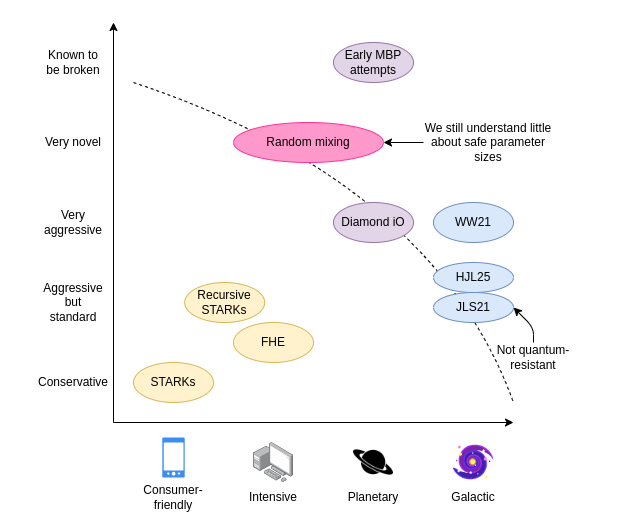
Source: Vitalik.eth.limo
Buterin compared the current state of obfuscation to the early days of zero-knowledge proofs before years of optimization transformed them into production-ready tools now widely used across Ethereum scaling systems. Buterin noted that obfuscation may mature into critical blockchain infrastructure, but significant engineering hurdles still stand in the way.
Privacy coins do not solve the same problem
In the lengthy post, Buternin also pushed back against comparisons between obfuscation and existing privacy-focused cryptocurrencies like Monero.
While privacy coins primarily hide transaction data such as wallet addresses and transfer amounts, obfuscation attempts to hide the actual logic of a program. For Buterin, the distinction is critical because it opens the door to far more advanced forms of decentralized computing and coordination beyond simple transaction privacy.
Meanwhile, privacy projects like Cardano’s Midnight have gathered significant steam in recent months. Midnight’s success has spawned a raft of privacy-enhanced DeFi platforms as institutional players begin wading into the space.
Early in the year, Buterin claimed that blockchain’s main problem of combining scalability, security, and decentralization will soon be solved. At the time, the Ethereum co-founder pointed to PeerDAS data sampling system and zero-knowledge proof virtual machines as the final puzzle pieces for the challenge.


You May Also Like

Solana price confirms bearish crossover following Drift exploit, will it crash?

EUR/GBP Exchange Rate Surges as Bank of England Rate Hike Expectations Intensify – Market Analysis


