Traditional perimeter-based security has become obsolete. By 2025, 60% of enterprises will phase out most of their remote access VPNs in favor of ZTNA. IBM’s *CostTraditional perimeter-based security has become obsolete. By 2025, 60% of enterprises will phase out most of their remote access VPNs in favor of ZTNA. IBM’s *Cost

Zero Trust Network Access(ZTNA) Enforcement Using Real Time Risk Scoring & Dynamic Path Segmentation

2026/01/14 22:02
6 min read
For feedback or concerns regarding this content, please contact us at crypto.news@mexc.com

\ As organizations rapidly embrace cloud services, remote work, and distributed architectures, traditional perimeter-based security has become obsolete. Today’s users, devices, and applications operate far beyond corporate network boundaries—rendering legacy security models ineffective against modern threats.

According to Gartner, by 2025, 60% of enterprises will phase out most of their remote access VPNs in favor of ZTNA. Meanwhile, IBM’s Cost of a Data Breach Report shows that organizations with Zero Trust deployed saved an average of $1.76 million per breach.

As threats grow more dynamic and sophisticated, ZTNA itself must evolve. The next phase of Zero Trust requires access decisions that adapt in real time—driven by continuous risk assessment and enforced through dynamic path segmentation.

Why Traditional ZTNA Needs Real-Time Adaptability?

Traditional ZTNA models authenticate users and validate device posture before granting access. But after authentication, most policies remain static—unable to respond to changes in user behavior, device compromise, or emerging threats during an active session. This exposes organizations to risks that appear after access is granted.

For example, a device may become infected mid-session, or a trusted user may begin accessing unusual resources. Static controls simply cannot detect these shifts.

Real-World Example: The SolarWinds Lesson

The 2020 SolarWinds attack demonstrated exactly why static access decisions fail. Attackers compromised legitimate credentials and moved laterally through networks for months all while appearing as trusted users.

A dynamic, risk-aware ZTNA system would have:

  • Flagged anomalous behavior
  • Triggered step-up authentication
  • Restricted or revoked access

before substantial damage occurred.

Where Static ZTNA Fails: Specific Scenarios

  1. Credential theft \n A user’s credentials are stolen via phishing, but their device and session remain trusted.
  2. Insider threat \n An authenticated employee begins accessing unusual resources.
  3. Session hijacking \n An attacker takes over a valid authenticated session.
  4. Device compromise \n Malware infects a previously compliant device mid-session.

Static ZTNA cannot respond to any of these threats once initial access is granted.

Real-Time Risk Scoring: The Engine of Adaptive Access

Real-time risk scoring adds a continuous evaluation layer that monitors user and device trustworthiness throughout an active session. Instead of relying on a one-time identity check, the system calculates a composite, evolving risk score based on:

Key Risk Inputs

  • User behavior: Login anomalies, activity deviations, unusual access patterns
  • Device posture: OS version, patch level, security configuration, EDR signals
  • Environmental signals: Geolocation, connection source, network reputation
  • Threat intelligence: Known malicious IPs, IOCs, active attack campaigns

With continuous scoring, ZTNA can dynamically adjust permissions:

  • Low risk → seamless access
  • Medium risk → step-up authentication or restricted access
  • High risk → session termination or quarantine

This ensures that access privileges always reflect the current threat landscape, not outdated assumptions.

Dynamic Path Segmentation: Reimagining Secure Connectivity

Dynamic path segmentation complements real-time risk scoring by enforcing least-privilege network access at the transport level. Unlike VPNs which provide broad network exposure once authenticated—dynamic segmentation creates per-application secure pathways that exist only as long as trust conditions remain valid.

These microtunnels:

  • Are built using software-defined routing
  • Exist only for individual applications
  • Offer zero lateral movement
  • Automatically adjust or terminate based on risk changes

How Dynamic Path Segmentation Works?

\ ** How Dynamic Path Segmentation works **
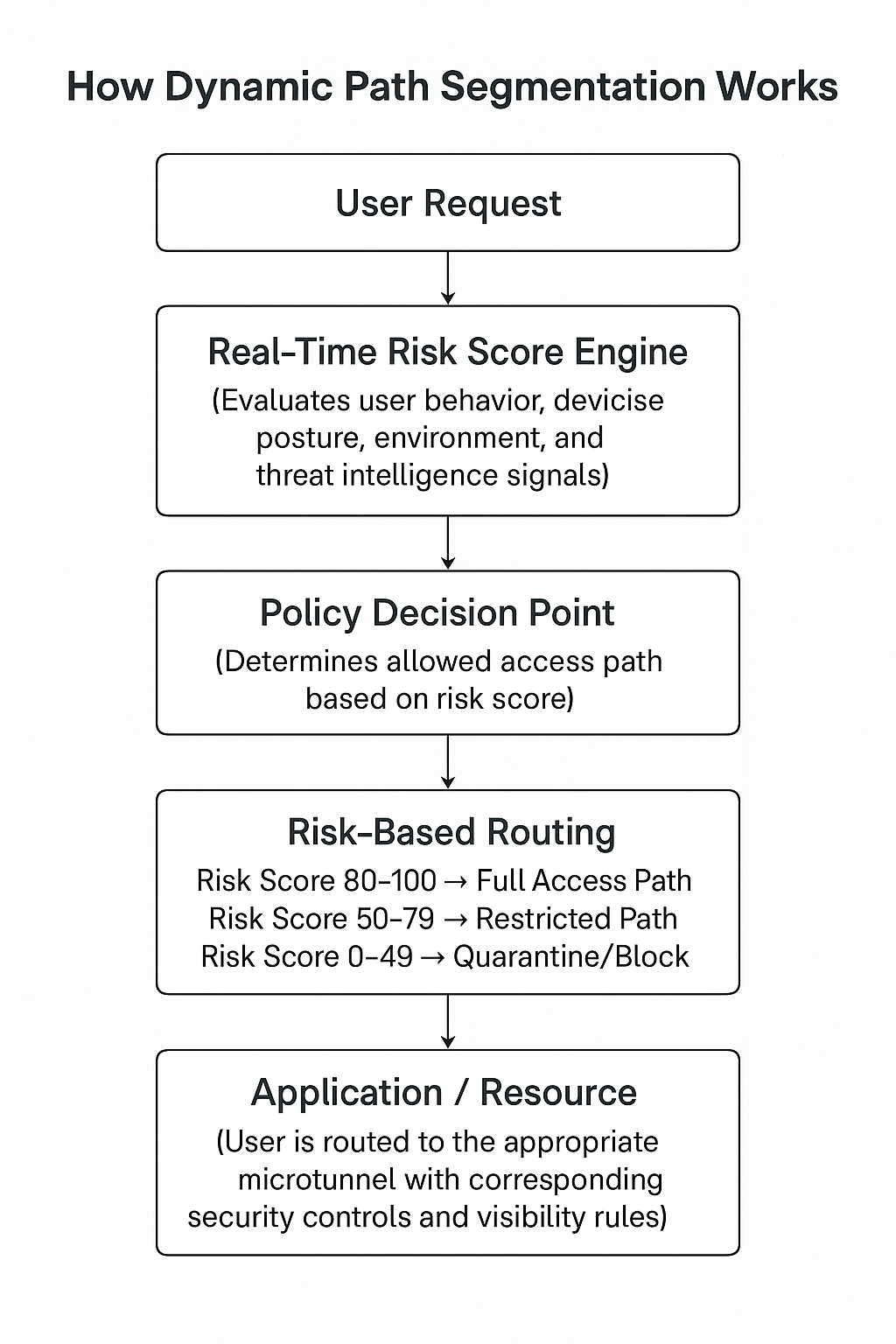
\ Each routing path corresponds to a dedicated network segment with unique security controls, logging levels, and permissions.

ZTNA + Real-Time Risk Scoring + Dynamic Path Segmentation: A Unified Adaptive Model

Together, these three components create an intelligent, self-adjusting Zero Trust architecture.

How the Unified Model Operates

  • Real-time access decisions: Authentication adapts based on the current risk score
  • Continuous monitoring: Risk scores evolve with each user action
  • Network-level enforcement: Path segmentation isolates users based on trust
  • Feedback loop: Logged events improve future detection accuracy

Access always reflects least privilege, and threats are contained before lateral movement occurs.

Implementation Considerations

When rolling out this unified model, organizations should consider:

  1. Start with visibility \n Deploy risk scoring in monitoring mode to baseline behaviors.
  2. Phased enforcement \n Introduce step-up authentication first before enabling automated blocking.
  3. Integration requirements \n Connect SIEM, identity provider, and endpoint tools to feed risk signals.
  4. False positive tuning \n Overly aggressive thresholds create friction—tune gradually.
  5. Compliance alignment \n Map risk thresholds to regulatory frameworks (PCI-DSS, HIPAA, SOC 2).

Key Integration Points

  • Identity Provider (IdP): User identity & posture
  • EDR: Device health and threat signals
  • SIEM/SOAR: Threat intelligence correlation
  • CASB: Application visibility and governance

Common Pitfalls and How to Avoid Them

1. Over-Aggressive Risk Thresholds \n Problem: Excessive false positives frustrate users. \n Solution: Start permissively in monitoring mode and tighten gradually.

2. Insufficient Signal Sources

Problem: Limited visibility results in inaccurate scoring. \n Solution: Integrate multiple data streams for holistic assessment.

3. Ignoring User Experience

Problem: High friction drives users to insecure workarounds. \n Solution: Optimize for low-risk common cases; add friction only when needed.

4. Static Policies on Dynamic Systems

Problem: Treating risk scoring as set-and-forget. \n Solution: Review thresholds and detection patterns regularly.

Conclusion

Zero Trust Network Access has become a foundational element of modern cybersecurity, but its effectiveness depends heavily on its ability to evolve alongside the shifting threat landscape. Traditional, static ZTNA models while valuable are no longer sufficient in an environment where user behavior, device posture, and external threat conditions can change at any moment. By integrating real-time risk scoring and dynamic path segmentation, organizations can elevate ZTNA from a one-time gatekeeper into a continuously adaptive security framework. This dynamic approach ensures that trust is never assumed and that access decisions reflect current conditions rather than outdated assumptions made at login.

The combination of continuous risk assessment and flexible, per-application segmentation dramatically reduces the chances of lateral movement, session compromise, or unnoticed insider threats. This unified model provides security teams with unprecedented visibility and responsiveness, enabling them to contain risks before they escalate into breaches. At the same time, it improves user experience by removing unnecessary friction for trusted interactions and only introducing additional checks when warranted by risk signals.

Looking forward, the future of adaptive ZTNA will be shaped by advances in AI, predictive analytics, and cross-organization threat intelligence. As these technologies mature, organizations will gain the ability to anticipate risks rather than simply react to them. Those who adopt adaptive ZTNA today will be better equipped to handle the increasingly sophisticated threats of tomorrow, strengthening both operational resilience and user trust.

For organizations ready to take their next step, the path forward begins with assessing current access controls, identifying risk signal gaps, and piloting real-time scoring in a targeted environment. With thoughtful implementation and ongoing refinement, adaptive ZTNA becomes not just a security enhancement, but a transformative shift in how access is governed across the enterprise.

\

:::tip This story was distributed as a release by Sanya Kapoor under HackerNoon’s Business Blogging Program.

:::

\

Market Opportunity
Intuition Logo
Intuition Price(TRUST)
$0.05148
$0.05148$0.05148
-3.23%
USD
Intuition (TRUST) Live Price Chart
Disclaimer: The articles reposted on this site are sourced from public platforms and are provided for informational purposes only. They do not necessarily reflect the views of MEXC. All rights remain with the original authors. If you believe any content infringes on third-party rights, please contact crypto.news@mexc.com for removal. MEXC makes no guarantees regarding the accuracy, completeness, or timeliness of the content and is not responsible for any actions taken based on the information provided. The content does not constitute financial, legal, or other professional advice, nor should it be considered a recommendation or endorsement by MEXC.

You May Also Like

Ethereum koers toont zeldzaam dubbel koopsignaal en richt zich op $4.550

Ethereum koers toont zeldzaam dubbel koopsignaal en richt zich op $4.550

Connect met Like-minded Crypto Enthusiasts! Connect op Discord! Check onze Discord   Ethereum laat op de uurgrafiek twee opeenvolgende TD Sequential koopsignalen zien. Deze indicator meet uitputting in een trend en geeft vaak een signaal dat de verkoopdruk kan afnemen. Dit dubbele signaal verschijnt rond het niveau van $4.516, waar de ETH prijs kortstondig steun vindt. Dit type formatie komt zelden voor en wordt daarom extra nauwlettend gevolgd. Wat gaat de Ethereum koers hiermee doen? Ethereum koers test steun rond $4.516 De scherpe daling van de Ethereum koers vanaf de prijszone rond $4.800 bracht de ETH prijs in korte tijd naar ongeveer $4.516. Op dit niveau trad duidelijke koopactiviteit op, waardoor de neerwaartse beweging tijdelijk werd gestopt. Het dubbele signaal dat door de TD Sequential indicator is gegenereerd, viel precies samen met dit prijspunt. De TD Sequential is opgebouwd uit negen candles die een trend meetellen. Wanneer de negende candle verschijnt, kan dit duiden op een trendomslag. In dit geval verschenen zelfs twee signalen kort na elkaar, wat aangeeft dat de verkoopdruk mogelijk uitgeput is. Het feit dat dit gebeurde in een zone waar ETH kopers actief bleven, maakt het patroon extra opvallend. TD Sequential just flashed two buy signals for Ethereum $ETH! pic.twitter.com/JPO8EhiEPi — Ali (@ali_charts) September 16, 2025 Welke crypto nu kopen?Lees onze uitgebreide gids en leer welke crypto nu kopen verstandig kan zijn! Welke crypto nu kopen? Fed-voorzitter Jerome Powell heeft aangekondigd dat de rentes binnenkort zomaar eens omlaag zouden kunnen gaan, en tegelijkertijd blijft BlackRock volop crypto kopen, en dus lijkt de markt klaar om te gaan stijgen. Eén vraag komt telkens terug: welke crypto moet je nu kopen? In dit artikel bespreken we de munten die… Continue reading Ethereum koers toont zeldzaam dubbel koopsignaal en richt zich op $4.550 document.addEventListener('DOMContentLoaded', function() { var screenWidth = window.innerWidth; var excerpts = document.querySelectorAll('.lees-ook-description'); excerpts.forEach(function(description) { var excerpt = description.getAttribute('data-description'); var wordLimit = screenWidth wordLimit) { var trimmedDescription = excerpt.split(' ').slice(0, wordLimit).join(' ') + '...'; description.textContent = trimmedDescription; } }); }); Technische indicatoren schetsen herstelkans voor ETH Naast de dubbele koopsignalen verstrekken ook andere indicatoren belangrijke aanwijzingen. Tijdens de daling van de ETH koers waren grote rode candles zichtbaar, maar na de test van $4.516 stabiliseerde de Ethereum koers. Dit wijst op een mogelijke verschuiving in het evenwicht tussen de bears en bulls. Als deze opwaartse beweging doorzet, liggen de eerste weerstanden rond $4.550. Daarboven wacht een sterkere zone rond $4.650. Deze niveaus zijn in eerdere Ethereum sessies al meerdere keren getest. Een doorbraak zou ruimte openen richting de all-time high van ETH rond $4.953. Wanneer de prijs toch opnieuw onder $4.516 zakt, liggen er zones rond $4.500 en $4.450 waar grotere kooporders worden verwacht. Deze niveaus kunnen als een vangnet fungeren, mocht de druk opnieuw toenemen. Marktdynamiek bevestigt technische indicatoren De huidige situatie volgt op een bredere correctie in de cryptomarkt. Verschillende vooraanstaande crypto tokens zagen scherpe koersdalingen, waarna traders op zoek gingen naar signalen voor een mogelijke ommekeer. Dat juist Ethereum nu een dubbel TD Sequential signaal toont, versterkt de interesse in dit scenario. Fundamenteel blijft Ethereum sterk. Het aantal ETH tokens dat via staking is vastgezet, blijft groeien. Dat verkleint de vrije circulatie en vermindert verkoopdruk. Tegelijk blijft het netwerk intensief gebruikt voor DeFi, NFT’s en stablecoins. Deze activiteiten zorgen voor een stabiele vraag naar ETH, ook wanneer de prijs tijdelijk onder druk staat. Fundamentele drijfveren achter de Ethereum koers De Ethereum koers wordt echter niet alleen bepaald door candles en patronen, maar ook door bredere factoren. Een stijgend percentage van de totale ETH supply staat vast in staking contracten. Hierdoor neemt de liquiditeit op exchanges af. Dit kan prijsschommelingen versterken wanneer er plotseling meer koopdruk ontstaat. Daarnaast is Ethereum nog steeds het grootste smart contract platform. Nieuwe standaarden zoals ERC-8004 en ontwikkelingen rond layer-2 oplossingen houden de activiteit hoog. Deze technologische vooruitgang kan de waardepropositie ondersteunen en zo indirect bijdragen aan een ETH prijsherstel. Het belang van de korte termijn dynamiek De komende handelsdagen zullen duidelijk maken of de bulls genoeg kracht hebben om door de weerstandszone rond $4.550 te breken. Voor de bears ligt de focus juist op het verdedigen van de prijsregio rond $4.516. De whales, die met grote handelsorders opereren, kunnen hierin een beslissende rol spelen. Het dubbele TD Sequential signaal blijft hoe dan ook een zeldzame gebeurtenis. Voor cryptoanalisten vormt het een objectief aanknopingspunt om de kracht van de huidige Ethereum trend te toetsen. Vooruitblik op de ETH koers Ethereum liet twee opeenvolgende TD Sequential signalen zien op de uurgrafiek, iets wat zelden voorkomt. Deze formatie viel samen met steun rond $4.516, waar de bulls actief werden. Als de Ethereum koers boven dit niveau blijft, kan er ruimte ontstaan richting $4.550 en mogelijk $4.650. Zakt de prijs toch opnieuw onder $4.516, dan komen $4.500 en $4.450 in beeld als nieuwe steunzones. De combinatie van zeldzame indicatoren en een sterke fundamentele basis maakt Ethereum interessant voor zowel technische als fundamentele analyses. Of de bulls het momentum echt kunnen overnemen, zal blijken zodra de Ethereum koers de eerstvolgende weerstanden opnieuw test. Koop je crypto via Best Wallet Best wallet is een topklasse crypto wallet waarmee je anoniem crypto kan kopen. Met meer dan 60 chains gesupport kan je al je main crypto coins aanschaffen via Best Wallet. Best wallet - betrouwbare en anonieme wallet Best wallet - betrouwbare en anonieme wallet Meer dan 60 chains beschikbaar voor alle crypto Vroege toegang tot nieuwe projecten Hoge staking belongingen Lage transactiekosten Best wallet review Koop nu via Best Wallet Let op: cryptocurrency is een zeer volatiele en ongereguleerde investering. Doe je eigen onderzoek. Het bericht Ethereum koers toont zeldzaam dubbel koopsignaal en richt zich op $4.550 is geschreven door Dirk van Haaster en verscheen als eerst op Bitcoinmagazine.nl.
Share
Coinstats2025/09/17 23:31
Fed Day Dry Powder: Cryptoquant Analyst Tracks $7.6B Stablecoin Pile on Exchanges

Fed Day Dry Powder: Cryptoquant Analyst Tracks $7.6B Stablecoin Pile on Exchanges

The post Fed Day Dry Powder: Cryptoquant Analyst Tracks $7.6B Stablecoin Pile on Exchanges appeared on BitcoinEthereumNews.com. With the Federal Reserve meeting today, onchain flows are telegraphing that crypto traders are topping off exchanges and leaning long ahead of a widely expected 25-basis-point cut. Pre-Fed Positioning Stablecoins are doing the heavy lifting. Cryptoquant data shows $7.6 billion in fresh USDT and USDC (ERC-20) deposits heading to trading venues ahead of the decision. […] Source: https://news.bitcoin.com/fed-day-dry-powder-cryptoquant-analyst-tracks-7-6b-stablecoin-pile-on-exchanges/
Share
BitcoinEthereumNews2025/09/18 01:36
Michael Saylor’s Bitcoin Treasury Strategy Has Finally Hit Its Breaking Point

Michael Saylor’s Bitcoin Treasury Strategy Has Finally Hit Its Breaking Point

Bitcoin (CRYPTO:BTC) transformed from a niche digital asset into a mainstream investment over the past decade, and few people did more to accelerate that shift
Share
247 Wall St.2026/06/28 20:17

Newbies:Deposit $100, Get $1,000

Newbies:Deposit $100, Get $1,000Newbies:Deposit $100, Get $1,000

Plus Up to a $50 Referral Bonus