

College students are voting with their feet on AI. Goldman has the receipts
At least one cohort isn’t waiting around to find out who’s right about AI and jobs. While executives debated “jobs armageddon” versus new opportunity at Fortune‘s Workplace Innovation Summit in May, college students were already acting—quietly abandoning the majors most exposed to AI disruption and flooding into the fields least likely to be automated away.
Goldman Sachs has the data to prove it.
A Goldman analysis published Monday found enrollment in computer science and computer programming majors each fell by more than 10% in the 2025–26 academic year, while healthcare and engineering surged roughly 3% on average—the first statistically significant evidence that students are rewiring their academic choices in response to AI’s assault on entry-level white-collar work. Prior to the 2024–25 academic year, no such pattern existed in the enrollment data. The shift is new, and Goldman’s economists believe it may be moving faster than any previous technological transition.
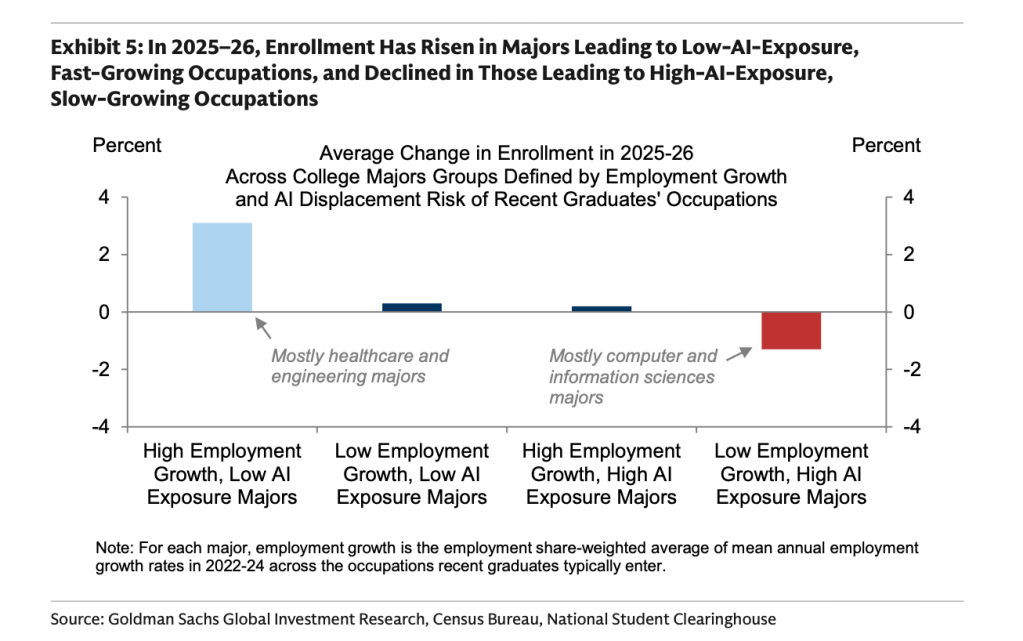
The findings are consistent with academic research showing a relationship between college major choices and shifting labor demand, noted Goldman economist Pierfrancesco Mei, with students moving toward fields tied to jobs that saw stronger recent employment and wage growth. “Historically, such adjustments have taken a few years, reflecting both the time required for students to observe job market outcomes among graduating peers and the difficulty of reversing major choices made in the early college years,” he wrote. “But the current adjustment may be unfolding more quickly, given the heightened salience of AI disruption.”
What Goldman actually measured
Goldman’s analysis is more rigorous than the wave of surveys and anecdotes that have dominated this conversation. Rather than asking students how they feel about AI, researchers mapped where recent graduates from 180+ majors actually ended up working—using American Community Survey data covering 2022–2024–then weighted each occupation’s AI automation risk score across more than 300 job categories. The result is a major-level displacement risk index grounded in real labor market outcomes, not hypothetical exposure.
The rankings are stark. Management and quantitative methods, computer science, and statistics and decision sciences carry the highest displacement risk. Pharmacy, nursing, and education-related fields rank among the safest. Majors feeding into professional and business services—consulting, finance, legal—also sit in elevated-risk territory.
The broader labor market picture supports the anxiety. The unemployment rate for recent college graduates has diverged sharply upward from the broader workforce average since 2024, a pattern that historically only emerges during recessions—but this time, the culprit isn’t a downturn, it’s automation. Goldman estimates AI is now cutting roughly 11,000 U.S. jobs a month, with Gen Z bearing a disproportionate share of the impact.
The shift also tracks with what Fortune documented in May: a widening “experience gap” in which AI is simultaneously eliminating entry-level jobs and the internships that once served as on-ramps to them, leaving new graduates with fewer opportunities to build the credentials employers demand. Goldman’s enrollment data is the behavioral response to that squeeze: students watching their older peers struggle and changing course before they graduate into the same wall.
Students are already responding
A Gallup and Lumina Foundation survey—cited in Goldman’s report—found roughly 42% of bachelor’s degree students have reconsidered their major because of AI, with about half actively factoring AI’s labor market impact into their decisions. That tracks with a separate April survey finding that about 70% of college students now view AI as a threat to their job prospects.
Goldman’s enrollment data suggests those anxieties are translating into action. The question is whether the adjustment is happening fast enough, and in the right directions. Health care and engineering—the two fields gaining the most enrollees—do offer lower AI exposure and stronger job growth. But nursing programs are capacity-constrained, and engineering pipelines take four to five years to translate into workforce supply.
Goldman’s conclusion is, cautiously, hopeful. Consistent with the firm’s prior research on past technological transitions—the rise of personal computing, the internet, the offshoring wave—young workers have historically adapted more flexibly than older ones, reorienting toward labor demand before displacement fully materializes. The greater vulnerability, the report implies, lies with workers already locked into high-risk occupations with limited ability to retrain.
That may be cold comfort for the class of 2026, caught in the transition rather than preparing for it. But for the students now choosing nursing over computer science, Goldman’s data suggests the instinct is rational—even if the labor market they’re training for is still being written in real time.
This story was originally featured on Fortune.com


You May Also Like

Daily Sector Snapshot — 6/16/26
GOP senators ready to pounce on Trump's Iran deal fall guy: analyst

DB Consulting’s Strategic Alliance with Encino Labs Elevates Local Business Search Presence



