
Buy Crypto
Markets
Spot
FuturesBTC
Earn
Event Center
Rewards Hub
More

MEXC Digest #50: How Big Is Anthropic's Slice?

Anthropic is about to test Wall Street's appetite for AI. The Claude maker has filed to list on the Nasdaq as ANT, with reports suggesting it could raise up to $100 billion. But the valuation being discussed has already fallen from $2 trillion to around $1.5 trillion, and investors are now pushing for an even lower price after Thursday's tech sell-off.


The growth is real. Revenue hit roughly $17 billion in the third quarter alone, about 12 times what it was a year earlier. So is the bill: the updated filing lists about $895 billion in multi-year compute and infrastructure commitments.


AI is a five-layer cake, and everyone agrees it's getting bigger. The harder question is who actually gets fed. And the cracks are showing up in the bottom layers first.


The Main Character: Demand Isn't a Return

The Cracks Beneath the Boom

CoreWeave has more AI demand than it can build for. It had $104.2 billion in contracted revenue backlog at the end of June. That didn't stop the stock from falling about 15% on October 14, when yields on its unsecured bonds climbed toward 15%. Investors weren't doubting the customers. They were doubting whether the company could carry the debt it took on to serve them.


Then came the midterms. Democrats won both chambers, and across 10 states, voters delivered a broad rebuke to new data centers, backing restrictions and rejecting proposals to support development in dozens of local votes.


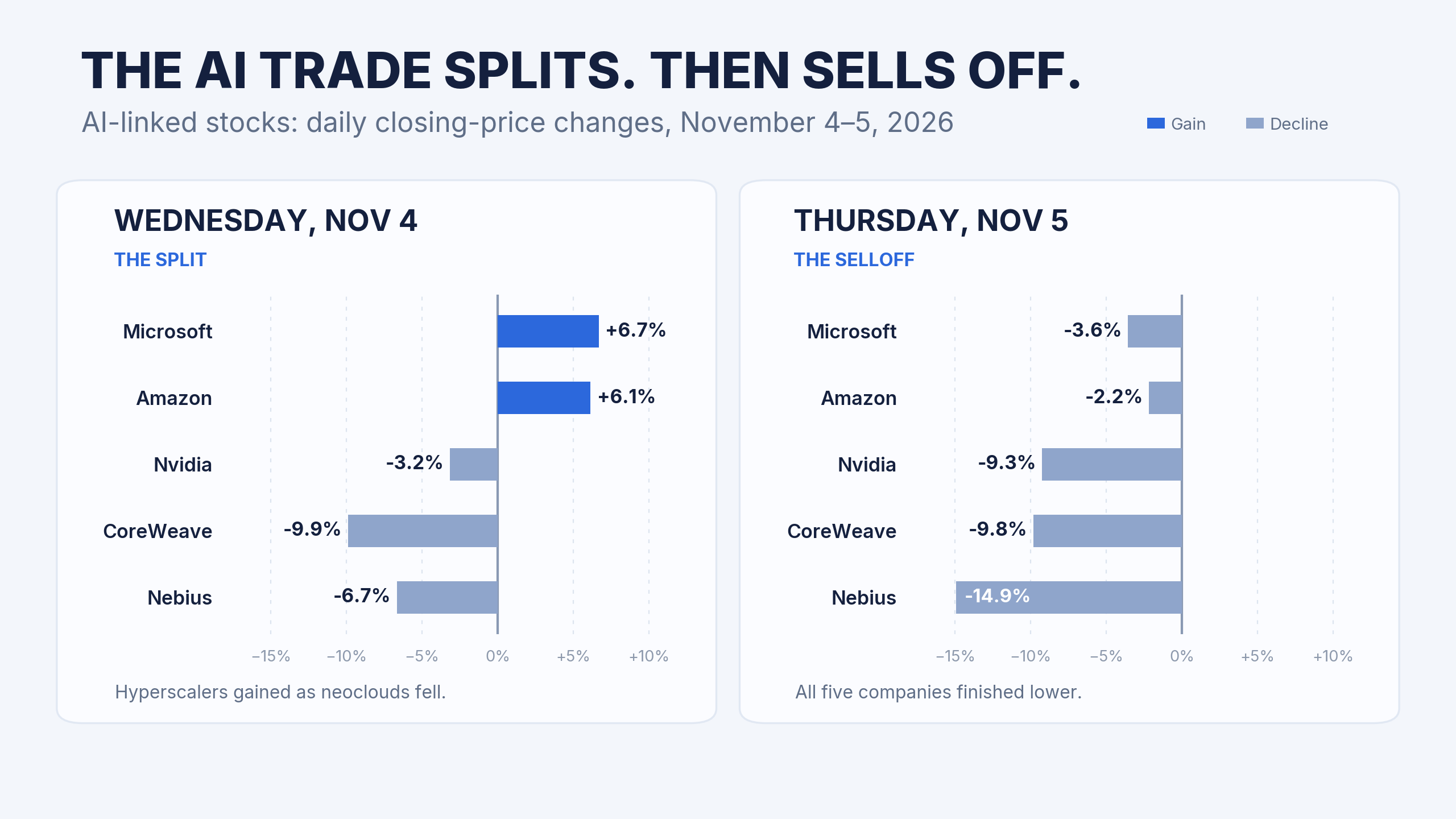
CoreWeave and Nebius fell more than 7% the next day. Nvidia slipped. But Amazon jumped more than 7%, while Microsoft and Alphabet also rallied. The market appeared to favor cash-rich hyperscalers over infrastructure specialists that rely more heavily on external financing. Broader post-election relief played a part too, but that split is the story.


The same election that threatened new data centers may have made existing ones more valuable. AI wasn't trading as one industry anymore.


That lasted a day. On Thursday, the selling hit every layer at once. The Nasdaq fell 5.5%, its worst day since April 2025, and slid into correction territory. Nvidia dropped about 9%, Micron 17%, and even Microsoft, Alphabet and Amazon fell with the rest. When fear spikes, everything with AI in the story gets sold together. As one investor told Reuters, the market is moving "from the promise of AI to the price of AI." The question now is whether it goes back to sorting.


Not All AI Is the Same Trade

We've seen this before. In the late 1990s, companies raced to lay fiber-optic cable under oceans and across continents, betting that internet traffic would explode. It did. Many of the builders didn't survive it. Global Crossing spent around $15 billion on its network and filed for bankruptcy in January 2002, carrying $12.4 billion in debt. In mid-2001, The New York Times reported that only 5% of the fiber in the ground was active. The internet won. The companies that paid for the pipes mostly didn't.


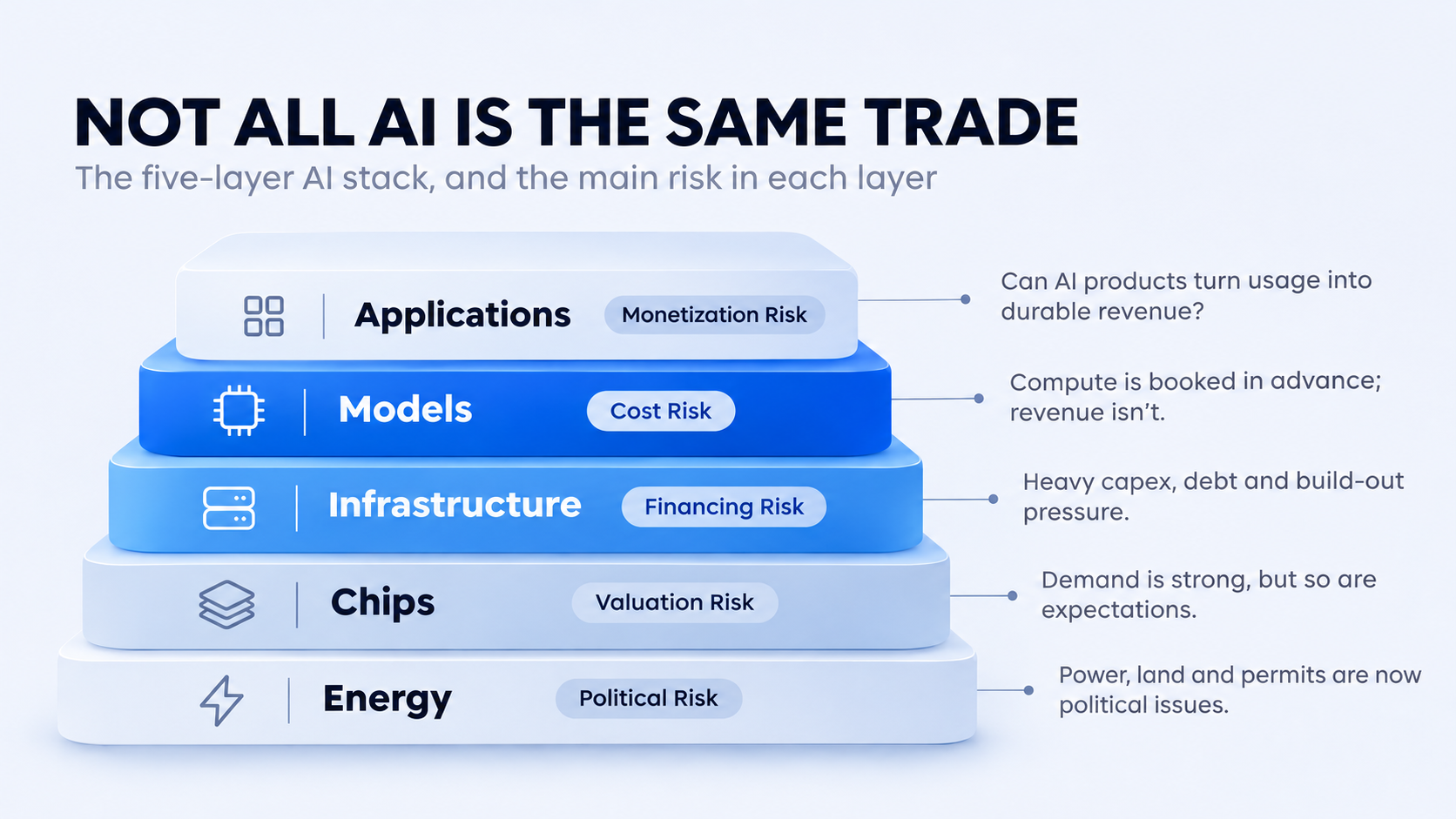
Nvidia CEO Jensen Huang describes AI as a five-layer cake: energy, chips, infrastructure, models and applications. Each layer depends on the ones below it. But they don't carry the same risks:


• Energy carries political risk. Power and land are now ballot issues.

• Infrastructure carries financing risk. CoreWeave is today's version of the fiber builders.

• Models carry cost risk. Compute is booked in advance. Revenue isn't.


And the risks don't always point the same way. Limits on new data centers hurt the companies that still need to build, but they make capacity that already exists scarcer and more valuable. Rising infrastructure costs can be good news for suppliers and bad news for the model makers paying them.


Worth remembering: Huang sells the chips, so every layer growing is good news for him.


Anthropic, Layer by Layer

Those risks look different at every layer. Anthropic sits near the top of the cake, but its biggest costs come from the layers below it.


Demand isn't the issue. Third-quarter revenue reached about $17 billion, up 47% from the quarter before. Returns are harder. Anthropic posted its first operating profit, $974 million, in the second quarter. One quarter later, it was back to a $567 million operating loss.


Two things drove the swing. One sits in the layers below. Anthropic books compute 12 to 18 months ahead. When demand ran past what it had booked, it bought about $5 billion of short-term compute that costs significantly more than its long-term contracts, and compute rose from 48% of revenue to 58%. The other was a $2 billion non-cash charge tied to its employee donation-matching program.


On the company's adjusted measure, which strips out non-cash items like that charge, operating profit actually rose to about $2.5 billion. But the adjusted margin still fell, from 19% to 15%. Demand grew. The return on each dollar of it shrank.


There's a dependence problem too. Anthropic relies on Amazon, Google and Microsoft for compute, and all three build competing models. Its filing says it has asked for more compute than its cloud partners were willing to provide.


The bull case is in the same filing. In the first half, the direct cost of serving paying customers was just $2.4 billion against $16.3 billion of revenue, an implied gross margin of about 85%. That figure leaves out training and free-tier compute, though. Counting all compute and infrastructure, costs took about 55% of first-half revenue. If the expensive compute is a phase, Anthropic's slice gets bigger. If it's a pattern, it doesn't.


Anthropic's IPO won't settle whether AI is a bubble. It will test something more specific: how much investors are willing to pay for the models layer when the infrastructure underneath it is becoming more expensive and politically contested.


Crypto Priced It First

Crypto traders have already put a number on it. Hours after the IPO filing went public on October 26, Anthropic pre-IPO perpetual futures were trading around $1,880 on Binance, implying a valuation near $1.88 trillion, before Wall Street had named a price range.


There's some early evidence. CoinGecko found that pre-IPO perpetual prices came within 4.9% of SpaceX's opening price and 4.6% of CXMT's. But those contracts pointed to where shares would trade once listed, not the IPO price set by underwriters. On SpaceX's first day, perps on Hyperliquid were trading around $162, about 20% above its $135 IPO price. The stock opened lower, at $150, but closed the day near $161. What no market called was what came next: within two months, SpaceX fell about 46% from its peak to a record low near $108, below its IPO price.


So when ANT's price range comes out, the two numbers may not match. The gap shows how much of a first-day move crypto traders are already pricing in. Day one prices the demand. The returns take longer.


[Trade Anthropic Pre-IPO on MEXC]{https://www.mexc.com/futures/ANTHROPIC_USDT}


Quick Hits

A December hike is now the base case. The Fed held at 3.75% to 4.00% on October 28, but two officials voted against, and CME FedWatch odds of a hike on December 9 jumped to about 85%. After this week's sell-off, they have eased to around 67% to 70%. October CPI on November 10 is the last inflation print before that decision. For AI, higher rates mean more expensive debt for everyone still building.


Crypto's new Congress problem, and opportunity. TD Cowen called a Democratic sweep the most negative scenario for crypto, but expects policy focus to shift toward tokenization, perpetual futures and stablecoins: the same rails that priced Anthropic first.


Two layers report next. CoreWeave's Q3 results (November 10) will show whether interest costs are outpacing new capacity. Nvidia follows on November 17, the biggest single read on whether AI spending is still accelerating, landing right around ANT's expected debut.


New & Noteworthy

Anthropic Pre-IPO futures are live on MEXC. Trade ANTHROPIC/USDT and track the market's view of Anthropic's valuation before the opening bell.


Pick your layer. MEXC's newest stock futures line up with the AI cake: First Solar (FSLR) on energy, Lattice Semiconductor (LSCC) on chips, and Fabrinet (FN), MasTec (MTZ) and Johnson Controls (JCI) on infrastructure, from the optical links inside data centers to the power lines and cooling around them. All trade 24/7 with up to 20x leverage.


Translation

“Anthropic hoping to get an investment grade bond rating is simply absurd.”

Jeffrey Gundlach, DoubleLine founder, on X (Nov 2).


The stock market is pricing Anthropic's growth. The bond market is pricing its bills: junior debt tied to its chip financing already carries a speculative-grade rating from Kroll, and pays about 8.5%.


Before You Go

Anthropic Pre-IPO Heatwave. Complete simple missions to earn lucky draw chances to win ANTHROPIC(PRE), an NVIDIA H200 GPU, a 1-year Claude subscription and up to $1,000 in Anthropic Pre-IPO allocations. Running now until the Anthropic Pre-IPO Launchpad begins.


[Join Now]{https://www.mexc.com/announcements/article/anthropic-pre-ipo-heatwave-17827791539239}


Not financial advice. We describe, you decide.

Coin Icon
Sign up now to receive 10,000 USDT in new user rewards

Subscribe to MEXC Digest

Weekly market moves, listings & insights, straight to your inbox.
By subscribing, you agree to receive MEXC newsletters and email updates, and to our Privacy Policy. The content provided is for informational purposes only and does not constitute investment advice.

Join MEXC on Telegram

Get the latest listings, events, and updates in real time, straight from our official Telegram channel.

MEXC Digest #50: How Big Is Anthropic's Slice?

Anthropic is about to test Wall Street's appetite for AI. The Claude maker has filed to list on the Nasdaq as ANT, with reports suggesting it could raise up to $100 billion. But the valuation being discussed has already fallen from $2 trillion to around $1.5 trillion, and investors are now pushing for an even lower price after Thursday's tech sell-off.


The growth is real. Revenue hit roughly $17 billion in the third quarter alone, about 12 times what it was a year earlier. So is the bill: the updated filing lists about $895 billion in multi-year compute and infrastructure commitments.


AI is a five-layer cake, and everyone agrees it's getting bigger. The harder question is who actually gets fed. And the cracks are showing up in the bottom layers first.


The Main Character: Demand Isn't a Return

The Cracks Beneath the Boom

CoreWeave has more AI demand than it can build for. It had $104.2 billion in contracted revenue backlog at the end of June. That didn't stop the stock from falling about 15% on October 14, when yields on its unsecured bonds climbed toward 15%. Investors weren't doubting the customers. They were doubting whether the company could carry the debt it took on to serve them.


Then came the midterms. Democrats won both chambers, and across 10 states, voters delivered a broad rebuke to new data centers, backing restrictions and rejecting proposals to support development in dozens of local votes.


CoreWeave and Nebius fell more than 7% the next day. Nvidia slipped. But Amazon jumped more than 7%, while Microsoft and Alphabet also rallied. The market appeared to favor cash-rich hyperscalers over infrastructure specialists that rely more heavily on external financing. Broader post-election relief played a part too, but that split is the story.


The same election that threatened new data centers may have made existing ones more valuable. AI wasn't trading as one industry anymore.


That lasted a day. On Thursday, the selling hit every layer at once. The Nasdaq fell 5.5%, its worst day since April 2025, and slid into correction territory. Nvidia dropped about 9%, Micron 17%, and even Microsoft, Alphabet and Amazon fell with the rest. When fear spikes, everything with AI in the story gets sold together. As one investor told Reuters, the market is moving "from the promise of AI to the price of AI." The question now is whether it goes back to sorting.


Not All AI Is the Same Trade

We've seen this before. In the late 1990s, companies raced to lay fiber-optic cable under oceans and across continents, betting that internet traffic would explode. It did. Many of the builders didn't survive it. Global Crossing spent around $15 billion on its network and filed for bankruptcy in January 2002, carrying $12.4 billion in debt. In mid-2001, The New York Times reported that only 5% of the fiber in the ground was active. The internet won. The companies that paid for the pipes mostly didn't.


Nvidia CEO Jensen Huang describes AI as a five-layer cake: energy, chips, infrastructure, models and applications. Each layer depends on the ones below it. But they don't carry the same risks:


• Energy carries political risk. Power and land are now ballot issues.

• Infrastructure carries financing risk. CoreWeave is today's version of the fiber builders.

• Models carry cost risk. Compute is booked in advance. Revenue isn't.


And the risks don't always point the same way. Limits on new data centers hurt the companies that still need to build, but they make capacity that already exists scarcer and more valuable. Rising infrastructure costs can be good news for suppliers and bad news for the model makers paying them.


Worth remembering: Huang sells the chips, so every layer growing is good news for him.


Anthropic, Layer by Layer

Those risks look different at every layer. Anthropic sits near the top of the cake, but its biggest costs come from the layers below it.


Demand isn't the issue. Third-quarter revenue reached about $17 billion, up 47% from the quarter before. Returns are harder. Anthropic posted its first operating profit, $974 million, in the second quarter. One quarter later, it was back to a $567 million operating loss.


Two things drove the swing. One sits in the layers below. Anthropic books compute 12 to 18 months ahead. When demand ran past what it had booked, it bought about $5 billion of short-term compute that costs significantly more than its long-term contracts, and compute rose from 48% of revenue to 58%. The other was a $2 billion non-cash charge tied to its employee donation-matching program.


On the company's adjusted measure, which strips out non-cash items like that charge, operating profit actually rose to about $2.5 billion. But the adjusted margin still fell, from 19% to 15%. Demand grew. The return on each dollar of it shrank.


There's a dependence problem too. Anthropic relies on Amazon, Google and Microsoft for compute, and all three build competing models. Its filing says it has asked for more compute than its cloud partners were willing to provide.


The bull case is in the same filing. In the first half, the direct cost of serving paying customers was just $2.4 billion against $16.3 billion of revenue, an implied gross margin of about 85%. That figure leaves out training and free-tier compute, though. Counting all compute and infrastructure, costs took about 55% of first-half revenue. If the expensive compute is a phase, Anthropic's slice gets bigger. If it's a pattern, it doesn't.


Anthropic's IPO won't settle whether AI is a bubble. It will test something more specific: how much investors are willing to pay for the models layer when the infrastructure underneath it is becoming more expensive and politically contested.


Crypto Priced It First

Crypto traders have already put a number on it. Hours after the IPO filing went public on October 26, Anthropic pre-IPO perpetual futures were trading around $1,880 on Binance, implying a valuation near $1.88 trillion, before Wall Street had named a price range.


There's some early evidence. CoinGecko found that pre-IPO perpetual prices came within 4.9% of SpaceX's opening price and 4.6% of CXMT's. But those contracts pointed to where shares would trade once listed, not the IPO price set by underwriters. On SpaceX's first day, perps on Hyperliquid were trading around $162, about 20% above its $135 IPO price. The stock opened lower, at $150, but closed the day near $161. What no market called was what came next: within two months, SpaceX fell about 46% from its peak to a record low near $108, below its IPO price.


So when ANT's price range comes out, the two numbers may not match. The gap shows how much of a first-day move crypto traders are already pricing in. Day one prices the demand. The returns take longer.


[Trade Anthropic Pre-IPO on MEXC]{https://www.mexc.com/futures/ANTHROPIC_USDT}


Quick Hits

A December hike is now the base case. The Fed held at 3.75% to 4.00% on October 28, but two officials voted against, and CME FedWatch odds of a hike on December 9 jumped to about 85%. After this week's sell-off, they have eased to around 67% to 70%. October CPI on November 10 is the last inflation print before that decision. For AI, higher rates mean more expensive debt for everyone still building.


Crypto's new Congress problem, and opportunity. TD Cowen called a Democratic sweep the most negative scenario for crypto, but expects policy focus to shift toward tokenization, perpetual futures and stablecoins: the same rails that priced Anthropic first.


Two layers report next. CoreWeave's Q3 results (November 10) will show whether interest costs are outpacing new capacity. Nvidia follows on November 17, the biggest single read on whether AI spending is still accelerating, landing right around ANT's expected debut.


New & Noteworthy

Anthropic Pre-IPO futures are live on MEXC. Trade ANTHROPIC/USDT and track the market's view of Anthropic's valuation before the opening bell.


Pick your layer. MEXC's newest stock futures line up with the AI cake: First Solar (FSLR) on energy, Lattice Semiconductor (LSCC) on chips, and Fabrinet (FN), MasTec (MTZ) and Johnson Controls (JCI) on infrastructure, from the optical links inside data centers to the power lines and cooling around them. All trade 24/7 with up to 20x leverage.


Translation

“Anthropic hoping to get an investment grade bond rating is simply absurd.”

Jeffrey Gundlach, DoubleLine founder, on X (Nov 2).


The stock market is pricing Anthropic's growth. The bond market is pricing its bills: junior debt tied to its chip financing already carries a speculative-grade rating from Kroll, and pays about 8.5%.


Before You Go

Anthropic Pre-IPO Heatwave. Complete simple missions to earn lucky draw chances to win ANTHROPIC(PRE), an NVIDIA H200 GPU, a 1-year Claude subscription and up to $1,000 in Anthropic Pre-IPO allocations. Running now until the Anthropic Pre-IPO Launchpad begins.


[Join Now]{https://www.mexc.com/announcements/article/anthropic-pre-ipo-heatwave-17827791539239}


Not financial advice. We describe, you decide.

Coin Icon
Sign up now to receive 10,000 USDT in new user rewards

Subscribe to MEXC Digest

Weekly market moves, listings & insights, straight to your inbox.
By subscribing, you agree to receive MEXC newsletters and email updates, and to our Privacy Policy. The content provided is for informational purposes only and does not constitute investment advice.

Join MEXC on Telegram

Get the latest listings, events, and updates in real time, straight from our official Telegram channel.
Stay up-to-date on the latest MEXC listings, delistings, trading events, and product updates. Discover new tokens, Launchpad projects, Earn opportunities, AI-powered tools, and futures trading enhancements on the MEXC platform.Stay up-to-date on the latest MEXC listings, delistings, trading events, and product updates. Discover new tokens, Launchpad projects, Earn opportunities, AI-powered tools, and futures trading enhancements on the MEXC platform.