Tokenized Commodities Move Beyond Gold Into Lending
Overview
Tokenized commodities are moving beyond the first-generation model of putting passive exposure to physical gold on a blockchain. Gold remains the most mature segment, but new products are increasingly trying to turn commodity-backed tokens into usable financial instruments through lending, collateral and secondary-market liquidity. At the same time, tokenized silver is expanding across blockchain ecosystems, while physical WTI oil and upstream energy financing are beginning to develop their own onchain structures.
The shift matters because these products introduce very different risk models. A token such as PAXG primarily converts allocated bullion into a transferable digital asset: each token represents one fine troy ounce of London Good Delivery gold held in segregated custody. By contrast, yield-bearing structures such as Theo's thGOLD add secured lending to the chain of economic exposure. The yield comes from borrower credit, not from gold itself.
Oil makes the problem even more complex. Energy Substantiation's WTIC represents exposure to one barrel of physical WTI through independently held energy receipts, with onchain secondary trading available continuously while primary minting and redemption operate around U.S. market days. Tokenized commodities are therefore evolving from simple digital wrappers into financing infrastructure—but greater utility also adds credit, liquidity, legal and physical-delivery risk.
Key Takeaways
- Tokenized gold is expanding from passive ownership toward lending and collateral use.
- Yield-bearing gold adds borrower and recovery risk; gold itself does not generate yield.
- Tokenized silver is broadening commodity collateral beyond gold.
- Physical-backed oil tokens connect 24/7 digital trading with much slower physical-market infrastructure.
- The next RWA phase may be measured by financial utility rather than the number of assets tokenized.
Why Are Tokenized Commodities Moving Beyond Gold?
Gold was the natural starting point for commodity tokenization because much of the infrastructure already existed. Institutional bullion is standardized, benchmark prices are widely available, vault custody is mature and London Good Delivery bars can be identified and audited. These characteristics make it comparatively straightforward to connect a blockchain token with a specific pool of physical assets.
PAX Gold illustrates the basic model. Paxos states that each PAXG represents one fine troy ounce of London Good Delivery gold held in LBMA-accredited London vaults on a segregated basis for token holders. The token can move through public blockchains and secondary markets even though the bullion remains inside conventional custody.
That solved the first tokenization problem: How can ownership of a difficult-to-move physical asset become digitally transferable?
The market is now moving toward a harder question: What can that digital commodity actually do once it is onchain?
Silver products such as Matrixdock's XAGm are being positioned for trading, collateral and lending rather than simple holding. Oil-token structures are exploring direct inventory-backed exposure and working-capital financing. Gold products are beginning to introduce lending income. In other words, the competitive frontier is shifting from representation toward financial utility.
How Does Tokenized Gold Lending Generate Yield?
Gold does not naturally produce cash flow. A bullion bar sitting inside a vault generates neither coupons nor dividends. If a tokenized gold product advertises yield, that return must come from an additional economic activity layered on top of the metal.
Theo's thGOLD provides a useful example. The product is built around the MG999 On-Chain Gold Fund, a tokenized secured private-credit structure managed by FundBridge Capital and using Libeara infrastructure. The underlying strategy lends against gold inventory held by commercial gold businesses, including Mustafa Gold.
The economic chain is broadly:
gold exposure
→ secured gold-related lending
→ commercial borrower receives financing
→ borrower pays interest
→ lending income supports investor yield.
The critical point is the yield comes from credit exposure, not from gold itself.
This changes the risk profile substantially. A passive allocated-gold token is primarily exposed to bullion prices, custody, legal ownership and redemption mechanics. A lending structure adds borrower default, collateral enforcement, recovery timing and potentially liquidity mismatch.
Calling this simply “yield-bearing gold” can therefore hide the financial mechanism producing the yield. A more precise description is productive gold exposure financed through secured credit.
Gold, Silver and Oil Need Different Tokenization Models
Tokenized commodities are often discussed as one RWA category, but physical assets do not become economically identical merely because all of them are represented by ERC-20 tokens.
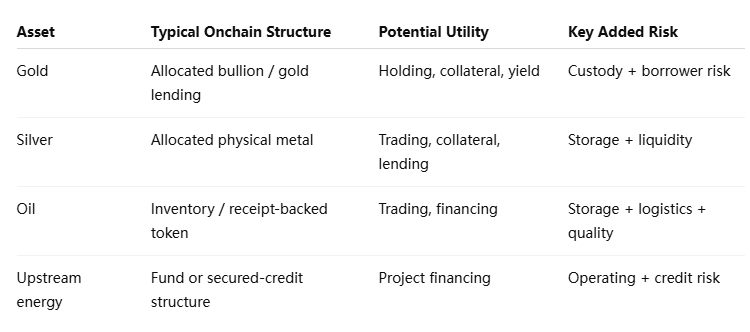
Gold is relatively fungible once it meets recognized bullion standards. Silver has similar properties but is bulkier relative to its value, which can increase storage and logistics costs. Matrixdock's XAGm is backed by fully allocated physical silver and has expanded from Ethereum to Sui with the explicit objective of enabling trading, lending and collateralized applications.
Oil is considerably more complicated.
One barrel of crude is not simply interchangeable with every other barrel. Grade, location, storage, pipeline access, delivery terms and inventory verification all affect economic value. Even when a token references WTI, the physical system underneath it remains geographically and operationally constrained.
Energy Substantiation's WTIC addresses this by using Volumetric Energy Receipts held with an independent custodian. Each token represents exposure to one barrel of physical WTI inventory, while minting and redemption are connected to a daily reference-price process.
That architecture can digitize ownership exposure, but it cannot digitize a pipeline, eliminate storage costs or make physical delivery instantaneous.
Does Tokenization Make Commodities More Liquid?
Potentially, but digital liquidity and physical liquidity are separate layers.
A commodity token can trade continuously onchain even when the primary physical or benchmark market is operating on a different schedule. This improves transferability and gives investors additional opportunities to enter or exit positions, but it does not guarantee that deep physical-market liquidity exists at every moment.
WTIC illustrates the distinction clearly. Its tokens can trade in secondary markets 24/7/365, while primary minting and redemption operate on U.S. business days using the relevant reference price. Cash settlement after redemption can also take additional business days.
A Saturday buyer may therefore be able to trade the token even though the underlying physical market is not producing the same level of real-time price discovery available during normal U.S. trading hours.
This creates a potential basis risk:
- Onchain token liquidity can remain active continuously.
- Benchmark liquidity can vary according to market hours.
- Physical redemption liquidity is constrained by operational processes.
- Actual commodity delivery can involve significant additional time and cost.
Tokenization can compress settlement and transfer friction. It cannot make the physical commodity itself behave like a native digital asset.
For a broader view of this shift, see the MEXC On-Chain Daily Report: Tokenized Commodities Expand Into Gold Lending and Oil Markets.
Why Commodity Lending Changes the Risk Model
The biggest structural change occurs when tokenized commodities stop being passive representations and start entering credit markets.
Consider a simple gold token. If the issuer actually holds allocated bullion 1:1, the investor's analysis centers on whether that gold exists, whether it is properly segregated, whether ownership claims are enforceable and whether redemption works as described.
Now lend the underlying economic exposure to a commercial borrower.
The analysis becomes broader. How strong is the borrower? What collateral supports the loan? Who can seize and sell it after a default? How long would recovery take? What happens if the borrower fails during a period when gold prices are moving rapidly?
The resulting asset may become more productive, but its risk chain becomes longer.
This matters for the broader RWA narrative because “yield” can sometimes be presented as a free improvement to tokenized assets. It is not. Lending converts a passive commodity position into part of a credit system.
The same principle applies to energy financing. Tokenized oil inventory can help suppliers unlock working capital, while tokenized upstream funds can finance projects that would otherwise depend on private credit or specialized commodity lenders. Those structures may broaden investor access, but the token cannot remove project execution, borrower or commodity-market risk.
Can Tokenized Oil Really Trade Like Crypto?
At the digital layer, partly. At the physical layer, no.
A token such as WTIC can be transferred through Ethereum and traded outside conventional market hours. That can make oil exposure more accessible to blockchain-native investors and avoid some of the rollover mechanics associated with futures-based exposure.
But the underlying commodity still follows physical-market rules. Oil needs to exist in inventory, quality and quantity need to be substantiated, and physical redemption involves real-world delivery procedures. Energy Substantiation's terms also distinguish secondary token trading from primary minting and redemption.
That difference is crucial because commodity tokenization is ultimately an exercise in connecting two systems with fundamentally different speeds. Ethereum can transfer a token within minutes; oil infrastructure operates through tanks, terminals, pipelines, custody records and delivery contracts.
The strongest products will therefore need reliable mechanisms for keeping those two states synchronized.
What Are the Main Risks and Limitations?
Commodity tokenization does not replace traditional commodity risk. It adds a digital layer on top of it.
The most important risks include:
- Custody risk: the physical commodity must exist, remain segregated where required and be independently verifiable.
- Credit risk: lending structures depend on borrowers repaying or collateral being recoverable.
- Liquidity mismatch: a token may trade continuously while physical redemption operates only during specific windows.
- Legal-claim risk: different products may represent direct ownership, beneficial interests, fund shares or contractual exposure.
- Logistics risk: oil and industrial commodities require storage, transportation and quality verification.
- Oracle and benchmark risk: the token may trade continuously while the reference commodity market is closed or thin.
- Smart-contract risk: digital transferability introduces technical vulnerabilities absent from direct physical ownership.
These risks differ substantially by product, which is why “1:1 backed” should never be treated as a complete description of an RWA token. Investors still need to ask 1:1 backed by what, held where, under whose legal control and redeemable under which conditions?
MEXC View: The Next RWA Phase Is About Utility, Not Token Count
The first generation of RWA tokenization was largely about proving that traditional assets could be represented on blockchains. The next phase is likely to be judged by whether those assets can function as useful financial building blocks.
Gold lending, silver collateral and oil-backed financing all point in that direction. A tokenized commodity becomes more economically relevant when it can support credit, liquidity and treasury management rather than simply mirror an offchain price.
That evolution also means RWA analysis must become more sophisticated. Higher utility generally introduces additional counterparties and dependencies. A productive tokenized commodity may create more financial value than a passive wrapper, but it can also move farther away from the simplicity of directly holding the underlying asset.
The metrics worth watching are therefore not only tokenized commodity market capitalization, but lending utilization, collateral usage, redemption performance, secondary liquidity and loss experience through stressed markets.
Tokenized Commodities Are Becoming Financing Instruments
Tokenized commodities are moving into a second phase. The first phase proved that physical gold and other assets could be represented as transferable blockchain tokens. Products such as PAXG demonstrated how allocated bullion could gain digital portability without changing the physical asset stored in custody.
The newer market is attempting something more ambitious. Gold can support secured lending and yield strategies, tokenized silver can enter collateral and DeFi markets, and physical-backed oil can connect inventory ownership with continuously tradable digital instruments. Upstream energy tokenization extends the concept further into project and working-capital financing.
That expansion increases utility, but it also changes the risk equation. Productive RWA structures add credit, legal, liquidity and operational dependencies that a passive commodity wrapper may not contain. A 24/7 token market also does not eliminate physical-market hours, logistics or redemption constraints.
The long-term significance of tokenized commodities will therefore depend less on how many metals or energy products receive tokens and more on whether those tokens can deliver useful financial functions without obscuring the risks beneath them.
If the market succeeds, commodity tokenization may evolve from digitizing ownership to digitizing commodity finance itself. That is a much larger opportunity—but also a materially more complex one.
Sources
MEXC internal link used:
https://www.mexc.com/learn/article/mexc-on-chain-daily-report-tokenized-commodities-expand-into-gold-lending-and-oil-markets
Paxos PAX Gold documentation:
https://docs.paxos.com/guides/stablecoin/paxg
Theo thGOLD announcement:
https://www.prnewswire.com/news-releases/theo-brings-yield-bearing-gold-onchain-via-regulated-tokenized-fund-structure-302671228.html
Matrixdock XAGm on Sui:
https://www.matrixdock.com/blog/announcements/matrixdock-expands-tokenized-silver-xagm-to-sui-enabling-institutional-grade
Matrixdock XAGm launch:
https://www.matrixdock.com/blog/announcements/matrixdock-launches-xagm-bringing-lbma-good-delivery-silver-on-chain
Energy Substantiation WTIC terms:
https://www.energysubstantiation.com/wtic-terms-and-conditions
Energy Substantiation WTIC overview:
https://www.energysubstantiation.com/
想最快获取 MEXC 最新资讯?立即加入我们的官方电报群!
MEXC 平台:下载 App | 零手续费交易 | 立即购买 USDT 加入 MEXC 社群:X (Twitter) | Telegram | Discord
获取资讯:新手学院 | 服务条款 | MEXC Blog | MEXC News
账户验证:了解 KYC | 如何进行 KYC
风险提示:本文内容仅供参考,不构成任何投资建议。数字货币市场波动较大,请根据自身情况审慎决策。
אולי תאהב גם
Which Cryptocurrencies Have Corporate Treasuries in 2026?
How Do U.S. Treasury Yields Affect Crypto Prices?