

Binance Inflow Data Explains The Mechanics Behind Ethereum Weakness – Details
Ethereum has lost the $2,150 level as selling pressure reasserts itself, and the market faces a wave of uncertainty that has erased weeks of cautious recovery. The decline has a specific origin that CryptoQuant data has now made visible — and understanding it changes how the current weakness should be interpreted and what it might take to reverse it.
The Exchange Netflow data for Binance tells the story of what was building throughout the first half of May before the price broke lower. Across multiple sessions, Binance continuously recorded positive netflow readings — large amounts of ETH being deposited onto the exchange in a sustained, repeated pattern rather than a single isolated event. Each positive reading represents more coins moving from cold storage or external wallets onto the venue where they can be most immediately and efficiently sold.
The supply that accumulated on Binance during those sessions did not disappear. It waited. Exchange deposits represent potential selling pressure rather than confirmed selling — coins positioned at the point of easiest exit, ready to move into the market when the holder decides the moment is right, or when a stop-loss level triggers the decision for them.
What the CryptoQuant data suggests is that the supply arrived before the selling — and that Ethereum losing $2,150 may be the market finally beginning to process the inventory that had been building on Binance throughout the first two weeks of May.
The Supply Arrived, The Price Followed It Down: Now the Market Needs Time
The CryptoQuant analysis connects the inflow pattern directly to the price response that followed it. The sequence is not ambiguous. Large ETH deposits accumulated on Binance throughout the first half of May. The price, which had been holding near $2,400, reacted negatively in the period immediately following those inflows — declining approximately $300 to reach the current level around $2,100.
The supply that arrived on the exchange found insufficient demand to absorb it without a price concession, and the market adjusted downward until sellers and buyers reached a temporary equilibrium.

The constructive element the analysis identifies is the most recent sessions. ETH deposit pressure to Binance has cooled over the past few days — the sustained pattern of large positive netflow readings that characterized the first half of May has not continued at the same pace. The immediate supply pipeline that drove the decline appears to have eased.
But easing is not the same as being resolved. The analysis is precise about what the cooling deposit pressure actually means for the forward outlook. The supply that arrived during the inflow period does not disappear simply because new deposits have slowed. It remains on the exchange, available for sale, and the market requires genuine accumulation activity — buyers willing to absorb that inventory at current levels — before Ethereum can find the new equilibrium point from which a sustainable recovery becomes possible.
The current $2,100 level is where the market is testing whether that accumulation is present. The deposit data says the selling pressure has eased. The price will confirm whether the demand has arrived to meet it.
Ethereum Struggles Below Major Weekly Resistance As Long-Term Trend Weakens
Ethereum is trading near $2,110 on the weekly chart after failing to sustain momentum above the critical $2,300-$2,450 region, an area that now acts as the market’s primary resistance zone. The structure reflects a market that remains trapped between long-term recovery hopes and persistent distribution pressure from larger participants.
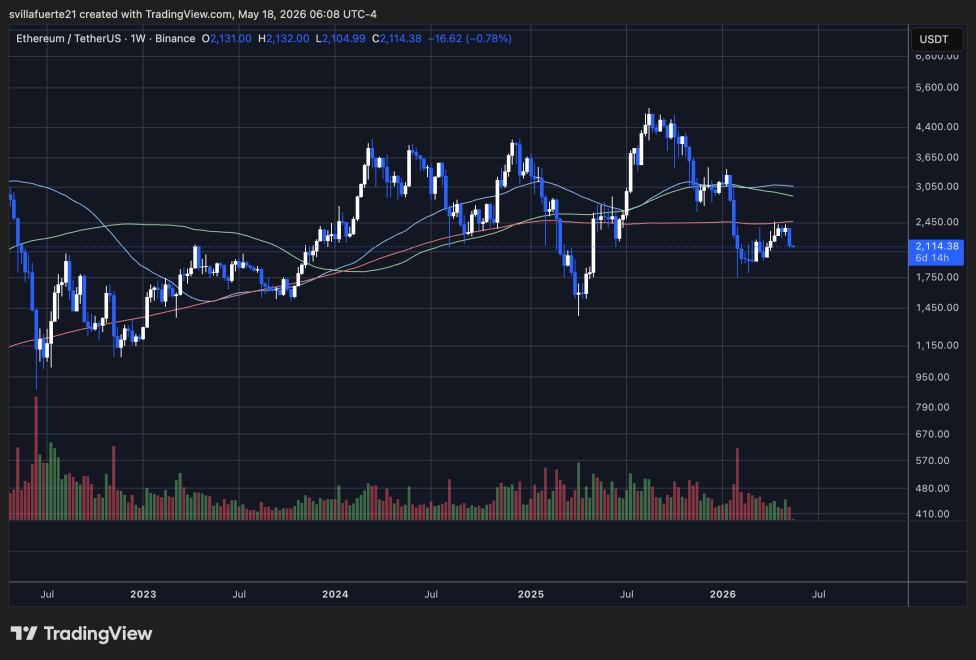
The chart shows that Ethereum lost its bullish momentum after sharply rejecting the $4,000-$4,500 range in late 2025. Since then, Ethereum has entered a prolonged corrective structure characterized by lower highs and repeated failures to reclaim major moving averages. The recent rebound from the March lows briefly improved sentiment, but the recovery stalled once the price approached the weekly 50 and 100 moving averages near the $2,400-$3,000 region.
Importantly, Ethereum is now trading below the weekly 200 moving average again, a signal that the broader market structure has weakened considerably compared to previous recovery phases. Volume during the latest decline has also remained elevated relative to recent weeks, suggesting that supply pressure is still active rather than fully exhausted.
The $2,000-$2,100 zone now becomes a decisive support region for bulls. Losing this level could expose Ethereum to another move toward the broader demand area between $1,700 and $1,800, where buyers aggressively defended the price earlier this year after the capitulation event.
Featured image from ChatGPT, chart from TradingView.com


추천 콘텐츠

Coinbase: US Crypto Bill Advances Amid Stablecoin Debate

Bitcoin treasury sell-off accelerates as Riot, Bhutan, and public companies exit positions

EU Crypto Users Face Possible Exchange Cutoffs as MiCA Deadline Nears


인기 뉴스
더보기
