

[DECODED] Why AI is no match for human creativity
I watched two horror films in the cinema over the weekend: Obsession and Backrooms. I’ve been curious about them because both films have reported grossing way beyond their production budgets, and I’ve been seeing positive reviews of both films online.
More than their commercial and critical success, I found that the two films share other similarities. Both are original horror movies, and both were directed by Gen Zs who have openly rejected the use of AI in filmmaking.
![[DECODED] Why AI is no match for human creativity](https://img.youtube.com/vi/gMC8kkwbIQQ/hqdefault.jpg)
Obsession’s 26-year-old director Curry Barker said that he doesn’t think AI will be replacing creatives like him soon, but it would come to a point when human-made work is pitted against AI-generated content, and the deciding factor would ultimately be audience demand. “I’m scared of AI for sure,” Barker said.
Meanwhile, 20-year-old Backrooms director Kane Parsons took a harder line against AI. He was quoted as saying, “Creatively, I get no enjoyment from using those tools. It defeats the purpose entirely for me.”
![[DECODED] Why AI is no match for human creativity](https://img.youtube.com/vi/0HjdiohVOik/hqdefault.jpg)
It’s not hard to understand why these young directors react this way. After all, they are both part of the generation that grew up online. In The Nerve’s previous industry report decoding Gen Zs, we found that Gen Zs prefer authenticity over virality, and they tend to put their personal values, goals, and boundaries above other things.
DOWNLOAD: Decoding Gen Z: Digital Habits, Money Moves, and Relationships
Gen Z creatives like Barker and Parsons also grew up with social media platforms such as YouTube as their creative playground. They are used to creating and putting out original content with minimal resources and sheer creativity, hoping that it would resonate with an audience that cares about their authenticity and artistry.
But there are several other factors why many creative professionals across generations are critical of AI. Creators from all over the world have called for proper licensing agreements and full transparency from AI developers, saying that the rapid and unregulated AI development has so far misused copyrighted works to train AI models without permission and proper compensation.
“Creators are not asking for AI to disappear — they are asking for a system that respects their rights, compensates them fairly, and ensures human creativity remains at the heart of art, music, literature, and beyond,” the Copyright Alliance said in a statement in 2025.
Swifties
In our latest Decoded story, Christa Escudero and Aidan Bernales also explored the wonders of human creativity through a data-driven analysis of Taylor Swift’s songwriting. Swift was officially inducted into the Songwriters Hall of Fame last week, making her the youngest woman to achieve this feat.
READ: [DECODED] The lyrics of a showgirl: Breaking down Taylor Swift’s 20-year songwriting
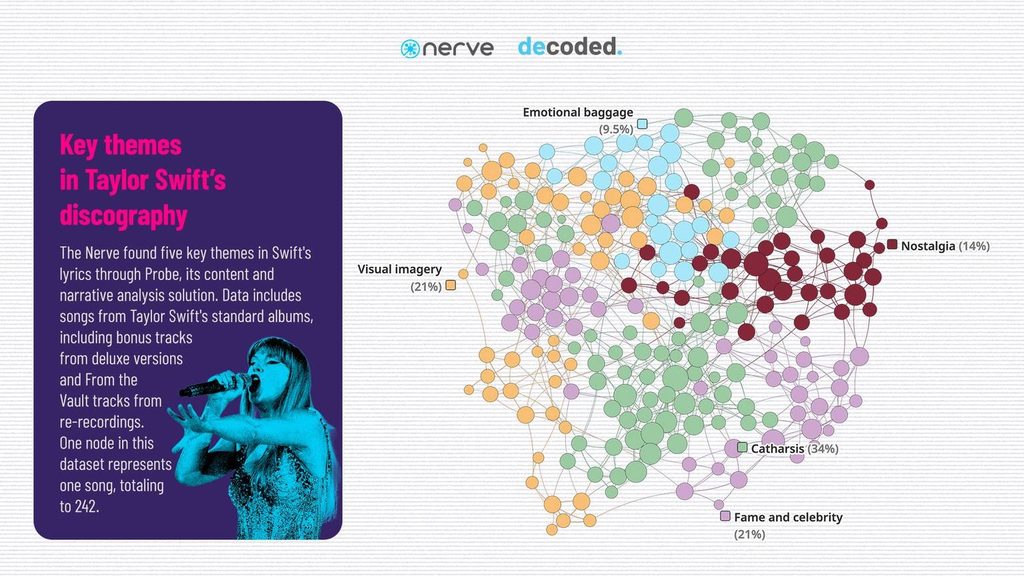
Using Probe, The Nerve’s proprietary content and narrative analysis solution, Christa and Aidan broke down Swift’s 20-year journey as reflected in her lyrics. They looked at her discography, consisting of 12 standard albums, bonus tracks from deluxe album versions, and From the Vault tracks from album re-recordings.
The analysis of her 242 songs showed five key themes that tie directly to Swift’s personal experiences, struggles, and triumphs over the years. Whether you’re a Swiftie or not, Christa and Aidan’s piece offers a fascinating look at what two decades of original and deeply personal songwriting look like — one that has made an impact not only on pop culture but also on the economy and even in the academe.
This is the magic of human creativity that AI can never replicate. While AI is very good at identifying patterns, such as how we utilized it in analyzing Swift’s lyrics, nothing it outputs is genuinely original. It’s all inferred from countless human creations that already exist. So even though AI is truly helpful in processing massive datasets in a faster and more efficient way, it will always take human ingenuity to make sense of any of it, and — more importantly — to make it matter.
Obsession, Backrooms, and Swift’s lyrics all showcase each creator’s lived experience, emotional depth, and instinct, making their creative works genuinely resonate. AI has no capacity for such things. – Rappler.com


추천 콘텐츠

Pi Network Smart Contracts Could Transform It Into a Full Web3 Powerhouse

World Cup Lifts Prediction Market Weekly Spot Volume to $8.7 Billion Record
The Louvre’s latest exhibit: A growing repair bill



