

Republican Lawmaker Pushes Prediction Markets Insider Trading Ban
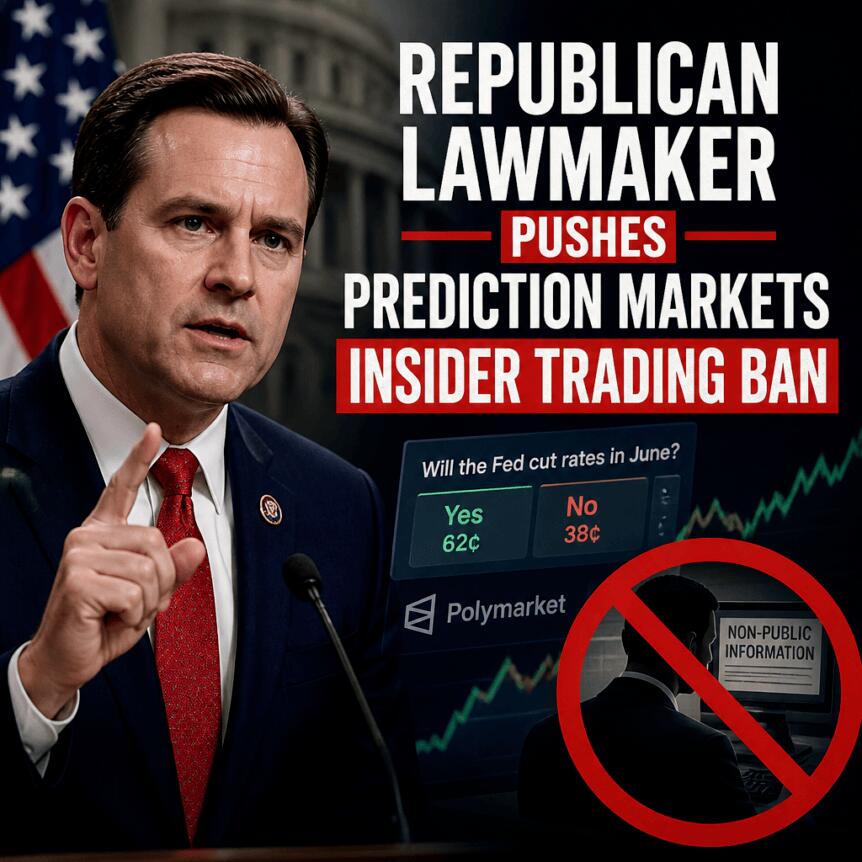
U.S. Representative Bryan Steil, who chairs the House subcommittee on digital assets, has introduced a bill aimed at curbing how elected officials participate in politically focused prediction market contracts. The proposal—called the Stop Lawmakers from Predicting Act—would restrict certain officeholders, along with their spouses and dependent children, from placing bets tied to specific government policies or political outcomes on platforms such as Kalshi and Polymarket.
Steil’s announcement, made in a Thursday notice, outlines a financial penalty structure for violations: officials who fall under the ban would have to pay either a $2,000 fee or an amount equal to 10% of the value of the prohibited bets placed on participating prediction market platforms.
Key takeaways
- Steil’s bill targets prediction market wagers tied to “government policies,” “government actions,” and broader political outcomes.
- The restriction applies to members of Congress plus their spouses and dependent children, but does not broadly prohibit all event betting.
- If enacted, the law would impose penalties ranging from a $2,000 fee to 10% of the bet value.
- The legislation does not extend to White House officials, which may keep political questions around insider influence in the spotlight.
- The bill lands amid ongoing federal-versus-state regulatory conflict over prediction markets led by the CFTC.
What the Stop Lawmakers from Predicting Act would bar
According to Steil’s notice, the bill is designed to prevent public officials from profiting from policy questions and political results. It does not attempt to shut down prediction markets entirely, and it does not frame the issue as a ban on lawmakers participating in all types of event contracts.
Instead, the proposed law focuses on the content of the wager: it would bar bets aligned with specific government policies, government actions, and “political outcomes.” In practical terms, that framing appears intended to cover politically sensitive contracts, which could include contracts reflecting election results or other outcomes closely tied to governmental decisions.
The bill also specifies timing. If passed by Congress and signed into law by the president, it would take effect 180 days after enactment.
Why lawmakers are targeting politically aligned event contracts
Steil’s proposal is the latest attempt to address concerns that lawmakers—or others with privileged access to information—could benefit from prediction markets before key developments become public. The push has gained public attention after widely reported claims surrounding political event betting.
Earlier coverage highlighted a case involving a U.S. soldier who allegedly placed more than $400,000 in bets related to the removal of Venezuela’s President Nicolás Maduro on Polymarket. Maduro was reported to have been ousted by U.S. forces in January, according to earlier reporting from Cointelegraph. The incident became a focal point for broader questions about whether market participants may exploit privileged knowledge connected to government activity.
While Steil’s bill is not described as a direct response to that single case, it reflects a similar policy concern: when contracts are tied to governmental actions or political results, the potential for unfair advantage becomes a central political issue.
Limits of the bill—and the unanswered White House question
Although the bill is aimed at members of Congress, it does not specifically place the same restrictions on White House officials. That omission has practical relevance because prediction markets regulation and compliance debates often extend beyond Capitol Hill.
Cointelegraph previously reported that lawmakers have moved to address insider trading and related concerns in prediction markets, but Steil’s legislation—based on the description in the notice—does not explicitly cover White House figures, including President Donald Trump and Vice President JD Vance. Earlier reporting also noted that Donald Trump Jr. has served as a strategic adviser to Kalshi, while another adviser role was reported in connection with Polymarket.
Additionally, Cointelegraph noted Polymarket’s sponsorship of the UFC Freedom 250 event at the White House on Sunday. While those details do not by themselves establish any wrongdoing, they help explain why critics may view the bill’s scope as incomplete—particularly if the objective is to reduce perceived conflicts of interest across the political ecosystem.
Cointelegraph reported that it reached out to Steil’s office for comment but did not receive an immediate response.
Prediction markets regulation is already a federal-state battleground
Steil’s bill enters a landscape where federal regulators have been asserting strong authority over prediction market activity. Under the Trump administration, the Commodity Futures Trading Commission (CFTC) and its chair, Michael Selig, have maintained that the agency has “exclusive jurisdiction” over regulation and enforcement related to prediction markets.
According to Cointelegraph, the CFTC has already filed multiple lawsuits against state-level authorities that attempted to restrict or ban prediction market platforms. The agency’s legal position, as described in earlier coverage, is that event contracts can be treated as “swaps” under the Commodity Exchange Act rather than as traditional bets subject to different regulatory frameworks.
Cointelegraph also reported that legal disputes over prediction markets could ultimately reach the Supreme Court, referencing the potential for continued appeals related to Kalshi. That federal litigation matters to investors and platform operators because it can determine whether prediction markets can expand nationally without being met by a patchwork of conflicting state rules.
In that context, Steil’s bill may function as a separate track—targeting conflicts of interest involving federal officeholders—while the broader question of regulatory classification and jurisdiction remains tied to ongoing court fights.
For market participants, the key next step is to watch whether the Stop Lawmakers from Predicting Act gains traction in Congress and how its political scope is debated—especially given the law’s apparent focus on members of Congress rather than the broader executive branch. Meanwhile, developments in the CFTC’s court strategy could still reshape the operational rules for prediction markets regardless of any new federal conflict-of-interest legislation.
This article was originally published as Republican Lawmaker Pushes Prediction Markets Insider Trading Ban on Crypto Breaking News – your trusted source for crypto news, Bitcoin news, and blockchain updates.


추천 콘텐츠

Solana (SOL), Dogecoin (DOGE), or Little Pepe (LILPEPE): Here’s Which Coin May Deliver $10,000 in Q4 if You Invest $1,000 Right Now

How to Avoid Crypto Scams: A Complete Guide for Beginners

If You’re 50+ and Tired of Watching Tech Boom Without You, Read This


인기 뉴스
더보기
