

Mastercard Expands Into XRP Ledger for Always-On Settlement
Mastercard is expanding its blockchain strategy by adding support for XRP Ledger-based settlement through Ripple’s RLUSD stablecoin. The payments giant announced plans to introduce intraday, weekend and holiday settlement options across its global network. The initiative will support regulated stablecoins and enable businesses to move funds beyond traditional banking hours.
The announcement marks a significant milestone for the XRP ecosystem. It also reinforces growing institutional interest in blockchain-powered payment infrastructure. According to Ripple, Mastercard’s support for RLUSD and XRP Ledger reflects increasing demand for trusted digital assets and always-on settlement networks. The latest XRP Ripple latest news arrives as institutions continue searching for faster and more efficient ways to move money globally.
XRP Ledger Chosen for Faster Settlement
Under the new framework, Mastercard will support settlement using Ripple’s RLUSD alongside other regulated stablecoins. These include USDC, PYUSD, USDG, USDP and SoFiUSD. The settlement infrastructure will operate across several blockchain networks, including Ethereum, Solana, Polygon, Base, Arbitrum and XRPL.
According to the XRP Ledger Foundation, Mastercard plans to use XRPL for time sensitive payment flows and continuous settlement operations. The move leverages XRP Ledger’s low transaction costs, near-instant finality and more than 14 years of operational history. For global payment providers, speed and reliability remain critical factors. XRPL’s infrastructure is designed to address both.
Mastercard Sees Stablecoins as the Next Phase
Mastercard executives believe stablecoins are moving beyond experimentation and into practical financial use. “The next phase of stablecoin adoption is about real-world utility, especially in settlement, where timing and liquidity matter most,” said Raj Dhamodharan, Executive Vice President of Blockchain and Digital Assets at Mastercard. He added: “By introducing intraday and weekend settlement options across our global network, we’re expanding how partners manage liquidity and operate in an always-on digital economy.”
Mastercard expects early support from Cross River, Lead Bank, CBW Bank, ARQ and Nuvei. Additional partners are expected to join through 2026. This development represents another major example of traditional finance integrating blockchain infrastructure into existing payment systems.
XRP Network Activity Continues to Grow
The Mastercard expansion comes during a period of rising activity on XRP Ledger. According to Messari, average daily transactions on XRPL increased 35.3% quarter-over-quarter to 2.48 million transactions in Q1 2026. Messari stated that Mastercard’s expansion could further accelerate adoption across the network.
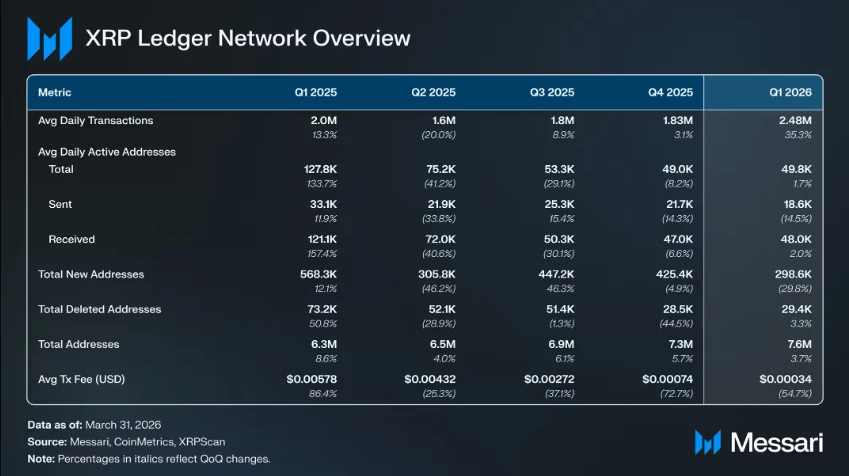
XRP Ledger Network Overview Q1 2025 – Q1 2026. Source: Messari
At the same time, institutional interest in XRP products continues to grow. Charles Schwab recently launched 24/7 XRP futures trading. While Grayscale executives suggested future XRP ETFs could absorb up to 6% of circulating supply. These developments continue to strengthen the narrative surrounding XRP and institutional adoption.
How This Affects Investors and Developers
For investors, the partnership provides another real-world use case for XRP Ledger infrastructure. Large financial institutions adopting XRPL may improve long term confidence in the network. Growing payment activity could also increase demand for services built around the ecosystem.
For developers, Mastercard’s integration validates blockchain technology for enterprise scale settlement. More institutions may now explore building applications, payment solutions and financial products connected to XRPL. The expansion could create new opportunities across tokenization, payments, liquidity management and stablecoin infrastructure.
A Major Win for XRP Ledger
The latest XRP Ripple latest news shows how traditional finance and blockchain networks are becoming increasingly connected. By supporting RLUSD and expands settlement capabilities on XRPL. Mastercard is helping push blockchain technology further into mainstream finance.
As institutions continue embracing digital assets, the role of XRP in global payments could become increasingly important. Combined with growing transaction activity and expanding institutional products. This development represents another significant chapter in the evolution of blockchain based settlement systems.
The post Mastercard Expands Into XRP Ledger for Always-On Settlement appeared first on Coinfomania.


You May Also Like
BDUSD Adds Major Utility Layer to BlockDAG – Is this the 100x Buy Sign SHIB & WLD Holders Have been Waiting For?

Best Mobile User Retention Tools in 2026

Maynilad to cut water bills in Q3 on peso strength



