

Former Tesla board member issues candid message on SpaceX stock
Venture capitalist Steve Westly says SpaceX is "three moonshots in one company" and the math only works if most of them pay off.
On June 12, SpaceX (SPCX) just pulled off the biggest initial public offering in stock market history.
- The company raised $75 billion, priced shares at $135 each, and debuted on the Nasdaq with a bang, jumping 19% on its first day of trading, according to CNBC.
- By the closing bell, shares had settled around $161. That put the company's market cap at roughly $2.1 trillion.
- The pop continued after hours, lifting the valuation closer to $2.2 trillion.
But behind the celebratory bell-ringing, a veteran investor with deep experience with Elon Musk has a pointed message for anyone considering buying in.
SpaceX is not just a rocket company
SpaceX isn't just a rocket company anymore. Musk folded his artificial intelligence startup xAI into SpaceX in February 2026.
The combined entity consists of AI data centers, the Grok AI models, the X social network (formerly Twitter), and an AI image generator.
So SpaceX now spans three very different businesses: rockets and space exploration, Starlink satellite internet, and an AI division.
More AI:
- Micron sits at the center of a red-hot chip rally
- IBM CEO sends blunt message on AI and quantum computing
- Anthropic CEO makes shocking admission about AI
The only part currently turning a profit is Starlink. According to the SEC filings, the satellite internet unit generated $4.4 billion in operating profit last year.
The AI division, by contrast, lost $6.4 billion while bringing in just $3.2 billion in revenue, as CNN reported.
The company has lost $41.3 billion in total since its founding in 2002, according to its prospectus filed with the Securities and Exchange Commission.
Steve Westly's candid warning about the $2 trillion SpaceX valuation
Westly, who served on Tesla's board and founded The Westly Group, told CNBC's "Squawk Box Europe" that figuring out what SpaceX is worth isn't easy.
The three businesses inside it are, in his words, "completely disparate."
His bottom line? At least two of the three bets need to work out.
"SpaceX is three moonshots in one company, but I think they're going to need to make at least two of these moonshots successful to keep that $2 trillion valuation," Westly told CNBC.
SpaceX's own IPO prospectus acknowledged that some of its plans rely on technologies that do not yet exist.
Related: 5 reasons why the SpaceX IPO could be an absolute dud
There's also the governance issue. Musk holds super-voting Class B shares that give him around 85% of the shareholder vote, CNN reported.
In plain terms, he would essentially have to vote against himself to be removed. Investors take on real financial risk but have almost no say in how the company is run.
Research firm Morningstar put SpaceX's fair value closer to $780 billion, less than half the IPO valuation, suggesting the market is pricing in significant future optimism.
Is a Tesla-SpaceX merger next?
There's one more wrinkle for investors to consider. Westly told CNBC he thinks a merger between SpaceX and Tesla is "absolutely likely."
CNBC reported in May, citing people familiar with the matter, that the two companies already share a long list of resources and that Musk has discussed combining them.
Westly didn't dismiss the governance headaches that would come with such a move, but he didn't back away from his prediction, either.
"It's going to be a tricky one. There will be a lot of governance issues, people will have complaints about that, but… I think there's a good chance that ends up happening," he told CNBC.
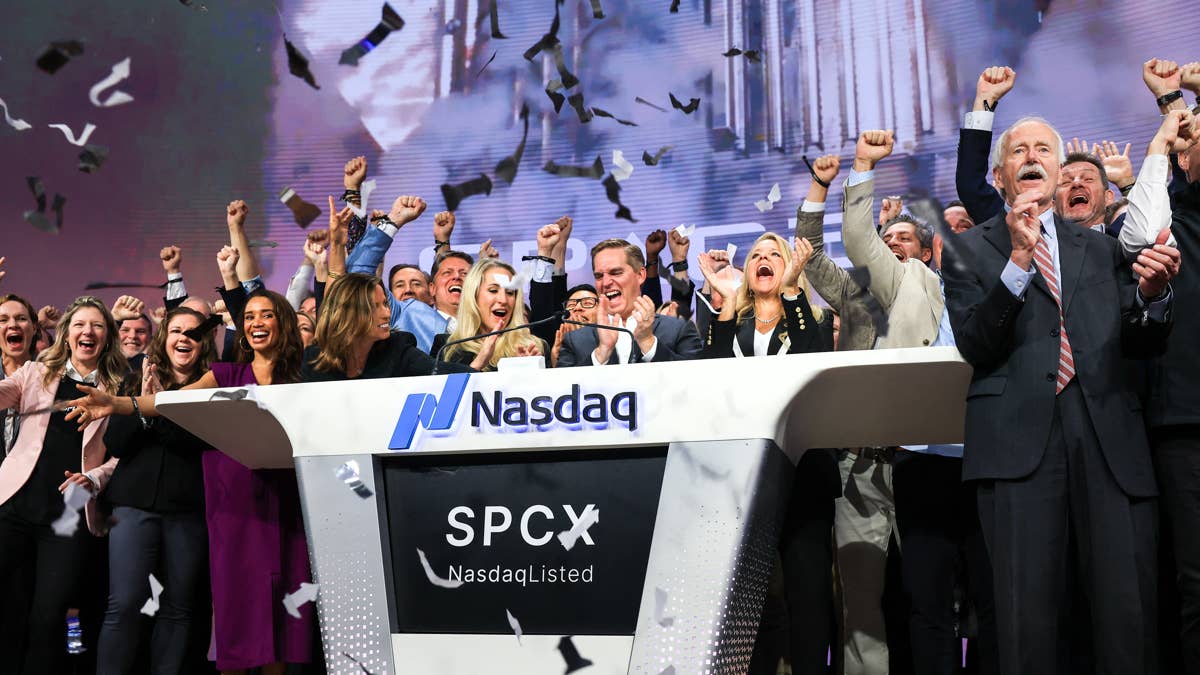 SpaceX trades at a lofty valuation following its IPO.
AFP&solGetty Images
History's verdict on giant, pricey IPOs
Academic research adds another layer of caution.
A long-running study of more than 9,200 IPOs by University of Florida finance professor Jay Ritter found that companies with more than $1 billion in pre-IPO revenue posted an average three-year market-adjusted return of -2.1%.
Separately, among tech companies priced above 40 times sales, 12 out of 14 trailed the broader market over their first three years.
Musk was candid about his reasons for going public.
He told a JPMorgan Chase livestream before the IPO that SpaceX has been cash-flow positive since around 2015 and wants to raise capital for a major growth phase, including plans to put more than 100,000 satellites in orbit and build AI data centers in space.
There's clearly a bull case. But Westly's math is worth sitting with: three moonshots, and you need most of them to land.
Related: Dan Ives spills the beans on SpaceX future


You May Also Like

Trump voters 'at a loss for words' trying to defend him amid 'watershed moment': pollster

KPMG retracts AI report after hallucinations surface in claims about organizations

Thousands turn out for anti-racism rally after Belfast unrest



