

Must Read
Japan and the Philippines are now connected in ways that go far beyond formal diplomacyJapan and the Philippines are now connected in ways that go far beyond formal diplomacy
[Between Islands] The Queen of Swag and a new rhythm for Philippines-Japan relations
For feedback or concerns regarding this content, please contact us at crypto.news@mexc.com
“There’s a Japanese-Filipino choreographer, Riehata, performing at Solaire this June,” my desk editor at Rappler messaged me. “You might want to feature her?”
I didn’t know who Riehata was back then, but curiosity — and a welcome break from my usual routine — piqued my interest.
A few weeks later, I received another invite to cover the launch of Stella Dance Jam, a program organized by the Japan Foundation Manila to cultivate dance exchanges between our two countries. I happened to be in Manila that week for the 4th ICC Philippines Arbitration Day, so when I was asked to cover her visit instead, it felt like a refreshing shift. For a few hours, I traded my work laptop for a notebook, stepping out of the rigid world of cross-border dispute resolution and into the fluid, kinetic world of dance.

When I arrived at Solaire, the atmosphere was a stark departure from the conferences I usually attend. Instead of the hushed, measured tones of legal and corporate delegates, the room buzzed with the frantic, creative energy of a media launch. Photographers adjusted lenses to find the perfect angle, and organizers managed last-minute logistics with polite, polished smiles.
Then, Riehata stepped onto the stage. She radiated a magnetic confidence that immediately hushed the room.
Born to a Japanese father from Niigata and a Filipina mother, Riehata has built an international career working across Tokyo, Los Angeles, and beyond. Widely known as the “Queen of Swag,” she is celebrated for her high-energy, hip-hop-heavy choreography for world-class artists like BTS, TWICE, NCT127, aespa, and King & Prince. Despite the global acclaim and the gravity of her professional achievements, what struck me most was her grounding.
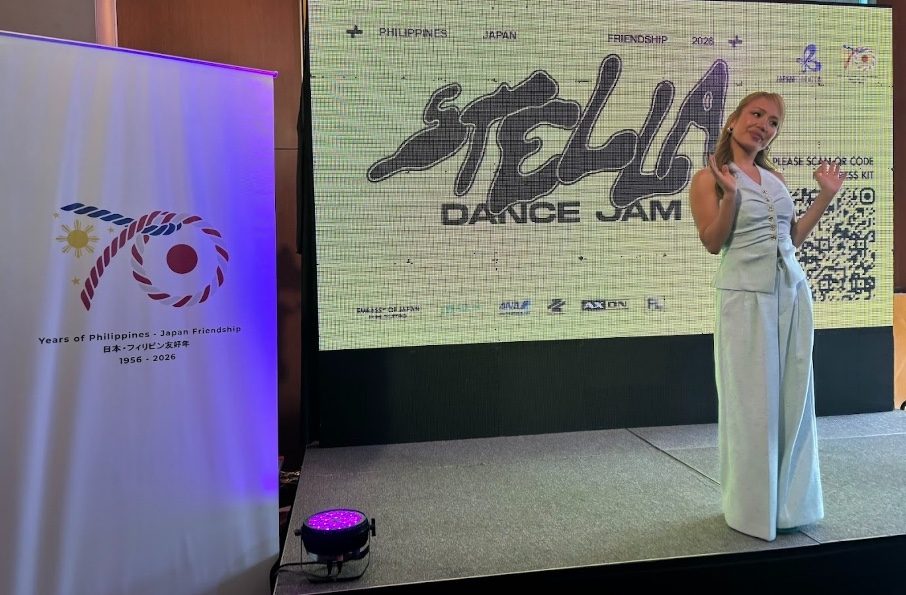 COLLAB. Japanese-Filipino choreographer Rie Hata poses during the launch on April 24, 2026 of Stella Dance Jam, a cultural exchange initiative by the Japan Foundation Manila aimed at strengthening dance collaborations between Japan and the Philippines. Photo by Ricky Sabornay
When the floor opened for questions, I asked her about her mother’s influence on her path.
Riehata’s gaze shifted and softened. “My mother always believed in me,” she said. “She always supported me and kept telling me, ‘Rie, you should dance, you should sing.’”
It was the simplest answer she gave all afternoon, yet it anchored everything else I learned about her later. Her journey was far from linear: at 15, she moved alone to Los Angeles to pursue dance; years later, she faced a career-threatening knee injury just as she entered motherhood. Her return to the highest level of performance is a testament to that early encouragement.
At one point, the conversation shifted toward identity. “I appreciate both cultures,” she noted. “Filipinos and Japanese have similarities and differences. But when we dance together, those differences disappear.”
 GENERATIONS. Alan Shirahama (right) and author during the Philippine Festival 2025 at Ueno Park, Tokyo, Japan. Photo by Ricky Sabornay
As I listened to Riehata in Solaire, it became difficult to see the event as mere cultural pageantry. The connections between Japan and the Philippines now run through everyday lives, especially among younger people moving comfortably between both worlds.
There is an entire generation of Filipino-Japanese individuals moving between these cultures without needing to explain themselves — people like Alan Shirahama, the leader of GENERATIONS from EXILE TRIBE; actress and model Elaiza Ikeda; and world-class table tennis Olympian Maharu Yoshimura.
I met Alan a couple of months back without realizing how big of a celebrity he is. Just like Riehata, Alan’s father is Japanese and her mother is Filipino. He has two siblings, her elder sister Loveli is a well-known fashion model and television personality in Japan, while his younger brother Ryu is also a singer and musician.
 Alan and his mother Mary Jane. Photo from Alan’s X account
And just like Riehata’s mother, Alan’s mother Mary Jane had the most profound impact on his life and career. Mary Jane moved from the Philippines to Japan entirely alone at the tender age of 16 to work and send money back home to support her family. In one of his interviews as the Philippines’ tourism ambassador to Japan, Alan said that one of the things about her mother is that he always felt her love and it is this “big love” that has supported not only Alan but all of his siblings.
Because of mixed families like those of Riehata, Alan, and many others like them, Japan and the Philippines are now connected in ways that go far beyond formal diplomacy.
We reached a point where more of these children of mixed heritage are stepping into leadership roles within their respective fields. By carrying the heritage of both nations, these individuals act as natural bridges, effortlessly moving between two different worlds and helping to heal old divides. As they rise to prominence, they naturally weave the best of both cultures together. This ensures that the bond between the Philippines and Japan rests not just on trade deals and government policy, but on genuine human connection — making their relationship stronger., more empathetic, and more enduring that ever.
Riehata understands this shift. Throughout the press conference, she spoke repeatedly about wanting to support younger dancers from the Philippines. Stella Dance Jam, she explained, is more than a showcase; it is an opportunity to mentor and discover new talent.
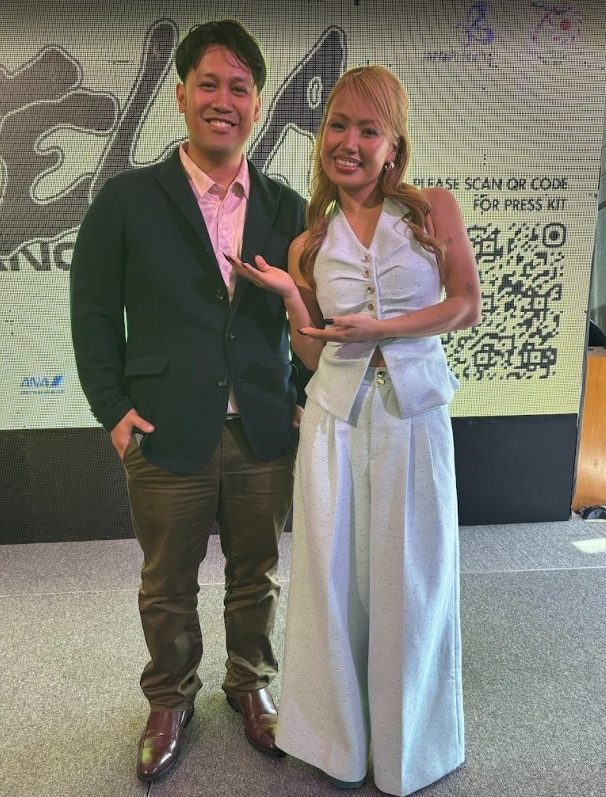 Riehata (right) with author strike a pose during the press conference launch of Stella Dance Jam in Manila on April 24, 2026, in Solaire, Parañaque City.
The planned collaboration with SB19 also feels inevitable in away that would have been harder to imagine years ago. Audiences in both countries are now consuming each other’s pop culture in real time, often through the same digital spaces.
As the event wrapped, I found myself thinking of the distance between the Japan of Riehata’s childhood — where her mother navigated a foreign land to raise her — and the stage at Solaire, where her daughter now stands as a mentor to a new generation.
The next 70 years of Philippines-Japan relations won’t just be built in conference rooms; they will be built on stages like this, where the boundaries between us and them simply dissolve into rhythm.
I am excited to see where that rhythm takes us. – Rappler.com
Ricky Aringo Sabornay is a cross-border lawyer who moves between the Philippines and Japan, helping people navigate not just different legal systems, but different ways of thinking. He runs Sabornay Law, a member firm of Uryu & Itoga, where his work sits at the intersection of two legal systems and two cultures that don’t always speak the same language. Connect with him on LinkedIn.
Below are other Between Islands articles you may have missed:
Market Opportunity
FAR Labs Price(FAR)
$0.002677
$0.002677$0.002677
USD
FAR Labs (FAR) Live Price Chart


Disclaimer: The articles reposted on this site are sourced from public platforms and are provided for informational purposes only. They do not necessarily reflect the views of MEXC. All rights remain with the original authors. If you believe any content infringes on third-party rights, please contact crypto.news@mexc.com for removal. MEXC makes no guarantees regarding the accuracy, completeness, or timeliness of the content and is not responsible for any actions taken based on the information provided. The content does not constitute financial, legal, or other professional advice, nor should it be considered a recommendation or endorsement by MEXC.
You May Also Like

CoreWeave (CRWV) Stock Surges 12% on $8.5B GPU-Backed Financing Deal — Here’s the Full Picture
TLDR CoreWeave closed an $8.5 billion GPU-backed term loan facility, the first of its kind tied to high-performance computing infrastructure and a customer contract
Share
Coincentral2026/04/02 18:11

Bitcoin 28% Haircut: Moody’s Sets Forced-Selling Trigger
Moody's gave a New Hampshire Bitcoin-backed bond a 72.06% advance rate, implying a 28% haircut and a 1.40x trigger that can force BTC selling if prices fall.
Share
CoinLive2026/04/02 18:45

AI predicts XRP price for April 30, 2026
The post AI predicts XRP price for April 30, 2026 appeared on BitcoinEthereumNews.com. The month has only just begun, and XRP is already in a bad spot, being down
Share
BitcoinEthereumNews2026/04/02 18:22


Trending News
More24/7 Live News
MoreQuick Reads
More
