

EU Lawmakers Call for Review of DeFi, Staking and NFT Rules
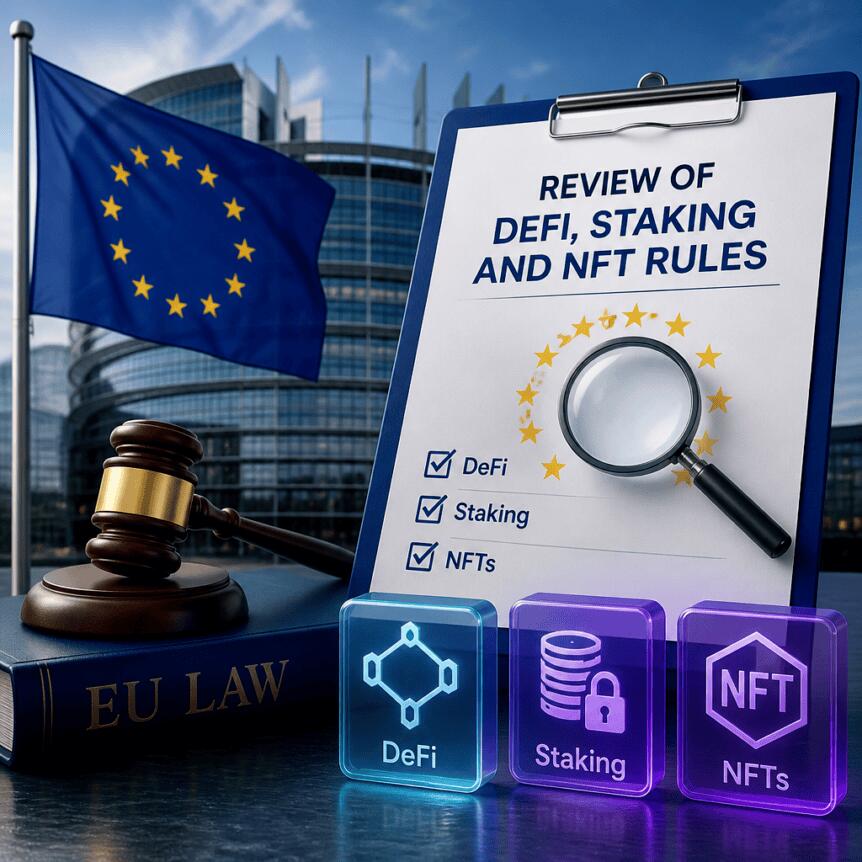
The European Parliament’s Committee on Economic and Monetary Affairs (ECON) has formally pushed the European Commission to consider whether several fast-growing areas of the crypto market should fall under EU-wide rules. In an own-initiative resolution scheduled for a plenary vote, lawmakers ask the Commission to assess the regulatory perimeter for crypto lending and borrowing, staking, non-fungible tokens (NFTs) and decentralized finance (DeFi), while also encouraging broader tokenization across financial services.
The proposal, drafted by Belgian MEP Johan Van Overtveldt, will be submitted to the full Parliament for voting expected on July 7. If adopted, it would become the Parliament’s policy position—but it would not itself amend the existing Markets in Crypto-Assets Regulation (MiCA) or create new binding legal obligations.
Key takeaways
- ECON is urging the European Commission to evaluate whether lending/borrowing, staking, NFTs and DeFi should be regulated beyond MiCA’s current coverage.
- The draft strongly supports the development of euro-denominated stablecoins under MiCA to support payments and tokenized financial infrastructure.
- ECON wants consistent application of MiCA across EU member states, warning against national rule-making that could fragment the market.
- The resolution is set for a plenary vote around July 7 and would reflect Parliament’s stance without directly changing MiCA.
From MiCA scope to a wider policy checklist
MiCA already provides an EU framework for certain categories of crypto assets and sets licensing expectations for crypto-asset service providers. But ECON’s report signals that lawmakers are now looking past MiCA’s current boundaries. The resolution asks the Commission to assess regulatory needs for additional activity types, including staking and crypto lending and borrowing, as well as NFTs and DeFi.
The timing matters for investors and operators because the Commission is already in review mode. According to the report’s context, the European Commission launched a public consultation in May on whether MiCA should be expanded to cover DeFi, staking, lending, NFTs and tokenized financial assets, and whether the current ban on interest-bearing stablecoins should be revisited. ECON’s resolution effectively adds political weight to those questions, by asking the Commission to consider a broader regulatory scope rather than treating MiCA as a closed endpoint.
In addition, lawmakers stress the importance of a level playing field for firms operating across the EU. The draft encourages consistent MiCA implementation throughout member states, and warns against additional national requirements that could fragment regulation and force crypto businesses to navigate a patchwork of rules.
Stablecoins shift from suspicion to policy support
While the resolution opens the door to evaluating regulation for more crypto activity types, it also reflects an increasingly supportive stance toward euro-denominated stablecoins. ECON backs the development of regulated stablecoins under MiCA and ties that support to the bloc’s payments strategy and broader tokenization plans across financial services.
The report’s stablecoin emphasis also follows a notable change in tone from some senior crypto critics in recent weeks. The policy direction comes shortly after former Bank for International Settlements general manager Agustín Carstens softened his stance on stablecoins and highlighted a potential coexistence with fiat systems, according to earlier coverage referenced in the source material.
ECON’s stablecoin perspective is consistent with the idea that euro-backed tokens could complement existing financial rails. The resolution argues that euro-denominated stablecoins could complement tokenized commercial bank deposits and wholesale central bank digital currencies, while also enabling faster and cheaper cross-border payments. It further claims that wider use could strengthen EU financial markets’ competitiveness and support the euro’s international role.
Importantly for market participants, these points do not signal a standalone rule change by themselves. Instead, they serve as a political directive: policymakers appear increasingly willing to treat certain stablecoin use cases as strategically valuable—provided they operate within the EU’s regulatory framework.
Why this vote matters for the EU crypto market
The ECON report is an own-initiative resolution, meaning it is Parliament setting out recommendations for the Commission rather than directly legislating. Even so, a Parliament-backed position can influence how regulators prioritize consultations, drafting work, and the next round of policy decisions.
The filing process also underscores what is at stake. The text drafted by Van Overtveldt went through negotiations and amendments within ECON before receiving committee approval. An earlier draft, presented in February, focused more narrowly on MiCA’s existing framework, including stablecoin classifications and legal certainty for multi-issued stablecoins. Months later, the committee’s final version broadens the emphasis toward whether additional crypto sectors—particularly DeFi-like activity and token-driven financial primitives—should be pulled under a more explicit regulatory framework.
Meanwhile, MiCA’s implementation timetable is already moving. The transitional period for crypto asset service providers ends July 1, after which providers generally must hold authorization under the regulation to continue serving customers across the EU. For businesses watching for additional MiCA expansion, the July plenary vote on the resolution could be another step in shaping regulatory expectations—especially for models that don’t neatly fit within today’s MiCA categories.
A broader push for “digital money” coexistence
ECON’s approach aligns with a parallel strand of EU digital money policy. In the source context, the committee previously backed legislation for a digital euro, with lawmakers arguing that public and private forms of digital money should coexist rather than compete.
That political framing matters because it helps explain why stablecoins and tokenized deposits are treated as complementary tools instead of outright replacements. If the Parliament’s position is adopted and the Commission follows through during its MiCA review process, the next policy cycle could be defined less by whether crypto should exist, and more by how different digital money instruments should interact within an overarching EU framework.
Readers should watch the European Commission’s response to its May consultation and any follow-on legislative proposals once the July 7 plenary vote sets Parliament’s official stance. The key uncertainty is how the Commission will translate “assessment” questions—especially around DeFi, staking, lending/borrowing, and NFTs—into concrete regulatory boundaries without undermining the consistent MiCA implementation ECON says it wants across the EU.
This article was originally published as EU Lawmakers Call for Review of DeFi, Staking and NFT Rules on Crypto Breaking News – your trusted source for crypto news, Bitcoin news, and blockchain updates.


You May Also Like

AI predicts XRP price for April 30, 2026
.webp)
Cap Price Prediction: $CAP Surges 175% After Tier-1 Listings

What is the Travel Rule? Crypto KYC, AML, and what exchanges must share



