

No Binance MiCA License by July 1: Can It Stay in the EU?
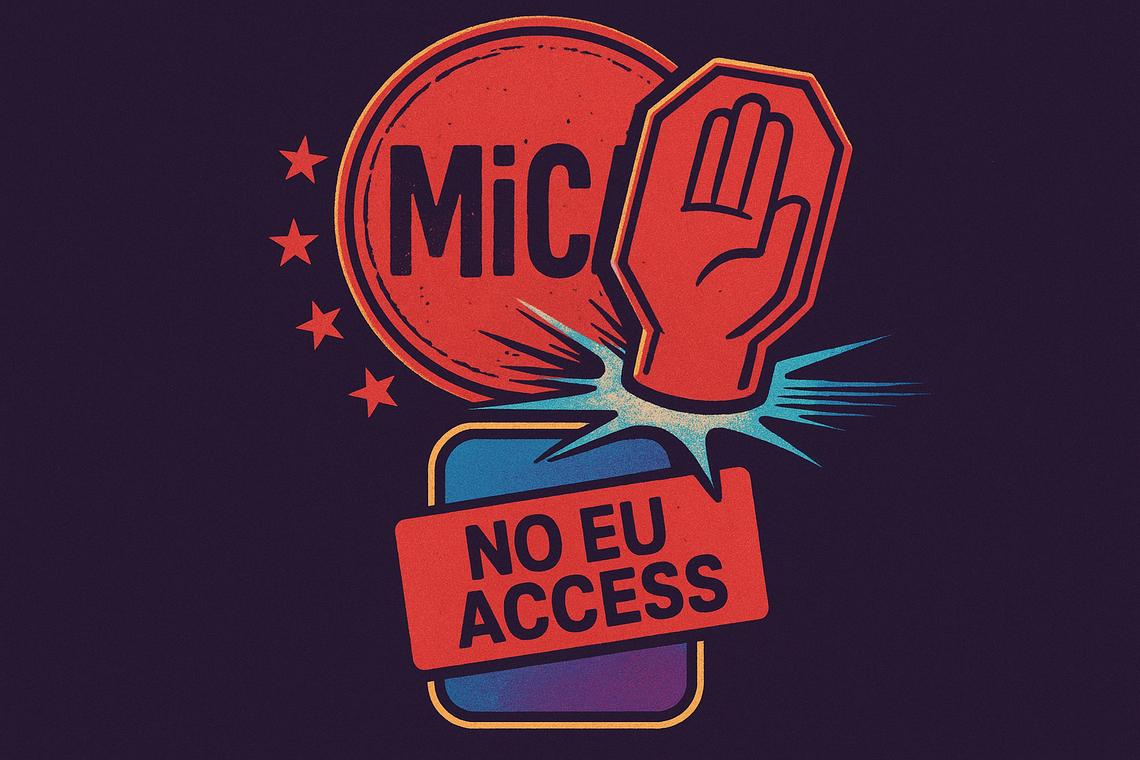
The world’s largest crypto exchange by trading volume has just run into one of the most consequential regulatory walls in its history. Binance’s attempt to secure a Binance MiCA license through Greece’s Hellenic Capital Market Commission collapsed on June 24, 2026, when the exchange confirmed it had withdrawn its application — just days before the July 1 deadline that will determine who gets to legally serve the European Union’s crypto market.
Key takeaways
- Binance withdrew its MiCA license application with Greece’s Hellenic Capital Market Commission on June 24, 2026, missing the July 1 deadline.
- Without a valid MiCA license, Binance cannot operate as an authorized crypto-asset service provider across the EU after July 1, 2026.
- Binance has halted new EU registrations and notified users in France, Italy, Poland, and Spain that services will be restricted.
- The exchange plans to pursue licensing in France and leverage the passporting mechanism to eventually re-enter the broader EU market.
- User assets remain safe and accessible, but the scope of service restrictions varies by country and account status.
Binance Withdraws Its Greek MiCA Application
The withdrawal was confirmed in a Binance statement posted on June 24, which said the exchange had decided to pull its application “after considering the progress and timeline of the licensing process in Greece.” The exchange was careful to add it had not received a formal decision from the Hellenic Capital Market Commission — a notable framing that leaves the door open for its next regulatory move.
That next move, according to reporting by the Financial Times, is France. Binance intends to seek MiCA authorization from French regulators, with the passporting mechanism as the long-term goal: a license granted in a single EU member state allows a provider to operate across all 27.
The stakes of missing the Greek application were not theoretical. As of the European Securities and Markets Authority’s June 26 update to its MiCA register, Binance does not appear on the list of authorized crypto-asset service providers in the EU.
The Compliance Cloud Around Changpeng Zhao
The Financial Times reported that the Greek application faced serious hurdles tied to anti-money laundering controls and “fit and proper” standards — including scrutiny of founder Changpeng Zhao. Binance did not officially confirm this characterization.
The context is hard to ignore. In 2023, Binance and Zhao reached a settlement with the U.S. Department of Justice in which the exchange pleaded guilty and agreed to pay $4.316 billion to resolve allegations related to AML violations, unlicensed money transmitting, and sanctions breaches. Zhao stepped down as CEO and personally pleaded guilty to failing to maintain an effective AML program.
Since then, Binance has moved aggressively to rebuild its compliance standing. The exchange now employs over 1,500 personnel in compliance roles and says it has prevented nearly $7 billion in potential losses from fraud. Whether that track record is enough to satisfy French regulators under MiCA’s “fit and proper” standards remains the open question that will define Binance’s European future.
What This Means for EU Users Right Now
Binance has already moved to notify users directly. Emails were sent to clients in France, Italy, Poland, and Spain informing them that the exchange can no longer accept new registrations and will restrict services. The exchange stopped short of publishing an official list of exactly which services are being halted in each country — leaving users to monitor their inboxes and in-app notifications for specific guidance.
The core assurance from Binance is that user assets remain safe, secure, and accessible at all times. The exchange also issued a warning against phishing attempts, clarifying it will never contact users to request passwords, two-factor authentication codes, or private keys.
Service restrictions will vary by country and account type. Users who need to act — to reduce positions, transfer assets, or close accounts — will receive direct guidance from Binance. The full scale of affected accounts across the EU has not been publicly confirmed by the exchange.
MiCA’s Hard Deadline and Why There Is No Escape Hatch
MiCA — the Markets in Crypto-Assets Regulation — is the EU’s unified regulatory framework designed to replace the fragmented, country-by-country approach that previously governed crypto services across the bloc. Its central promise is consistency: one license, granted by one member state’s regulator, unlocking access to the entire European single market through passporting.
Article 143 of Regulation (EU) 2023/1114 allowed existing providers to operate during a transitional period — but only until July 1, 2026, or until their application was granted or refused. For Binance, withdrawal effectively ends that window.
Any hope that the deadline might flex was extinguished by Spain’s market regulator, the CNMV, which ruled out any exceptions or extensions to the MiCA licensing deadline. Platforms without a license after July 1 cannot solicit new clients or continue regular services — they can only wind down positions, transfer assets, or facilitate an orderly exit. The CNMV’s position reflects a bloc-wide stance: MiCA enforcement is not negotiable.
Consequences and Competitive Fallout
Missing this deadline does not just create a bureaucratic inconvenience for Binance — it hands a structural advantage to exchanges that secured MiCA authorization in time. Licensed platforms can continue acquiring new EU users, offering the full range of trading and yield products, and operating without service disruption. Binance, for now, cannot.
This is where the broader market implication sharpens. Binance’s EU user base — spread across major markets like France, Italy, Poland, and Spain — represents a significant addressable audience that licensed competitors can now actively pursue. Every week that Binance operates in a restricted state is a week those competitors can consolidate market share.
Zhao reacted on social media, arguing that the EU is effectively cutting users off from the world’s best liquidity pool and framing liquidity itself as a form of consumer protection. It’s a pointed argument, but one that runs directly counter to MiCA’s design philosophy, which prioritizes licensed governance, risk controls, and investor protection over exchange-level liquidity claims.
The Path Through France
Binance says its commitment to Europe is unchanged and that it remains confident of securing a MiCA license in the coming months through another EU member state — now reported to be France. If that application succeeds, the passporting mechanism would allow the exchange to restore full EU access from a single authorization. But the timeline is unknown, and French regulators will scrutinize the same compliance history that complicated the Greek application.
For now, the points to watch are ESMA’s authorized CASP register, any public response from the HCMC or other national regulators, and Binance’s formal announcement of its French application. The exchange’s ability to navigate MiCA’s “fit and proper” standards — particularly the shadow cast by the DOJ settlement and Zhao’s personal legal history — will likely determine whether Europe becomes a comeback story or a prolonged exclusion.
FAQ
Why did Binance withdraw its MiCA license application in Greece?
Binance withdrew its application after assessing the progress and timeline of the licensing process with Greece’s Hellenic Capital Market Commission. The exchange has since indicated it plans to pursue authorization in another EU member state, reported to be France.
What happens to Binance users in the EU after the MiCA deadline?
EU users will face service restrictions that vary by country and account status. Binance has notified users in France, Italy, Poland, and Spain directly. The exchange has halted new registrations and will restrict certain services, but has confirmed that user assets remain safe and accessible throughout this process.
Can Binance still operate in the EU without a MiCA license?
No. Without a MiCA license, Binance cannot operate as an authorized crypto-asset service provider in the EU after July 1, 2026. Unlicensed platforms are only permitted to carry out activities necessary to wind down positions, transfer assets, or close accounts in an orderly manner.
Will the MiCA licensing deadline be extended for crypto platforms?
No. Spain’s CNMV has explicitly ruled out any exceptions or extensions to the July 1, 2026 MiCA licensing deadline, signaling that EU regulators intend to enforce the rule uniformly across all platforms.
Article produced with the assistance of artificial intelligence and reviewed by the editorial team.


You May Also Like

3 Reasons Investors Are Following Mutuum Finance (MUTM) Since Q1 2025

Pump.fun (PUMP) Has Spiked by 200%: Can the Rally Survive?

What is the Travel Rule? Crypto KYC, AML, and what exchanges must share



