

SanDisk Stock Fell 10% in a Day. Management Says the NAND Cycle Is Different
Key Stats for SanDisk Stock
- Current Price: $2,090.71
- Target Price (Mid): ~$2,930
- Street Target: ~$1,850
- Potential Total Return: ~40%
- Annualized IRR: ~9% / year
- Earnings Reaction: 8.25% (April 30, 2026)
- Max Drawdown: 31.34% (December 3, 2025)
Now Live: Discover how much upside your favorite stocks could have using TIKR’s new Valuation Model (It’s free) >>>
What Happened?
Sandisk (SNDK) just gave investors a brutal reminder of what a memory stock can do in reverse. The shares closed June 26, 2026, at $2,090.71, down 10.46% on the day, a $244.29 drop that erased weeks of gains in hours. Nothing broke inside the business. The selling came from sentiment, not from a single bad number out of Milpitas.
That gap between the stock and the story is the whole debate right now. This is a company up from roughly $40 to above $2,000 in about 16 months, the best-performing stock in the S&P 500 in 2026. Bulls see a NAND flash producer, meaning the chips that store data in phones, drives, and AI servers, sitting at the center of an AI build-out that is nowhere near finished. Bears see a famously cyclical business priced as if the cycle has been repealed. The market cannot yet answer the one question that matters: Is elevated NAND pricing the new normal, or the top of another boom?
Sandisk’s own management spent a recent conference trying to answer exactly that.
What Management Told Investors at Mizuho
At the Mizuho Technology Conference on June 9, 2026, CEO David Goeckeler made the case that this cycle is different, and he did it without dodging the industry’s scars. Asked how he convinces investors that “this time it’s different” when NAND has been plagued by cyclicality, Goeckeler did not pretend the skepticism was unfair. “There’s so much scar tissue, and there’s so much history,” he said. His answer was not a promise. It was a method: “You just keep putting points on the board.” That tone matters because it tells you management knows the burden of proof sits with them, not the doubters.
The substance behind that confidence is a shift in how Sandisk sells. CFO Luis Visoso described a new contract structure that puts a floor and a ceiling on pricing for some agreements, so neither side gets wrecked when the market swings. “Even in the low end prices, we like the margins,” Visoso said, adding that those margins stay consistent with fourth-quarter guidance. Goeckeler was blunt about what the contracts are not: “We’re not trading duration for price.” The pitch is continuity of supply, not a discount for locking in. If that holds, it attacks the exact thing that has kept NAND multiples low for years: volatility.
That is the bridge from a conference soundbite to the stock. Sandisk reported fiscal Q3 2026 revenue of $5.95 billion, up 251% year over year, with a gross margin of 78.4% and adjusted EPS of $23.41, all far above estimates. The company signed five multiyear supply agreements, announced a $6 billion share buyback, and extended its manufacturing joint venture with Kioxia, its longtime Japanese production partner, through 2034. Management also confirmed it has reached its net cash target, and the balance sheet now shows LTM net debt of negative $3.53 billion. That is real cash, not a forecast.
Why the Stock Dropped Anyway
If the business is this strong, why the 10% day? Because the selloff was not about Sandisk. On June 23, 2026, a historic crash in South Korean chip stocks, with SK Hynix and Samsung both falling more than 12% and the KOSPI down roughly 10%, dragged the entire memory sector lower. Sandisk, as a pure-play NAND name with no DRAM or high-bandwidth memory business to cushion it, led the U.S. decline. The June 26 leg down added profit-taking and a fresh worry: reports that OpenAI may delay its IPO to 2027 cooled sentiment across the AI trade.
There is also a structural threat dated on the calendar. SK Hynix, the world’s second-largest memory chipmaker, filed to raise up to $29 billion through a Nasdaq listing of American depositary receipts, certificates that let a foreign company’s shares trade on a U.S. exchange, with trading expected to begin July 10, 2026, according to the company’s SEC filing reported by CNBC. For Sandisk, that listing is a direct challenge to its scarcity premium. Sandisk has been one of the only pure ways for U.S. funds to own AI-memory exposure. SK Hynix, which holds roughly 57% of the high-bandwidth memory market, would give those funds a bigger, more diversified alternative trading right next door.
 SanDisk Beats & Misses (TIKR)
See historical and forward estimates for SanDisk stock (It’s free!) >>>
The Valuation Nobody Can Quite Settle
Here is what complicates the bubble call. After the drop, Sandisk trades at around 9x NTM EV/EBITDA and a trailing P/E near 70x, a split that captures the entire argument. On forward earnings, the stock is not expensive. On trailing earnings, it looks stretched. The catch is that the analyst consensus price target now sits below where the stock trades, so the Street, on average, sees downside from here. The risk does not live in the valuation multiples. It lives in the durability of the “E,” whether those record margins survive the next time supply catches demand.
Peer comparison sharpens the point. On the TIKR Competitors page, Sandisk trades at around 9x NTM EV/EBITDA against Western Digital, its former parent, at around 25x, and Samsung at under 4x. Sandisk sits between a far pricier WDC and a cheaper, conglomerate-structured Samsung. The discount to Western Digital is hard to justify on fundamentals alone, given Sandisk’s faster growth and stronger near-term margins. That gap suggests the market is not paying up for Sandisk’s growth. There is real doubt about how long the good times will last. Bulls read the discount as an opportunity. Bears read it as the market being right to worry.
Analyst opinion has scattered as the stock has run. TIKR’s data shows 22 analysts covering the stock with 15 Buys, 3 Outperforms, 3 Holds, and 1 Underperform, but the mean target sits around $1,850, roughly 12% below the current price. In other words, the average analyst sees downside from here. The most bullish target on the Street is $3,250, the outlier that the stock would need a sustained AI-memory upcycle to reach. That spread, from a mean below the price to a high near $3,250, tells you the pros are as divided as everyone else. Morgan Stanley analyst Joseph Moore, after meeting management the week of June 21, called the AI-driven shift in NAND a “fundamental repricing,” arguing that cloud customers buy on capability and availability, not price, which changes the negotiating dynamic entirely, per TheStreet.
 SanDisk Drawdowns (TIKR)
See how SanDisk performs against its peers in TIKR (It’s free!) >>>
TIKR Advanced Model Analysis
- Current Price: $2,090.71
- Target Price (Mid): ~$2,930
- Potential Total Return: ~40% over the next four years
- Annualized IRR: ~9% / year
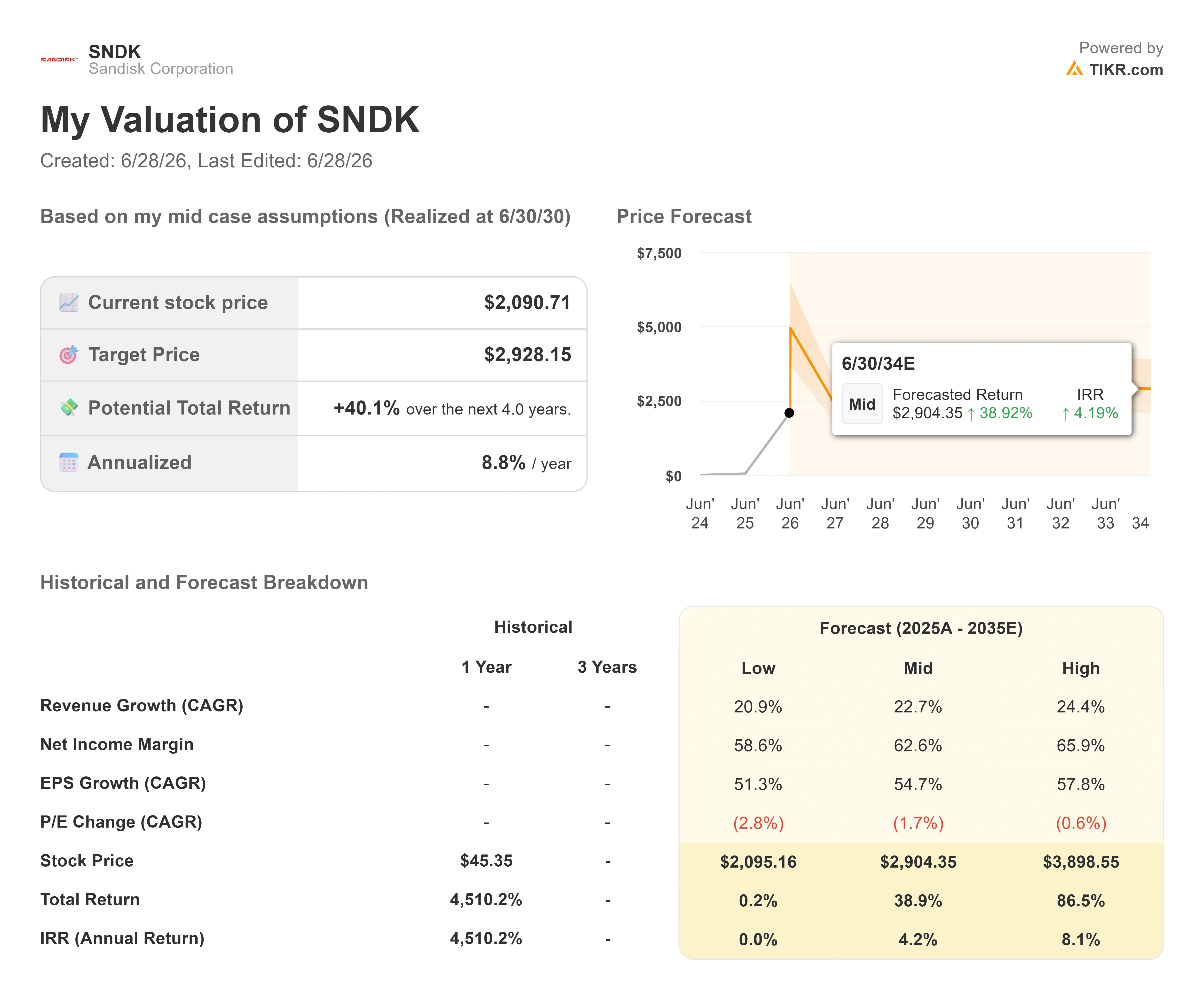 SanDisk Advanced Valuation Model (TIKR)
See analysts’ growth forecasts and price targets for SanDisk stock (It’s free!) >>>
Two drivers do the heavy lifting on revenue. The first is data center growth, where management says enterprise SSD demand and AI workloads are pushing the segment toward becoming Sandisk’s largest end market. The second is the shift to multiyear supply agreements, which raises revenue visibility and smooths the bit-growth ramp of mid- to high-teens per year. The margin driver is the pricing structure Visoso described, where contractual floors hold profitability up even if spot NAND prices soften.
The primary risk is the oldest one in the sector: a simultaneous capacity build across Sandisk, Samsung, and SK Hynix that floods the market and collapses pricing. The upside is that AI demand makes this cycle structurally longer, and Sandisk compounds from a net cash base toward the high case near $3,900. The downside is that NAND behaves like it always has, pricing rolls over, and the multiple compresses fast.
Conclusion
The next real test is July 10, when SK Hynix begins trading on the Nasdaq. Watch how Sandisk holds up in the days around that listing. If the stock absorbs the new competition for AI-memory capital and stabilizes above its recent range, the scarcity-premium fear was overdone. If it keeps bleeding as institutional money rotates toward a larger, more diversified rival, the bears were early, not wrong. After that, fiscal Q4 results are due in late summer, with management having guided to revenue of $7.75 billion to $8.25 billion and EPS of $30 to $33. A clean beat with no crack in gross margin confirms the “new business model” thesis. Any softness in pricing language is the first sign the cycle is turning. Until one of those two things happens, this stays a conviction stock for people who can stomach a 10% day.
See what stocks billionaire investors are buying so you can follow the smart money with TIKR.
Should You Invest in SanDisk?
The only way to really know is to look at the numbers yourself. TIKR gives you free access to the same institutional-quality financial data that professional analysts use to answer exactly that question.
Pull up SanDisk, and you’ll see years of historical financials, what Wall Street analysts expect for revenue and earnings in the quarters ahead, how valuation multiples have moved over time, and whether price targets are trending up or down.
You can build a free watchlist to track SanDisk alongside every other stock on your radar. No credit card required. Just the data you need to decide for yourself.
Analyze SanDisk on TIKR Free →
Looking for New Opportunities?
- See what stocks billionaire investors are buying so you can follow the smart money.
- Analyze stocks in as little as 5 minutes with TIKR’s all-in-one, easy-to-use platform.
- The more rocks you overturn… the more opportunities you’ll uncover. Search 100K+ global stocks, global top investor holdings, and more with TIKR.
Disclaimer:
Please note that the articles on TIKR are not intended to serve as investment or financial advice from TIKR or our content team, nor are they recommendations to buy or sell any stocks. We create our content based on TIKR Terminal’s investment data and analysts’ estimates. Our analysis might not include recent company news or important updates. TIKR has no position in any stocks mentioned. Thank you for reading, and happy investing!
You May Also Like

Iran’s foreign minister targeted in assassination attempt, wife killed

Trump insiders reveal he 'isn't sold' yet on his biggest 2028 decision

The Trade Desk Is Down 51% in 2026. Is the Multiple Finally Cheap Enough?

