USDC SAP Payments: Can Stablecoins Transform ERP?
Overview
Circle is bringing stablecoin settlement deeper into corporate finance through a partnership with Tereina, the SAP-backed payments company powering SAP Pay. Announced on October 7, 2026, the partnership is designed to integrate USDC and EURC into Tereina’s enterprise payments platform, beginning with the SAP ecosystem that Circle says supports approximately 84% of global commerce. The result is materially different from asking a corporate treasury team to adopt a separate crypto wallet: stablecoin payments can increasingly sit inside the ERP workflows companies already use for invoices, approvals, cash positioning and reconciliation.
Current SAP documentation specifically highlights native USDC integration with Circle. SAP Pay is embedded in SAP Cloud ERP and supports traditional payment rails—including ACH, EFT, wire and checks—alongside digital-currency payments. It covers 89 global corridors, can route payments across more than 40 currencies and automatically reconciles transactions to the originating purchase order or invoice.
USDC SAP payments therefore represent an infrastructure story rather than simply another stablecoin acceptance announcement. The stablecoin becomes one possible settlement rail inside an existing corporate financial process. That matters because enterprise adoption is usually constrained less by whether blockchain payments are technically possible than by whether finance departments can use them without rebuilding approval, compliance and accounting systems.
Key Takeaways
- Circle and Tereina are integrating USDC and EURC into enterprise payment workflows, starting with SAP.
- SAP Pay is embedded directly in SAP Cloud ERP rather than operating as a standalone crypto payment application.
- Current SAP product documentation specifically highlights native USDC integration with Circle.
- SAP Pay supports 89 global corridors and more than 40 currencies while retaining traditional payment rails.
- The larger opportunity is making stablecoin settlement invisible inside existing treasury, accounts-payable and reconciliation processes.
How Do USDC SAP Payments Actually Work?
Corporate Finance Teams Can Stay Inside Their Existing ERP Workflow
The central advantage of USDC SAP payments is workflow integration. A finance team can begin with a normal supplier invoice inside SAP Cloud ERP, initiate the payment through its existing payment run and move through familiar approval controls. SAP’s current stablecoin demo then shows the transaction appearing in Tereina’s platform, executing in USDC through a Circle wallet and returning settlement information to SAP for cash positioning and end-of-day statement posting.
That sequence matters because corporate payments are more complex than transferring a token from one address to another. Enterprises need authorization matrices, sanctions screening, accounting records, purchase-order matching, treasury visibility and audit trails. A crypto payment rail that sits outside those controls may be technically fast but operationally expensive to adopt because finance teams must create new processes around it.
SAP Pay takes the opposite approach. The payment rail changes while much of the surrounding enterprise workflow remains intact. SAP states that payments can be initiated, approved and reconciled through the standard SAP environment, reducing the need for manual file uploads or repeated logins to external bank portals.
For background on the wider stablecoin and enterprise-payment developments, see the MEXC On-Chain Daily Report: Sky Protocol Receives Moody’s First Stablecoin Protocol Rating, which also covers Circle’s expansion of USDC and EURC into SAP-linked enterprise workflows.
How Does Circle Fit Into SAP Pay?
Circle supplies the stablecoin infrastructure. SAP specifically describes USDC payments as having native integration with Circle, while Circle says the Tereina partnership is intended to bring both USDC and EURC into enterprise workflows. Eligible institutional users can use Circle’s infrastructure to access and manage these digital currencies while Tereina and SAP handle the enterprise payment workflow around them.
The distinction between the partnership announcement and current product documentation is important. Circle’s October 7 announcement covers both USDC and EURC as part of the planned integration scope, but SAP Pay’s current product page is more explicit about native USDC support. It would therefore be premature to assume that every USDC workflow documented today already has an identical EURC implementation across every SAP corridor.
This is a broader lesson in enterprise stablecoin adoption: commercial partnerships may describe the target architecture before every payment rail has the same production footprint. The most useful metric is therefore not simply the number of stablecoins named in an announcement, but how many corridors, currencies and enterprise customers can execute them in real workflows.
Why Is ERP Integration More Important Than Another Stablecoin Wallet?
Enterprise Adoption Depends on Workflow Compatibility
Crypto-native payment products often begin with the wallet. Corporate finance begins somewhere else: the invoice, purchase order, treasury policy or accounts-payable approval. This difference explains why technically efficient stablecoins can still face friction inside large enterprises.
A global company may process thousands of payments every day. Each transaction needs to map back to accounting records, internal approvals and compliance controls. If stablecoin payments require finance teams to export transaction files, operate separate wallets and manually reconcile activity afterward, the time saved in blockchain settlement can be lost in back-office operations.
Embedding the payment inside ERP software changes the economics of adoption. The finance team does not need to treat USDC as a separate crypto project; it can become another rail that the treasury function selects based on cost, speed, currency and destination. SAP Pay is explicitly designed as a multi-rail system, meaning stablecoins coexist with ACH, wire, EFT and other payment methods rather than replacing them outright.
That design is likely to be more important for enterprise adoption than raw blockchain throughput. Corporate treasurers typically prioritize reliability, controls and reconciliation before they prioritize block times. The technology becomes valuable when it improves those existing processes without forcing the company to reorganize its finance department around crypto infrastructure.
What Can Companies Use USDC and EURC For?
Cross-Border Supplier Payments Are the Most Immediate Use Case
Cross-border business payments are a natural target because they combine several of the inefficiencies stablecoins are designed to address: banking cut-off times, intermediary fees, multiple currency conversions and delayed settlement visibility.
A company could approve a supplier invoice in SAP and select USDC as the settlement rail where available. The payment can then move onchain while the ERP records remain connected to the invoice and treasury system. SAP’s demonstration specifically shows the USDC transaction appearing in the company’s short-term cash position and later flowing into statement posting.
The benefit is not simply settlement speed. Faster visibility can reduce uncertainty over whether a payment has reached its destination, while automated reconciliation can reduce manual work after settlement. For multinational businesses, this can be valuable even if the underlying invoice is still denominated in traditional currency.
Intercompany transfers are another potential use case. Large groups frequently move liquidity between subsidiaries and jurisdictions, and delays can require additional cash buffers. Stablecoin rails may allow treasury teams to reposition liquidity more quickly where legal and operational conditions permit.
Accounts receivable could eventually follow the same logic. If businesses can both send and receive regulated stablecoins from within ERP workflows, digital-dollar and digital-euro balances become part of corporate cash management rather than isolated crypto assets.
Why Does 24/7 Settlement Matter for Corporate Treasury?
The Real Benefit Is Capital Availability, Not Just Faster Payments
The phrase “instant settlement” can obscure the more important treasury issue: working capital. Traditional cross-border payments can require companies to pre-fund accounts in different jurisdictions or leave extra liquidity available because settlement timing is uncertain. That cash has an opportunity cost.
Stablecoins can potentially reduce some of this trapped liquidity because value can move outside conventional banking cut-off windows. A company that needs to fund an overseas subsidiary on a weekend does not necessarily have to wait for every correspondent-bank layer to reopen if an approved stablecoin rail is available.
This can improve cash positioning, especially for businesses operating across time zones. Treasury teams can make decisions closer to the moment liquidity is actually needed rather than maintaining larger buffers in advance.
The benefit should not be overstated. A blockchain may run 24/7, but corporate compliance, redemption channels and banking counterparties still impose operational constraints. Moving USDC at midnight is useful only if the recipient can use, hold or convert that asset within its own financial framework. Stablecoin settlement therefore expands treasury flexibility without making the rest of the financial system continuously available by default.
USDC SAP Payments vs Traditional Corporate Payments
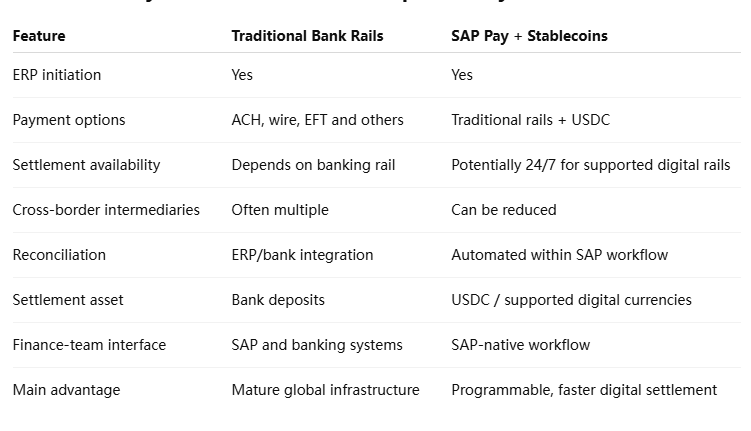
The comparison shows why stablecoins do not need to replace bank payments to become economically relevant. A treasury function can use a wire for one corridor and USDC for another while managing both through the same ERP environment.
This multi-rail approach also reduces adoption risk. Enterprises do not need to make an all-or-nothing decision about blockchain payments. They can introduce digital settlement where it has a clear benefit and retain traditional rails where banking infrastructure remains more suitable.
Why Does EURC Matter for Global Enterprises?
USDC solves the digital-dollar side of the problem, but international companies frequently manage significant euro balances and obligations. EURC gives Circle a euro-denominated stablecoin that is redeemable 1:1 for euros through eligible Circle services, providing a potential digital settlement instrument for European corporate workflows.
A dual-currency architecture could eventually allow businesses to maintain both dollar and euro stablecoin liquidity and select the appropriate settlement asset based on invoice currency or treasury requirements. That would reduce the need to route every digital payment through a dollar stablecoin before converting back into euros.
The regulatory dimension also matters. Circle operates EURC under its European regulatory framework, which can be important for companies that require clarity around issuer status and redemption. Enterprise treasury teams tend to place legal certainty alongside liquidity and transaction cost when approving a new payment instrument.
Still, current SAP documentation is more explicit about USDC than EURC. The partnership direction clearly includes both currencies, but EURC adoption should be evaluated according to actual corridor availability and production implementation rather than assuming immediate parity with USDC.
What Are the Main Limits of Enterprise Stablecoin Payments?
Enterprise integration does not remove compliance. Businesses still need KYC and AML controls, sanctions screening, accounting policies and jurisdiction-specific treatment for digital assets. SAP states that Tereina applies OFAC and KYC/AML screening, but companies remain responsible for their own treasury and compliance frameworks.
Liquidity and redemption also matter. A supplier may accept USDC only if it can hold or convert the asset efficiently. If conversion into local currency is expensive, the benefit of faster settlement can disappear. This means stablecoin payment adoption will vary significantly by corridor.
Operational risk remains as well. Wallet security, blockchain congestion, smart-contract dependencies and incorrect address handling introduce risks that conventional ERP teams may not normally manage. The value of integrated products is partly that these risks can be handled through institutional workflows rather than leaving employees to manage standalone wallets manually.
Accounting treatment may also differ across jurisdictions, particularly for firms that hold stablecoins beyond the immediate settlement window. Corporate adoption will therefore depend on finance, tax, treasury and compliance teams agreeing on the operating model.
MEXC View: Stablecoins Matter More When the Blockchain Disappears
The next stage of enterprise stablecoin adoption may depend less on persuading treasury teams to use crypto tools and more on making blockchain settlement invisible inside systems they already understand. SAP Pay is important for this reason: the user begins with an invoice and an ERP approval process rather than with a wallet address.
This changes the competitive metric for stablecoins. Transaction speed and chain support remain relevant, but enterprise adoption will increasingly depend on ERP integration, reconciliation, compliance controls and access to reliable fiat liquidity. A stablecoin that can settle quickly but cannot fit into the corporate accounting process may be less useful than one embedded directly into financial software.
For the broader market, the important question is whether stablecoin payment volume begins appearing as ordinary enterprise treasury activity rather than as a separate crypto category. If that happens, institutional adoption could scale without requiring employees or suppliers to think of themselves as blockchain users at all.
USDC SAP Payments Could Make Stablecoins Invisible to Finance Teams
USDC SAP payments represent a more mature stage of stablecoin integration than simply adding a crypto payment button. Circle, Tereina and SAP are connecting digital settlement with the processes enterprises already use to approve invoices, manage liquidity and reconcile payments.
That difference matters because the biggest barrier to enterprise adoption is rarely whether a stablecoin can move quickly between two addresses. The harder problem is fitting that transfer into audit, accounting, treasury and compliance systems. SAP Pay approaches the problem from the enterprise side: preserve the workflow, then introduce stablecoins as another settlement option.
USDC currently has the clearest documented integration, while Circle’s partnership with Tereina also covers EURC as the platform expands. Traditional bank rails remain available alongside digital currencies, making the model additive rather than a forced replacement of existing payment infrastructure.
The long-term significance will depend on usage rather than announcement scale. If companies begin routing meaningful supplier, intercompany and treasury flows through USDC while employees remain inside standard SAP processes, stablecoins will have crossed an important threshold. They will no longer function primarily as crypto-market settlement assets; they will be embedded directly into the operating systems of corporate finance.
Sources
MEXC internal link used:
https://www.mexc.com/learn/article/mexc-on-chain-daily-report-sky-protocol-receives-moodys-first-stablecoin-protocol-rating
Circle pressroom — Tereina and Circle enterprise workflow partnership:
https://www.circle.com/pressroom
Circle official website:
https://www.circle.com/
SAP Pay powered by Tereina:
https://www.sap.com/products/financial-management/digital-currency-hub.html
SAP Pay stablecoin payment workflow demo:
https://www.sap.com/assetdetail/2026/09/84ba83c0-6b7f-0010-bca6-c68f7e60039b.html
Circle reserve and redemption information:
https://www.circle.com/transparency
Risk Disclaimer: This article is for reference only and does not constitute investment advice. The cryptocurrency market is highly volatile. Please make decisions cautiously based on your individual circumstances.
You May Also Like

Altcoin Trading Volume Nears 4x BTC—Is Rotation Real?

RWA Perpetuals Hit $1.4T: Why Trading Is Exploding