- Quick Buy/SellBuy & sell with cards and mobile payments
- P2PTrade with local payments at best prices
- Fiat DepositDeposit in BRL, COP, EUR, and more
- Global Bank TransferBuy and sell via local banks
- MEXC CardSpend your crypto worldwide
- SpotBuy and sell crypto with ease
- RealStocksTrade top US equities directly with crypto
- ConvertSwap hot tokens instantly with 0 fees
- Pre-MarketGet in early before official listings
- MX ZoneUnlock exclusive perks with MX
- Spot DCASteady growth through ups and downs
- Spot GridBuy low and sell high 24/7
- Meme+Discover on-chain gems early
- On-ChainYour unified hub for discovering, trading, and managing on-chain assets
- USDT-MPerpetual Futures settled in USDT
- USDC-MPerpetual Futures settled in USDC
- USD1-MPerpetual Futures settled in USD1
- Coin-MPerpetual Futures settled in other cryptos
- Futures EarnEarn up to 20% APR on your Futures funds
- AI StrategyConvert ideas into strategic action
- Grid TradingCapture volatility with automated trading
- Copy Trade × AIFollow seasoned traders or strategize with AI
- Demo TradingSimulate Futures trading risk-free
- Futures OverviewExplore Futures tools, products, and features
- GOLD Futures24/7 access to top liquidity & leveraged power
- OIL Futures24/7 access to top liquidity & leveraged trading
- SILVER FuturesTrade with 0 fees, top liquidity, and flexible leverage.
- BTC FuturesMarket's lowest fees and high leverage
- ETH FuturesMarket's lowest fees and high leverage
- ZEC Futures SurgeEnjoy 0 fees, up to 150× leverage, and top position capacity at 21×+ leverage
- MEXC EarnEarn high APR on your crypto
- Hold and EarnHold assets and earn interest daily
- Futures EarnEarn on balance and unlock higher APR as you trade
- On-Chain EarnEasy staking. Real on-chain yield
- MEXC LoansBorrow instantly at competitive rates
- Rewards HubGet started with $10,000 in bonuses
- Event CenterHigher rewards, 0 fees
- Invite and EarnInvite friends and earn 140 USDT each
- $500K BTC CarnivalWin up to 1 BTC & more!
- LaunchpadAccess top tokens early or at a discount
- Airdrop+Deposit and trade to claim new airdrops
- KickstarterHold MX to earn new tokens
- 0 FeesTrade hot futures, enjoy limited 0 fees
- Futures M-DayTrade Futures and claim daily rewards
- Futures Loss Coverage PlanGet triple protection and win $5,000 in XAUT
- Referral ProgramInvite friends and unlock commissions from 40%
- Affiliate ProgramTop-tier affiliate commissions up to 70%
- MEXC VVIPM-Score into Wealth, 10+ Elite Benefits Upgrading
- MEXC × TradingViewConnect MEXC to trade directly on TradingView
- Crypto NewsFollow the latest crypto headlines
- AnnouncementsStay on top of every happening on MEXC
- LearnStrong crypto fundamentals for every beginner
- MEXC InstitutionalTailored solutions for institutional clients
Mastercard Stablecoin Payments: Can Crypto Reach Every Merchant?
Overview
Mastercard is bringing stablecoin balances closer to mainstream commerce through the Mastercard Global Money Platform, launched with BVNK on October 15, 2026. The platform combines Mastercard's global payment capabilities with BVNK's stablecoin infrastructure through a single API, allowing banks, fintechs and enterprises to hold fiat and stablecoins side by side, convert between them in real time, issue stablecoin-linked cards, make local bank payouts through Mastercard Move and manage treasury and settlement flows from one infrastructure layer.
The headline reach is substantial. Global Money Platform customers will be able to spend stablecoin balances across Mastercard's acceptance network of hundreds of millions of merchant locations, while card issuing is available across more than 130 countries. Mastercard Move already reaches more than 17 billion endpoints, with local payment coverage expected to expand to more than 40 currencies across 200-plus countries and territories in 2027.
But Mastercard stablecoin payments do not mean hundreds of millions of merchants are suddenly receiving crypto. The merchant can continue using familiar card acceptance and local-currency settlement infrastructure while stablecoins operate behind the payment flow. That distinction may be the platform's most important feature: mass stablecoin adoption may depend less on converting merchants into crypto users and more on making blockchain money interoperable with payment rails they already use.
Key Takeaways
- Mastercard and BVNK launched Global Money Platform as a combined fiat-and-stablecoin infrastructure layer.
- Stablecoin balances can become spendable across Mastercard's network of hundreds of millions of merchant locations.
- Merchant reach does not mean merchants must directly receive or custody stablecoins.
- Mastercard Move connects the platform to more than 17 billion endpoints for local payouts.
- The larger opportunity is integrating stablecoins into existing cards, treasury and banking workflows rather than building a separate crypto payment network.
How Do Mastercard Stablecoin Payments Actually Work?
The Global Money Platform is designed around interoperability rather than replacing fiat. At its center is a multi-currency account in which traditional currencies and stablecoins can sit side by side. Banks, fintechs and enterprises can use one API to receive funds, manage balances, convert between forms of money and route payments through different rails according to the needs of the transaction. A business can therefore use stablecoins for one part of its liquidity stack while continuing to use bank accounts and local payment networks elsewhere.
Card spending extends that model to the merchant layer. A customer or business can fund spending from supported stablecoin balances through a stablecoin-linked card, while Mastercard connects the transaction to its existing acceptance network. The merchant does not need to install a blockchain wallet or redesign checkout around a particular token. Instead, the digital asset can be converted and routed through infrastructure that is already compatible with mainstream card acceptance.
For additional context on how Mastercard reached this stage, see MEXC's analysis of the Mastercard acquisition of BVNK and its stablecoin strategy. The acquisition was completed in August 2026 and gave Mastercard infrastructure for holding, moving, managing and converting value between fiat and stablecoins.
Do Hundreds of Millions of Merchants Now Accept Stablecoins Directly?
No. Mastercard is making stablecoin-funded spending compatible with its merchant network; it is not requiring every merchant in that network to accept blockchain assets directly.
This is an important distinction because direct merchant adoption has historically been one of the largest frictions in crypto payments. A merchant that directly accepts a stablecoin may need wallet infrastructure, blockchain monitoring, treasury policies, conversion services and procedures for handling digital assets. Requiring all of those changes before stablecoins can be spent at scale would make adoption slow.
Mastercard effectively separates the source of funds from the merchant experience. A supported user can hold digital money, while the merchant can continue operating within familiar payment infrastructure. The stablecoin becomes one possible funding and settlement rail inside a larger payment system rather than a new payment system that every merchant must independently join.
That changes the adoption equation. The question shifts from “Will every merchant accept stablecoins?” to “Can stablecoin balances behave like ordinary spending power wherever existing payment infrastructure already works?”
Why the Merchant Layer Matters More Than Another Crypto Wallet
Stablecoin wallets are already capable of transferring value globally, often at any hour of the day. The harder commercial problem is connecting that value to the places where businesses and consumers actually need to spend it. A technically efficient blockchain payment is of limited use if each merchant, supplier or contractor has to independently adopt the same wallet and token.
Mastercard's approach uses the card network as an interoperability layer between those two worlds. Rather than building a separate merchant universe for stablecoins, Global Money Platform connects blockchain balances with payment acceptance that already exists. This allows a stablecoin to provide the funding source while Mastercard handles the bridge into conventional commercial infrastructure.
That architecture can materially reduce the amount of behavior change required on the receiving side. Merchants can continue pricing goods in local currency, operating existing point-of-sale systems and reconciling transactions through established channels. Stablecoin complexity can remain concentrated in the backend infrastructure used by the platform, issuer and payment provider.
The implication is important for stablecoin adoption. Distribution may matter more than direct acceptance. A stablecoin does not necessarily need millions of merchants to hold it; it needs reliable infrastructure capable of converting its value into whatever form those merchants already accept.
One Platform Connects Fiat, Stablecoins and Existing Payment Rails
Mastercard describes Global Money Platform as a modular system spanning send, receive, convert, store, spend and earn. This differentiates it from a simple crypto card, because the product targets broader financial workflows for banks, fintechs and businesses rather than only consumer checkout.
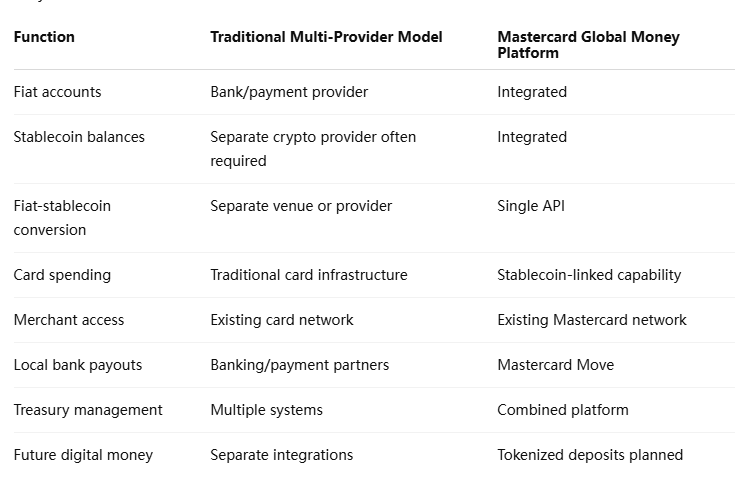
The advantage is operational consolidation. A fintech that wants to support stablecoins today can require separate relationships for wallets, conversion, card issuing, local payouts and treasury management. Each integration adds compliance, liquidity management and reconciliation work. Mastercard and BVNK are attempting to collapse more of that stack into one infrastructure layer.
This also explains why the platform is better understood as multi-money infrastructure rather than a stablecoin-only product. Mastercard expects fiat currencies, stablecoins and eventually additional regulated forms of money such as tokenized deposits to coexist. The strategic objective is to control the connectivity between those forms of value rather than betting that one will completely replace the others.
Why Mastercard Move Changes the Stablecoin Story
Consumer card payments attract the clearest headline, but Mastercard Move may be more important for enterprise adoption. The network reaches more than 17 billion endpoints, creating pathways from digital balances into local bank accounts and other payout destinations. Mastercard expects relevant coverage to expand to more than 40 currencies across 200-plus countries and territories in 2027.
For a multinational business, the problem is rarely limited to making one payment. Treasury teams have to collect money in different currencies, pay suppliers across jurisdictions, maintain sufficient balances in local accounts and reconcile those movements after they occur. The result can be fragmented liquidity and cash sitting idle simply because funds need to be pre-positioned before a payment is due.
Global Money Platform is designed to connect those activities. A company could hold multiple fiat currencies and stablecoins in one environment, convert between them when needed and use local payment rails to deliver funds to a recipient's bank account. The recipient may never interact with a stablecoin at all.
This leads to a broader principle: stablecoin utility increasingly depends on the quality of the off-ramp network as much as the blockchain itself. Fast onchain settlement has limited enterprise value if companies cannot efficiently turn that value into payroll, supplier payments or local-currency bank balances.
Can Stablecoins Reduce Prefunding and Working-Capital Friction?
Potentially. Mastercard specifically uses multinational business payments to illustrate the problem: companies can be forced to manage separate accounts, payment providers and pre-funded balances across markets, tying up capital simply to ensure payments can be executed when needed.
Stablecoins can change part of this structure because digital value can move across borders outside many traditional banking windows. If a business can hold liquid stablecoin balances centrally and convert or pay out into local currencies when required, it may be able to reduce some of the cash that would otherwise need to sit in multiple accounts in advance.
But the benefit depends on the entire conversion chain working efficiently. Stablecoin liquidity, FX pricing, banking connectivity, local payout availability and regulatory permissions all affect whether a nominally 24/7 asset actually improves working-capital efficiency. A blockchain can settle continuously while the recipient's local financial system still has operational constraints.
The realistic opportunity is therefore not eliminating banking infrastructure. It is using stablecoins to make liquidity more mobile between banking environments.
Why Did Mastercard Buy BVNK?
The launch provides a clearer view of the strategic logic behind Mastercard's August 2026 acquisition of BVNK. Mastercard could already issue cards and connect merchants; what BVNK added was infrastructure for businesses to hold, convert and move stablecoins alongside traditional currencies.
Combining the two gives Mastercard control over a much larger part of the transaction lifecycle. The company is not simply adding a stablecoin checkout button. It is connecting accounts, conversion, cards, payouts, treasury and settlement inside a common platform.
That positioning matters as stablecoins increasingly compete with correspondent banking and specialized payment providers in cross-border flows. Mastercard does not need to choose between traditional cards and blockchain rails if it can act as the orchestrator between them. The company can preserve its distribution network while adding new forms of money underneath it.
The Global Money Platform is the first major product integration following the BVNK acquisition, making it an important test of whether established payment networks can absorb stablecoins without being displaced by them.
MEXC View: The Winning Stablecoin Rail May Be Invisible to Merchants
The most important development in Mastercard stablecoin payments may be that merchants do not need to become crypto-native. Stablecoins can scale as a payment instrument even if the person receiving the payment never opens a wallet, chooses a blockchain or manages a token balance.
That changes the way adoption should be measured. Merchant stablecoin addresses are not the only relevant indicator. Stablecoin-funded card volume, local payouts, treasury flows and conversion activity may become more meaningful as digital money is embedded inside existing payment experiences.
Mastercard's strategy also suggests that the competitive layer could shift toward orchestration. If fiat currencies, stablecoins and tokenized deposits coexist, the valuable infrastructure may be the system capable of determining which rail to use, converting between them and delivering value in the form the recipient prefers.
Mass adoption, in that model, does not look like every merchant displaying a “USDC accepted here” sign. It looks like stablecoins becoming part of ordinary payment infrastructure without merchants needing to know that blockchain was involved.
Risks and Limitations
The scale of Mastercard's network should not be confused with universal availability of every stablecoin feature.
- Merchant reach is not direct stablecoin acceptance. Merchants can continue receiving funds through existing settlement arrangements.
- Product availability varies by market. Card issuing, local payouts and other functions are subject to jurisdiction and partner coverage.
- Stablecoin risk remains. Issuer, reserve and redemption risks do not disappear because a token is connected to Mastercard.
- Conversion costs still matter. FX rates, spreads and payment fees can affect the economic advantage over traditional rails.
- Banking infrastructure remains important. Local payouts ultimately depend on functioning banking and payment systems.
- Future capabilities are not current capabilities. Mastercard says tokenized deposits and agentic-commerce support are part of future development.
- Blockchain operational risk remains. Network congestion, wallet infrastructure and technical failures can still affect digital-money flows.
The biggest analytical mistake would therefore be treating the platform as a complete replacement for banking or card settlement. It is designed to make different forms of money interoperable, not to make every transaction purely onchain.
Mastercard Stablecoin Payments Could Make Crypto Invisible at Checkout
Mastercard stablecoin payments represent a different path to adoption from the early crypto vision in which consumers and merchants would both abandon existing payment infrastructure and transact directly through blockchain wallets. Global Money Platform instead keeps much of the familiar commercial experience intact while inserting stablecoin capabilities into the financial infrastructure behind it.
That approach may be more scalable. Banks, fintechs and enterprises can hold and convert stablecoins, issue linked cards and use Mastercard Move for local payouts, while customers can potentially spend stablecoin-funded balances across a network containing hundreds of millions of merchant locations. The merchant does not need to custody the token for the stablecoin to become economically useful at checkout.
The significance extends beyond card payments. By combining accounts, treasury management, conversion, merchant spending and bank payouts, Mastercard is positioning itself as an interoperability layer between traditional money and tokenized money. The acquisition of BVNK becomes strategically clearer in that context: Mastercard is building the infrastructure around stablecoins rather than treating them as an isolated payment product.
The key test will be actual usage. Stablecoin-funded card spending, enterprise treasury flows, local payouts and conversion volume will show whether Mastercard can turn blockchain liquidity into mainstream payment activity. If it succeeds, the largest effect may be almost invisible to end users: stablecoins could become part of everyday commerce without requiring hundreds of millions of merchants to become crypto users themselves.
Sources
Mastercard — Global Money Platform launch:
https://www.mastercard.com/global/en/news-and-trends/press/2026/october/mastercard-and-bvnk-launch-global-money-platform-to-power-a-mult.html
Mastercard — BVNK acquisition:
https://www.mastercard.com/us/en/news-and-trends/press/2026/august/mastercard-completes-acquisition-of-bvnk-to-advance-global-stabl.html
Risk Disclaimer: This article is for reference only and does not constitute investment advice. The cryptocurrency market is highly volatile. Please make decisions cautiously based on your individual circumstances.
You May Also Like
Do ETFs Really Diversify Risk? From Sector Concentration to Cross-Market Allocation

USDC MiCA: Is Europe Raising the Bar for Stablecoins?