Buy Crypto
Markets
Spot
FuturesBTC
Earn
Event Center
Rewards Hub
More
100%+ PoR
MEXC Editorial Team

MEXC Editorial Team

MEXC Editorial Team is the official content team of MEXC Exchange, staffed by eight full‑time professional editors. Each editor brings over 7 years of professional financial writing experience, with hands‑on investment and journalism expertise across cryptocurrency, stocks, commodities and global financial markets. Our team produces original market reports, breaking industry news, on‑chain research and macro‑economic commentary built upon independent analysis. We strive to deliver accurate, timely financial market insights for investors and users worldwide.

MEXC

MEXC Editorial Team's Articles

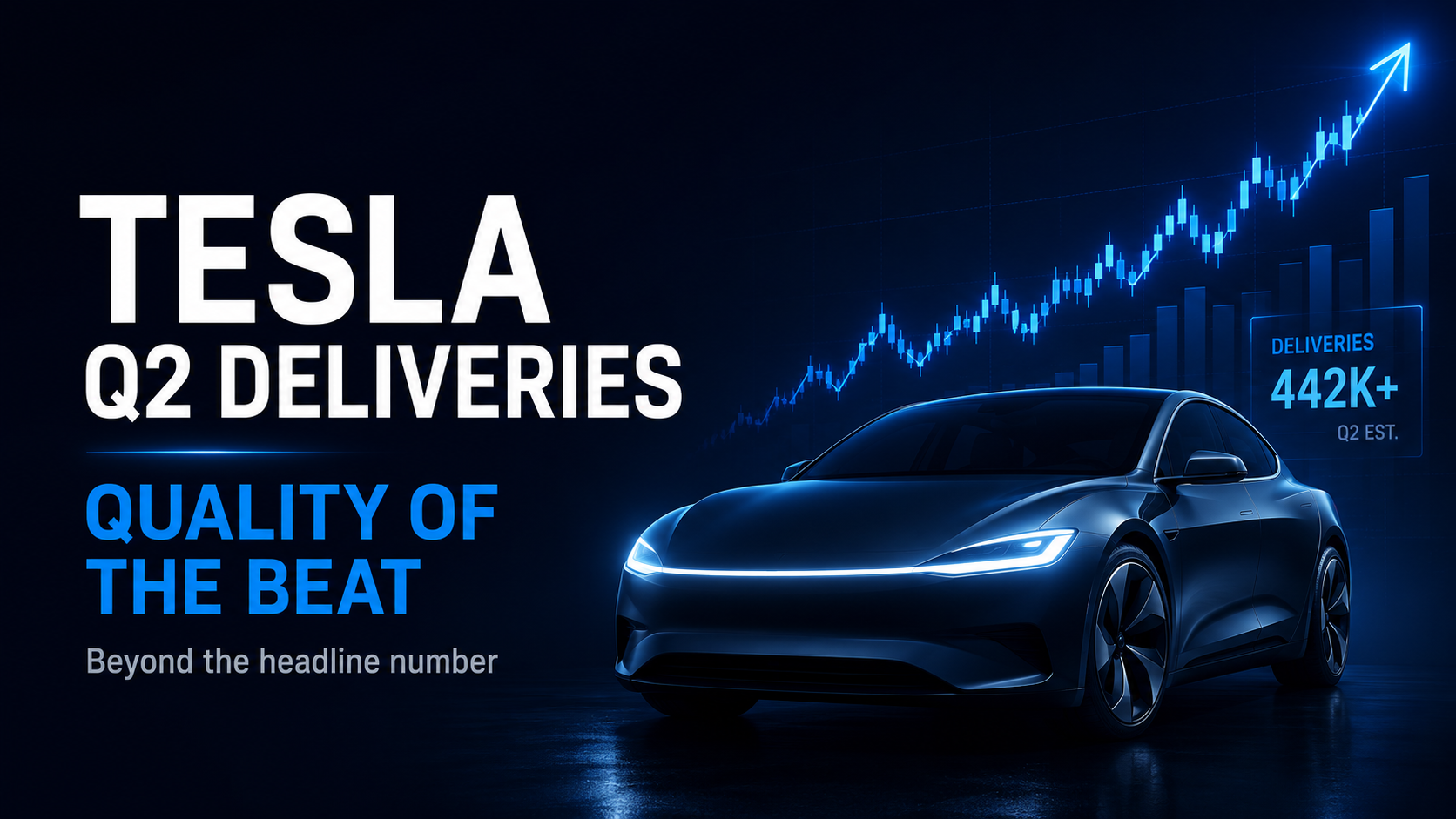
Tesla Jumps Before Q2 Deliveries: Why the Real Test Is Not Just the Number, but the Quality of the Beat

Tesla Jumps Before Q2 Deliveries: Why the Real Test Is Not Just the Number, but the Quality of the Beat

Tesla (TSLA) shares surged 8.46% to $411.84 ahead of its Q2 2026 delivery report, outperforming major indexes in what analysts call an expectations-reset trade. Wall Street has aggressively raised the bar, with major firms revising whisper numbers up to the 413,000–420,000 range, well above the official company consensus of 406,024. While easing regulatory overhangs and a massive 16GW virtual power plant partnership provide multi-narrative support for Tesla's energy and AI infrastructure, the ultimate market reaction hinges on the quality of the delivery beat—specifically whether it reflects sustainable global demand or margin-compressing inventory liquidations. Tesla shares surged ahead of the release of its Q2 delivery report, but the move should not be read as confirmation that the company has already beaten expectations. Instead, it is better understood as an expectations-reset trade before the official data arrives. TSLA recently closed at $411.84, up 8.46% on the day, sharply outperforming the broader market. By comparison, the Nasdaq Composite rose 2.07%, the S&P 500 gained 1.18%, and the QQQ advanced 2.49%. The magnitude of this move suggests it was not simply a broad tech rally. Rather, the rising Tesla stock price reflected a combination of stronger market risk appetite, rising delivery expectations, easing regulatory pressure, and renewed interest in Tesla’s energy and AI infrastructure narrative. The key question is no longer whether Tesla can beat consensus, but whether the beat is high-quality enough to justify this recent rally.

Are Memory Giants Becoming AI’s New Toll Booth? Korea’s Expansion Plan, DRAM Lawsuit and Micron’s Wild Reversal Show the Trade Is Changing

Are Memory Giants Becoming AI’s New Toll Booth? Korea’s Expansion Plan, DRAM Lawsuit and Micron’s Wild Reversal Show the Trade Is Changing

The AI supply chain debate is shifting from GPUs to memory. South Korea has announced a massive semiconductor and AI investment push, with Samsung Electronics and SK Hynix each set to build two new large-scale chip fabrication facilities in the country’s southwest region. The broader project is designed to create a chip production ecosystem valued at roughly 800 trillion won, or about $518 billion, as Seoul tries to strengthen its position in the global AI infrastructure race. At almost the same time, Samsung, SK Hynix and Micron Technology were hit with a U.S. class-action antitrust lawsuit alleging that the three memory giants coordinated to restrict conventional DRAM supply while shifting capacity toward high-bandwidth memory, or HBM. The allegations have not been proven in court, and Micron has denied the claims, saying it competes fairly and lawfully. Micron stock became the market’s live stress test. MU fell as low as about $1,024.86 intraday on June 29 before closing at $1,145.28, slightly above the previous close. The move suggests that investors are not abandoning the AI memory bull case, but they are starting to price its side effects: legal risk, downstream cost pressure and the possibility that memory inflation could become a problem for the wider AI economy.
MEXC On-chain Daily Report:The MiCA regulation will fully take effect on July 1

MEXC On-chain Daily Report:The MiCA regulation will fully take effect on July 1

Institutional adoption and regulatory developments continued to shape the digital asset market. The U.S. IPO boom reached a record high in the first half of 2026, Ripple unveiled an institutional lending proposal for XRPL, while Chainalysis introduced a standardized blockchain forensic framework. Meanwhile, AI regulation and infrastructure remained major industry focus areas alongside growing institutional participation.
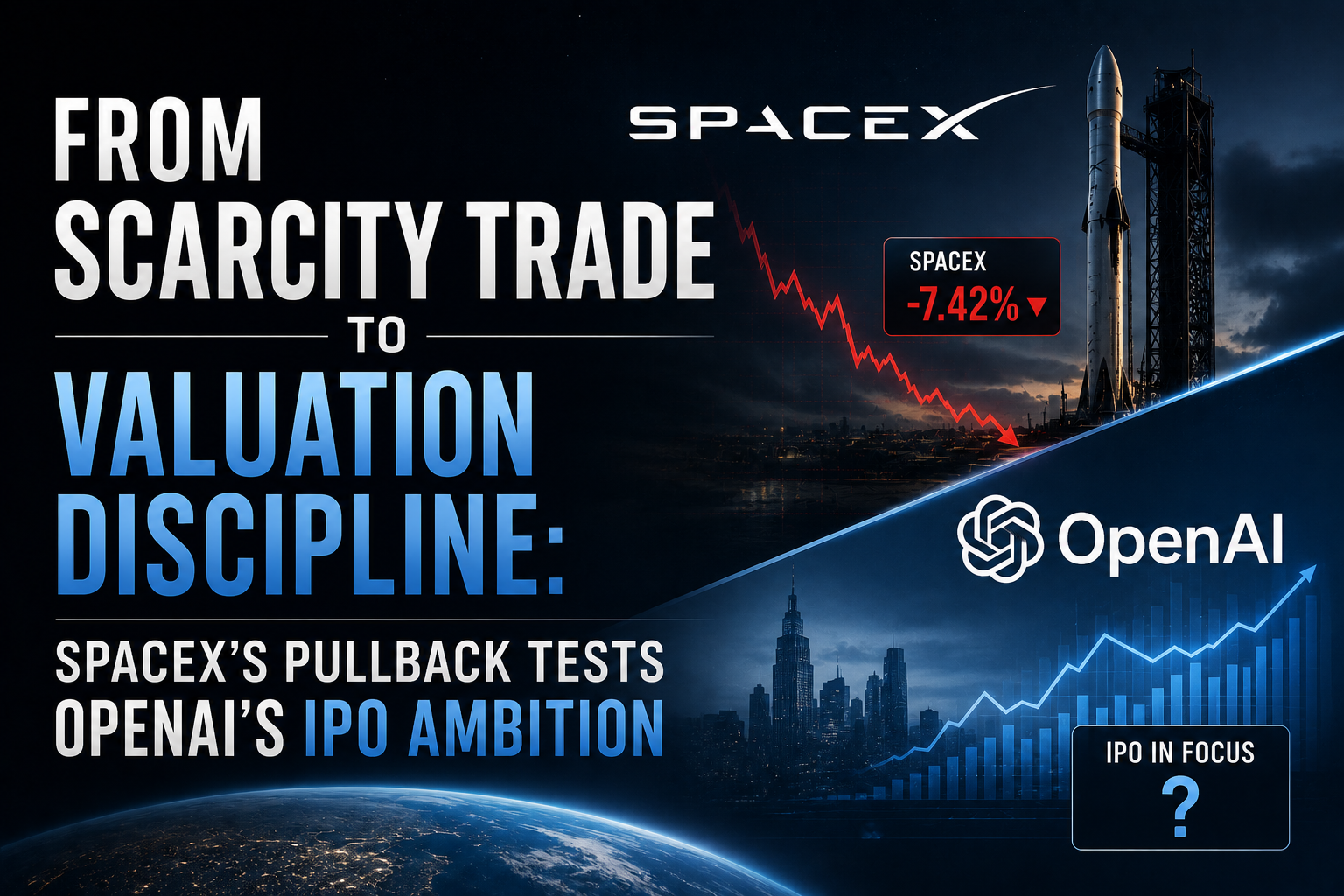
From Scarcity Trade to Valuation Discipline: SpaceX’s Pullback Tests OpenAI’s IPO Ambition

From Scarcity Trade to Valuation Discipline: SpaceX’s Pullback Tests OpenAI’s IPO Ambition

OpenAI is reportedly leaning toward delaying its IPO until 2027, but the sharper market signal is coming from SpaceX. SpaceX closed down 16.4% at $154.60 on June 22, down 31.5% from its $225.64 intraday high, though still 14.5% above its $135 IPO price. That move turned SpaceX from a clean scarcity-driven IPO success into the first major public-market stress test for the AI-adjacent mega-listing cycle. OpenAI’s issue is not demand, but price. Reuters, citing The New York Times, reported that OpenAI is considering waiting until 2027 to preserve a valuation target of up to $1 trillion, while advisers have framed the choice as either waiting for that valuation or going public sooner at a lower target. Prediction markets are already reflecting that caution. Polymarket’s OpenAI IPO market recently showed roughly one-in-four odds for an OpenAI IPO by Dec. 31, 2026, signaling that traders no longer see a near-term listing as the clear base case. For crypto traders, that makes AI pre-IPO exposure less of a one-way scarcity trade and more of a valuation-discipline trade tied to public-market benchmarks.
MEXC On-chain Daily Report:USDT surpasses Ethereum to become the second-largest cryptocurrency by market capitalization.

MEXC On-chain Daily Report:USDT surpasses Ethereum to become the second-largest cryptocurrency by market capitalization.

Regulatory developments accelerated across major markets as Europe prepared for MiCA implementation, while institutional interest remained focused on AI infrastructure, stablecoins, and prediction markets. Meanwhile, Story completed its transition to DATA Foundation, Polymarket surpassed $1 billion in annualized revenue, and multiple AI-native blockchain projects secured fresh funding.
NVIDIA Annual Meeting 2026: Jensen Huang’s AI Factory Thesis Faces Its Next Market Test

NVIDIA Annual Meeting 2026: Jensen Huang’s AI Factory Thesis Faces Its Next Market Test

NVIDIA held its 2026 Annual Meeting of Stockholders online on June 24, 2026, at 9:00 a.m. Pacific Time. The formal agenda included the election of directors, advisory approval of executive compensation, auditor ratification, and several shareholder proposals. However, for the market, the meeting was about more than annual governance. It was another test of whether NVIDIA can continue to defend the AI infrastructure trade after a historic year of revenue growth. Although some Asia-Pacific investors followed the NVIDIA annual meeting on June 25 local time, the official meeting schedule was June 24 Pacific Time. According to NVIDIA’s 2026 Annual Meeting of Stockholders page, the event was held virtually, with shareholders able to participate online. The key question for investors is no longer simply whether AI chip demand is strong. That has already been proven by NVIDIA’s fiscal 2026 results. The bigger question is whether AI data center spending can keep converting into lower token costs, higher inference activity, and durable earnings power. In other words, the 2026 annual meeting was not just a shareholder vote. It was a fresh checkpoint for Jensen Huang’s “AI factory” thesis.
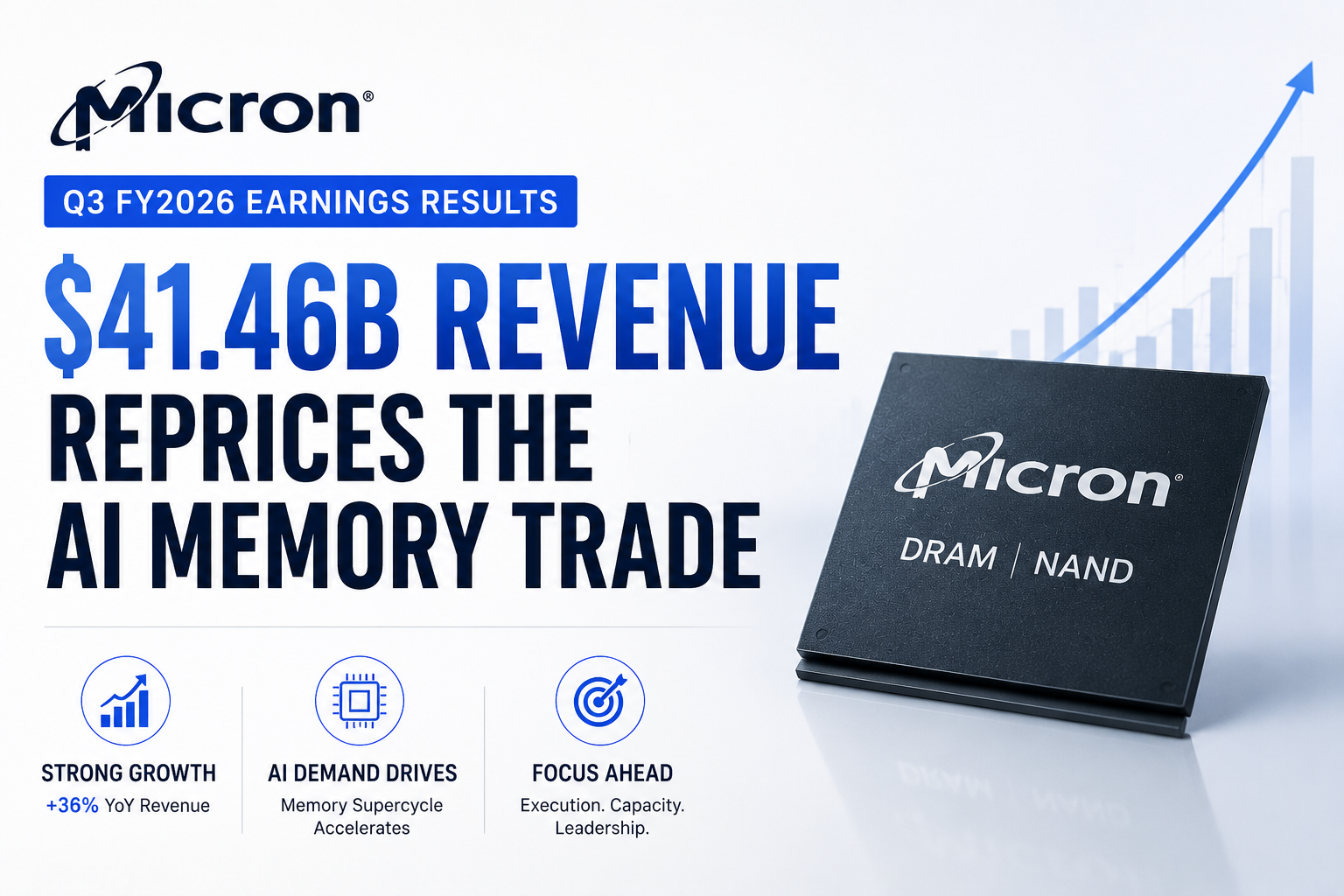
Micron Q3 2026 Earnings Results: $41.46B Revenue Reprices the AI Memory Trade

Micron Q3 2026 Earnings Results: $41.46B Revenue Reprices the AI Memory Trade

Micron Technology reported record fiscal Q3 2026 earnings results, with revenue reaching $41.46 billion, up from $9.30 billion a year earlier, as demand for AI-related memory and storage continued to exceed supply. Non-GAAP diluted EPS rose to $25.11, while non-GAAP gross margin expanded to 84.9%. The company also guided for about $50 billion in fiscal Q4 revenue, plus or minus $1 billion. This is not ordinary earnings news because Micron is no longer being judged only as a cyclical DRAM and NAND supplier. The latest Micron results suggest the market is repricing memory as a strategic bottleneck in the AI infrastructure buildout. High-bandwidth memory, data-center DRAM, enterprise SSDs, and long-term customer supply agreements are reshaping how investors think about Micron’s role in the AI supply chain.
MEXC On-chain Daily Report: SK Hynix Plans to Raise $29.4 Billion via Nasdaq Listing

MEXC On-chain Daily Report: SK Hynix Plans to Raise $29.4 Billion via Nasdaq Listing

Japan's first trust-backed yen stablecoin JPYSC has officially launched; the U.S. House of Representatives approved a housing bill with CBDC ban provisions, SK Hynix intends to raise $29.4 billion via a Nasdaq IPO slated for July 10 trading, prediction market Kalshi readies for a potential 2027 IPO, while U.S. policymakers are debating granting crypto firms direct access to Federal Reserve payment systems.
MEXC On-chain Daily Report: U.S. House of Representatives Passes Bill to Fully Ban CBDCs

MEXC On-chain Daily Report: U.S. House of Representatives Passes Bill to Fully Ban CBDCs

The crypto industry continues to move toward greater institutional adoption and regulatory clarity. The U.S. House passed a bill prohibiting CBDCs, while Visa’s stablecoin settlement pilot reached an annualized volume of $7 billion, highlighting growing real-world stablecoin usage. Ethereum’s ecosystem funding proposal and Franklin Templeton’s expansion into digital assets reflect increasing institutional engagement. Meanwhile, Meta’s development of a prediction market platform and Chainlink’s collaboration with 47 banks underscore the ongoing convergence of traditional finance, blockchain infrastructure, and emerging digital asset markets.